Chapter 1 contains the heart of Dutch traffic law — the rules that govern what every road user must and must not do at every moment. These rules apply to everyone: cyclists, moped riders, car drivers, truck drivers, pedestrians forming a procession, horse riders. No one on the road is exempt.
The rules are organised by topic. Each section covers one aspect of road behaviour. Together they form a complete picture of how Dutch roads are expected to function.
§ 1 — Position on the Road
Where each type of road user must travel — and on which part of the road.
Every driver is required to keep as far to the right as possible. This is the fundamental position rule — it applies on every road, in every situation, unless another rule specifically provides otherwise.
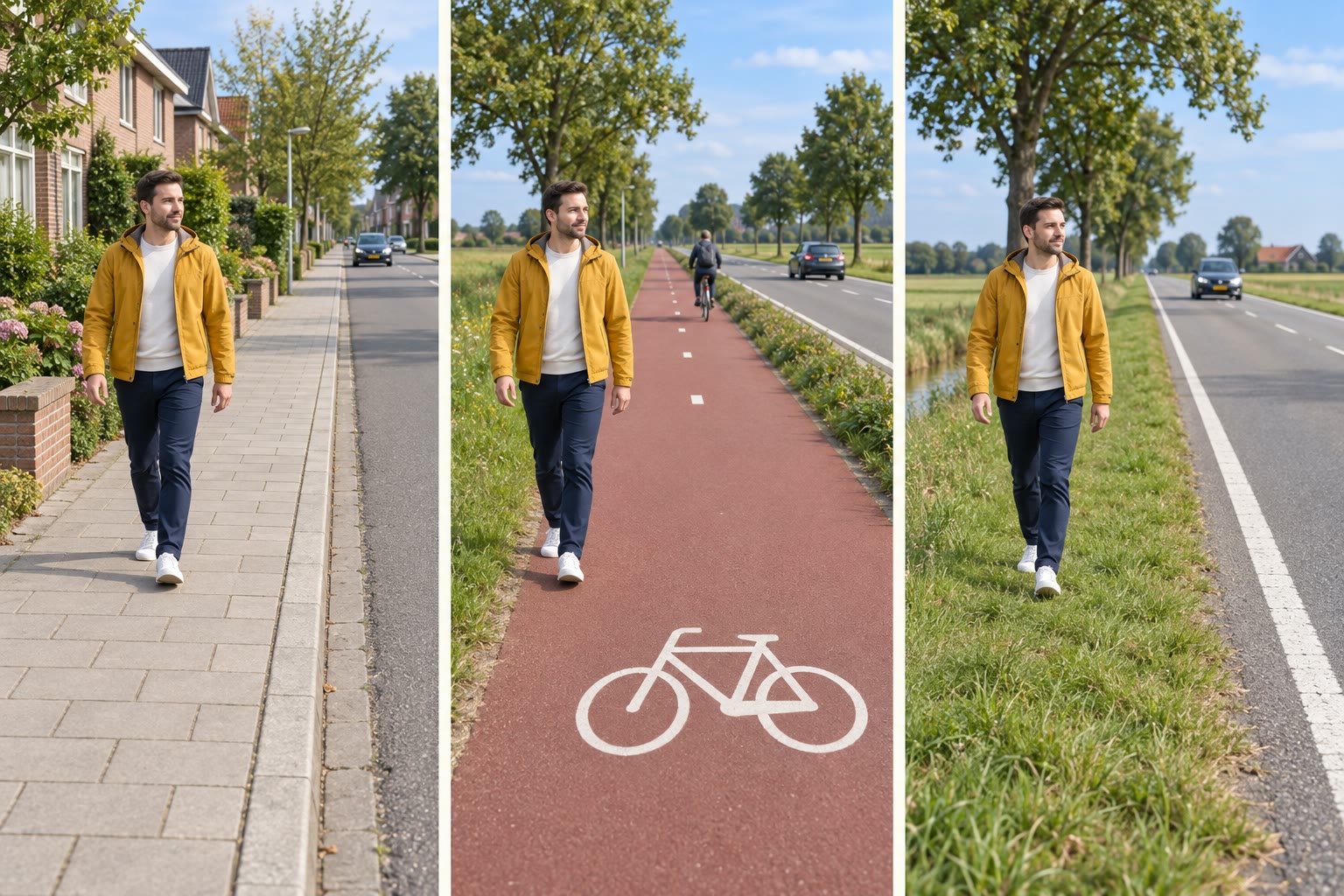
Pedestrians follow a strict order of preference for where they walk. First choice: pavement (trottoir) or footpath. If neither exists: the bicycle path or combined bicycle/moped path. If none of those exist either: the verge or the very edge of the carriageway.
People moving with non-vehicle objects — roller skates, a skateboard, a walking frame — use the bicycle path, footpath or pavement. If none of those are present, they use the carriageway.
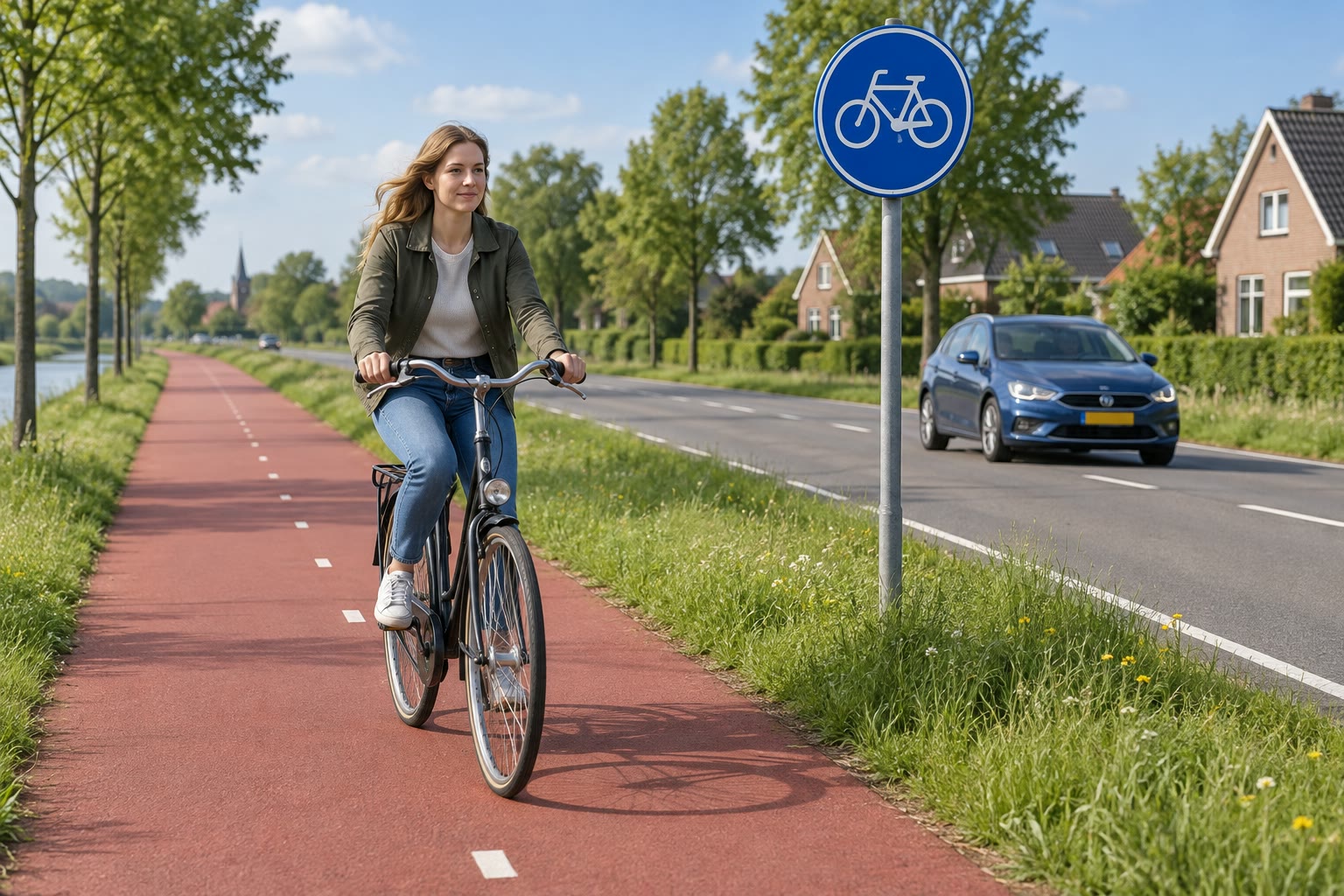
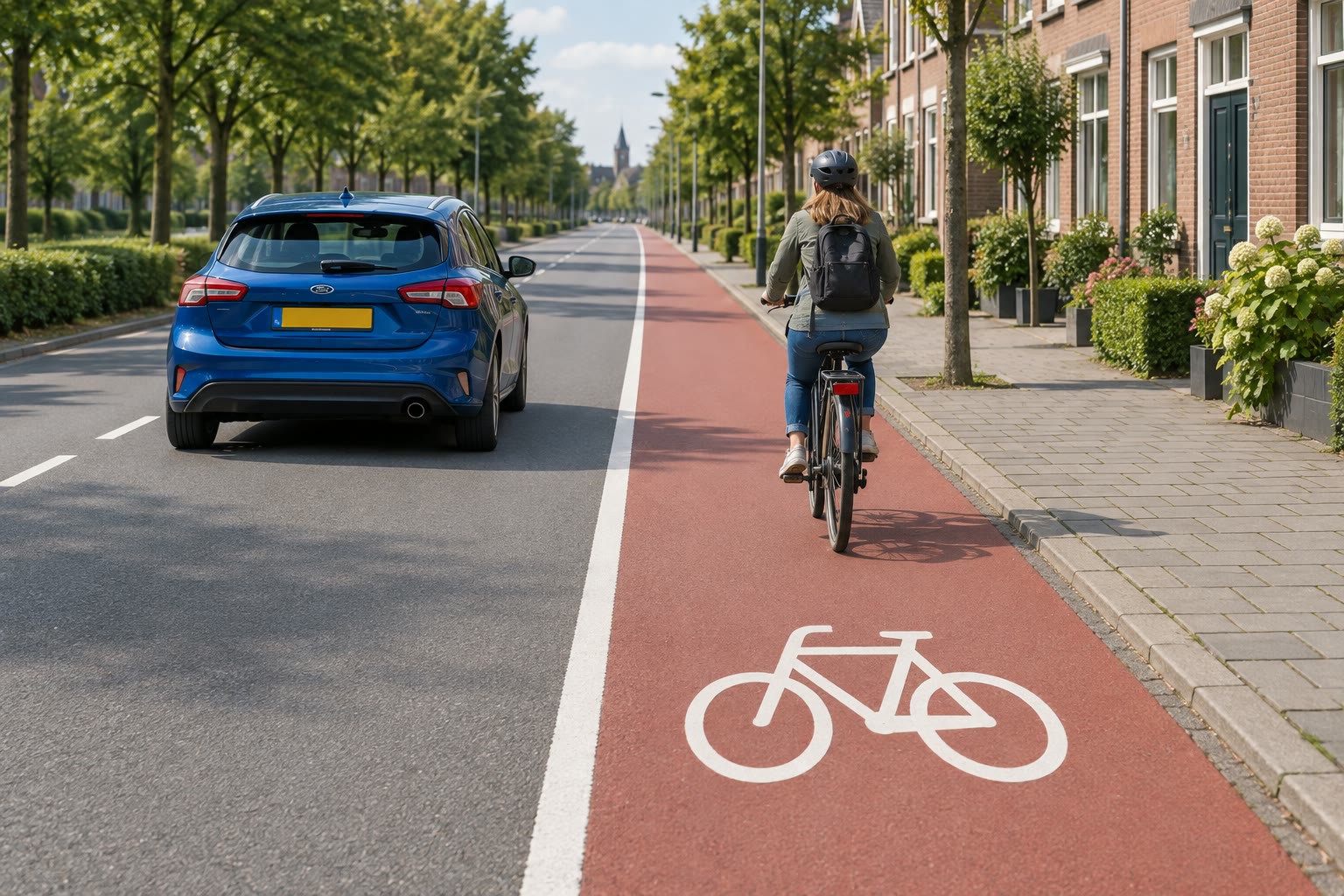
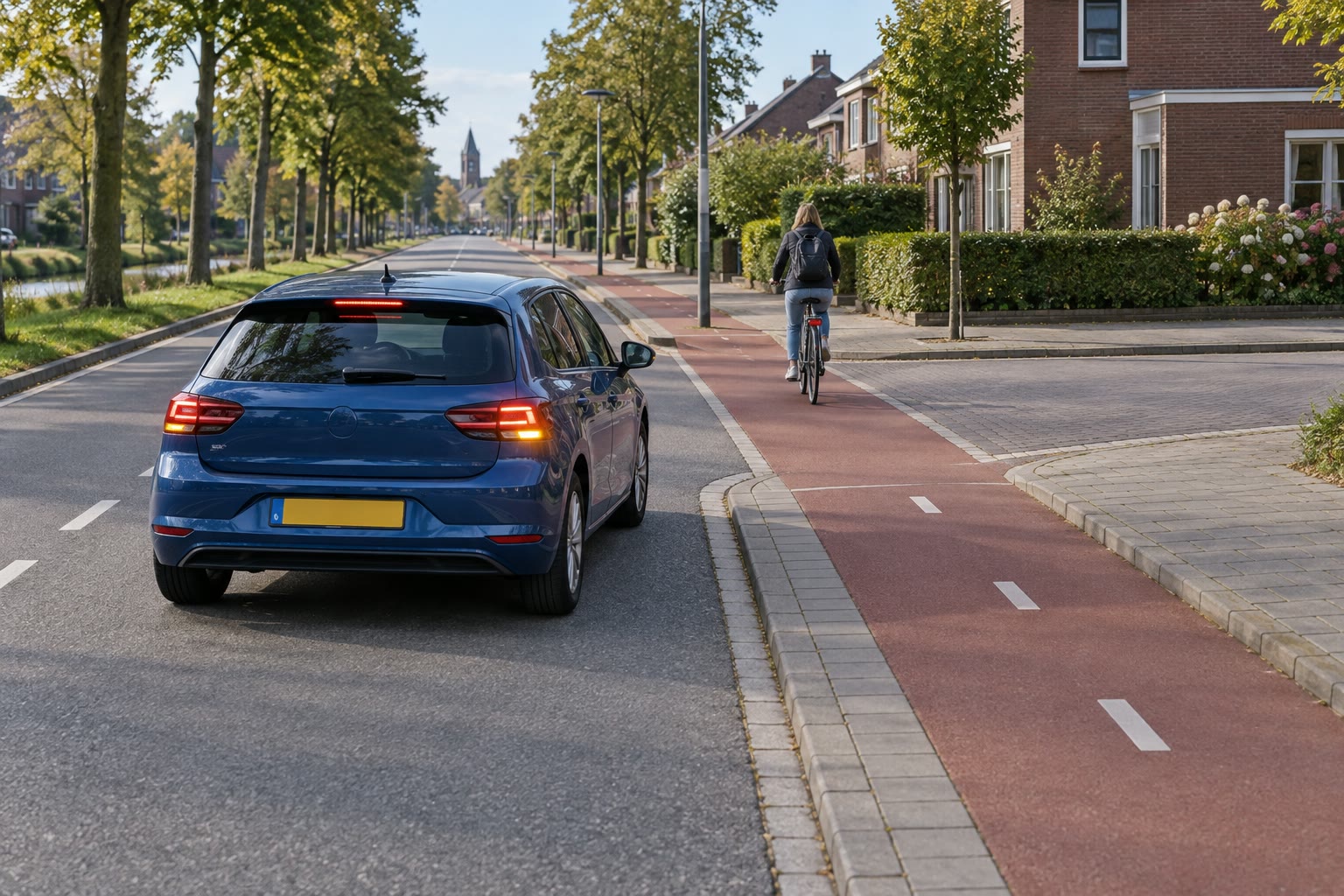
Cyclists must use the mandatory bicycle path or combined bicycle/moped path where one is present. If no mandatory path exists, they use the carriageway. They may also use an optional (non-mandatory) bicycle path.
A snorfiets with a combustion engine may only use an optional bicycle path with its engine switched off.
Bicycles or bicycles-with-trailer that are wider than 0.75 metres (including load) may use the carriageway regardless.
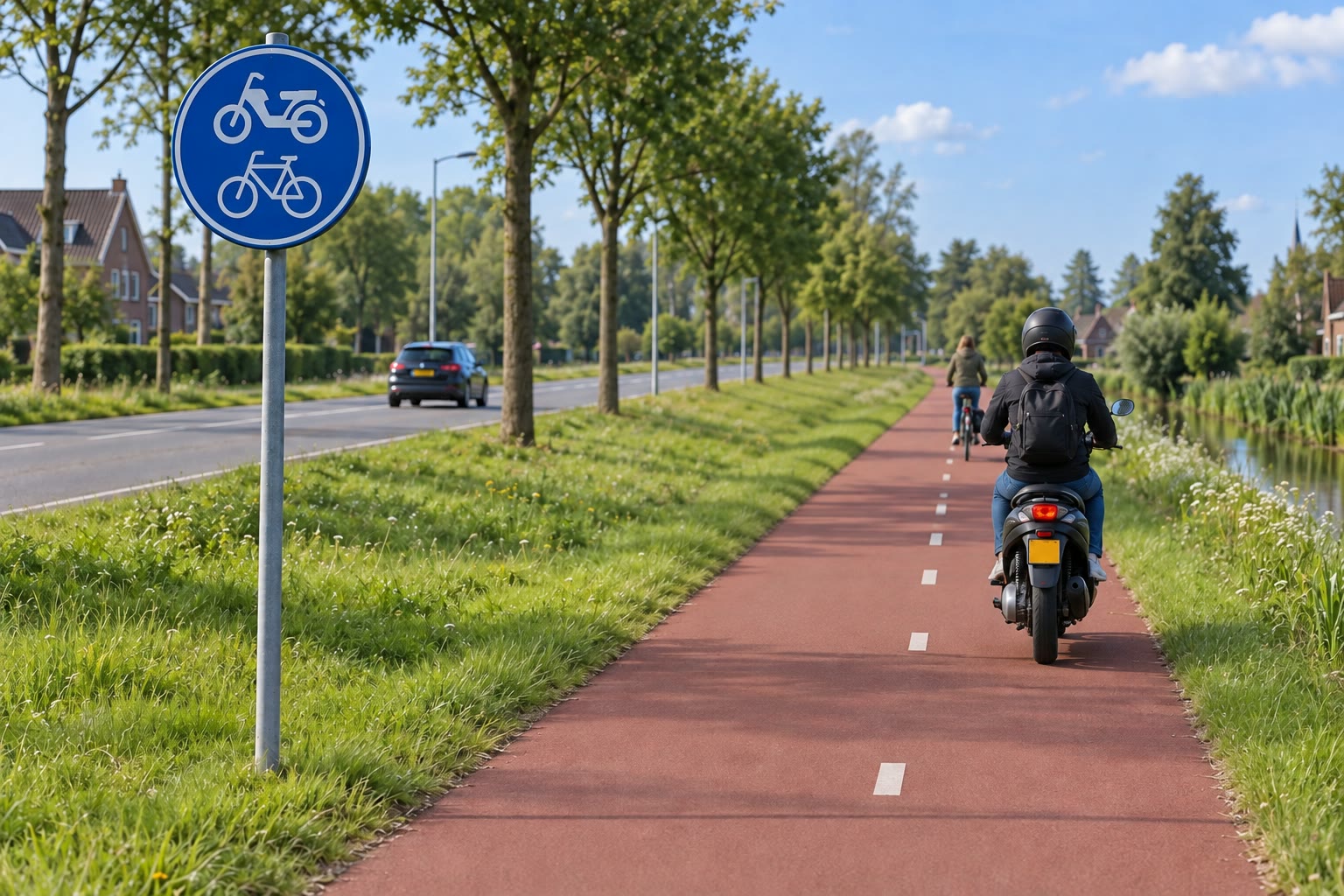
Moped riders (bromfietsers) use the combined bicycle/moped path. If none exists, they use the carriageway. Mopeds or mopeds-with-trailer wider than 0.75 metres (including load) always use the carriageway.
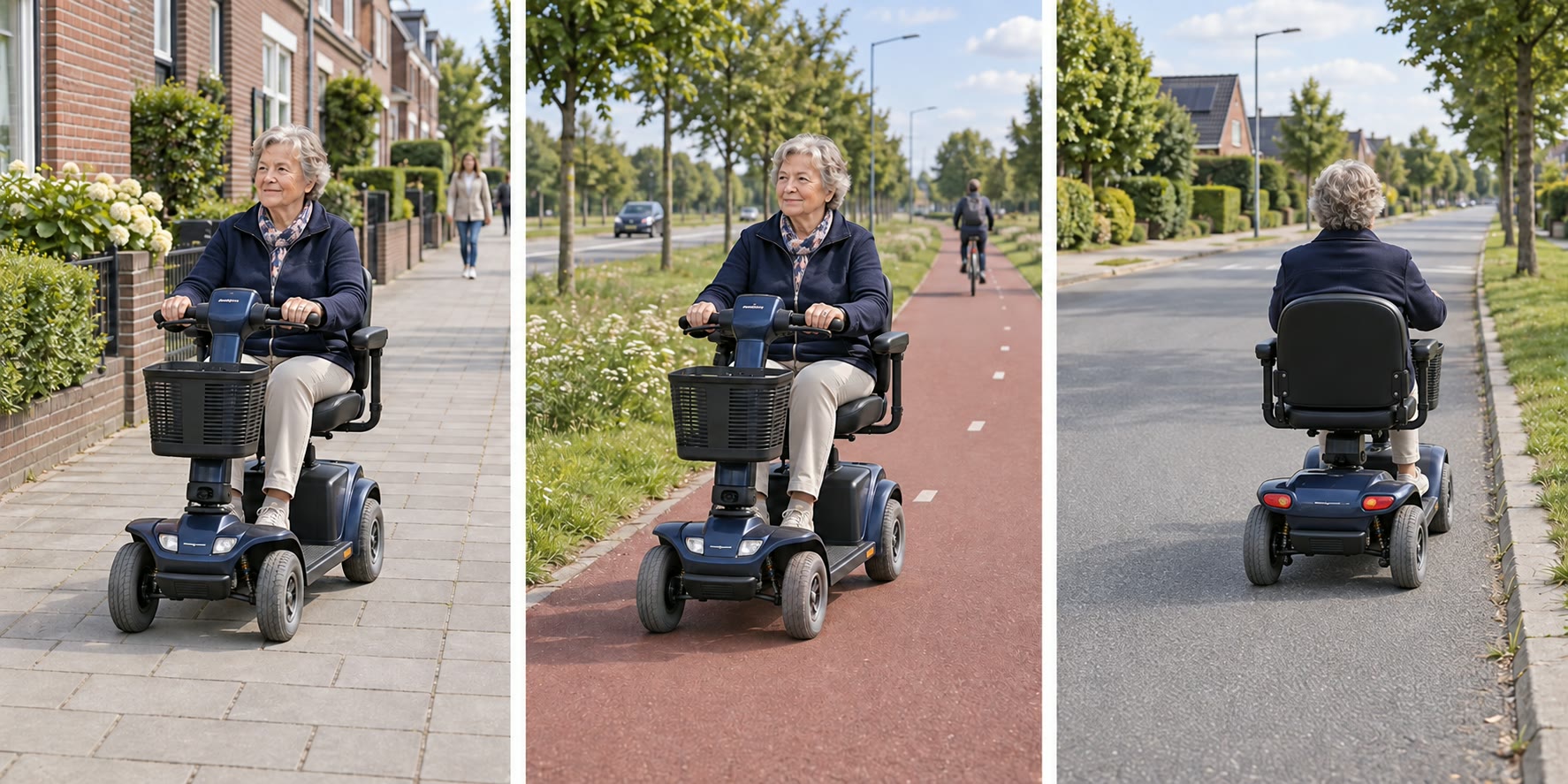
Drivers of disability vehicles may use any of the following: the pavement, the footpath, the bicycle path, the combined bicycle/moped path, or the carriageway. They have full flexibility in choosing the most appropriate surface.
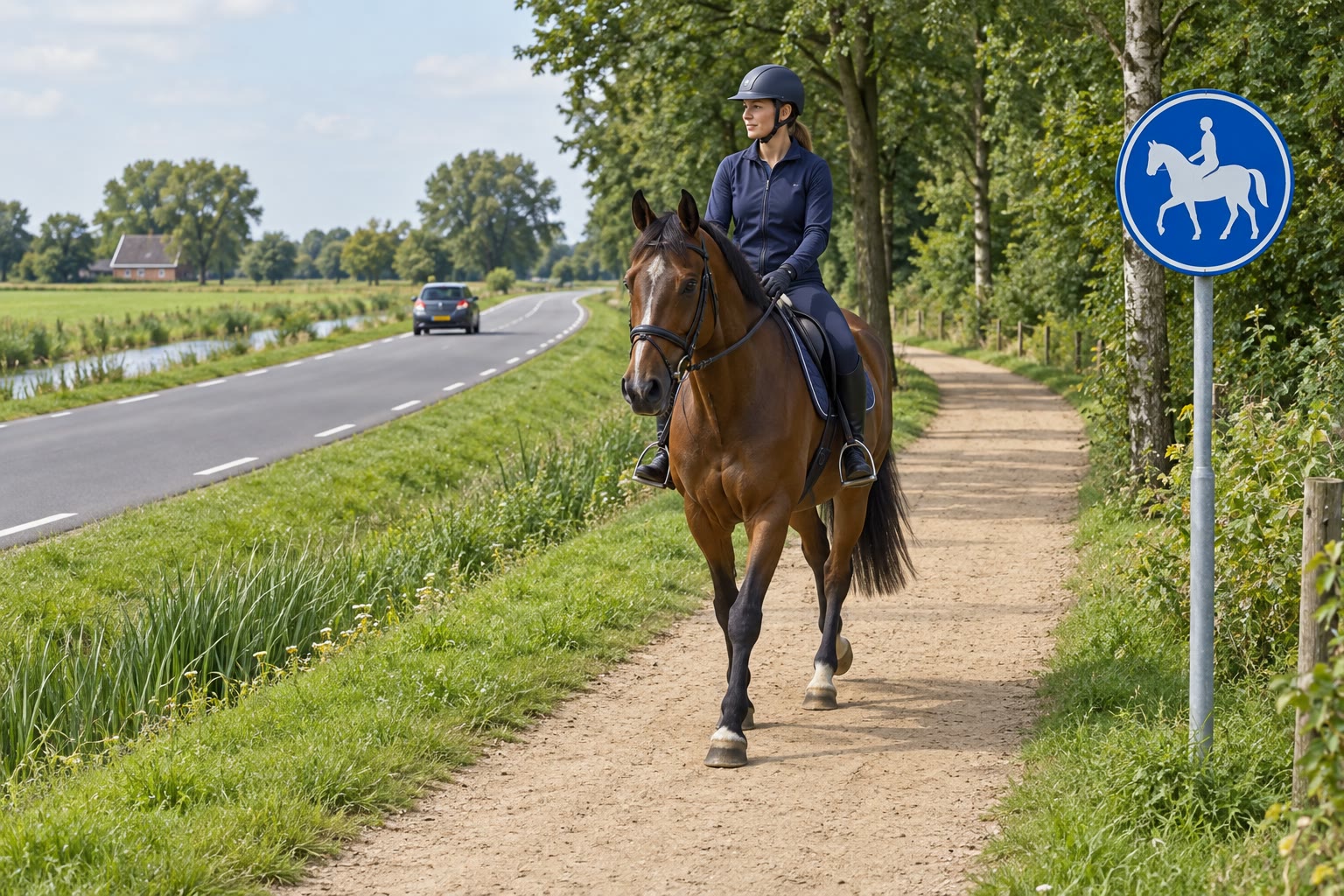
Horse riders use the bridlepath (ruiterpad). If no bridlepath is present, they use the verge or the carriageway.
All drivers not covered by the specific rules above — car drivers, truck drivers, bus drivers — use the carriageway. For parking, they may also use other parts of the road except the pavement, footpath, bicycle path, combined bicycle/moped path or bridlepath.
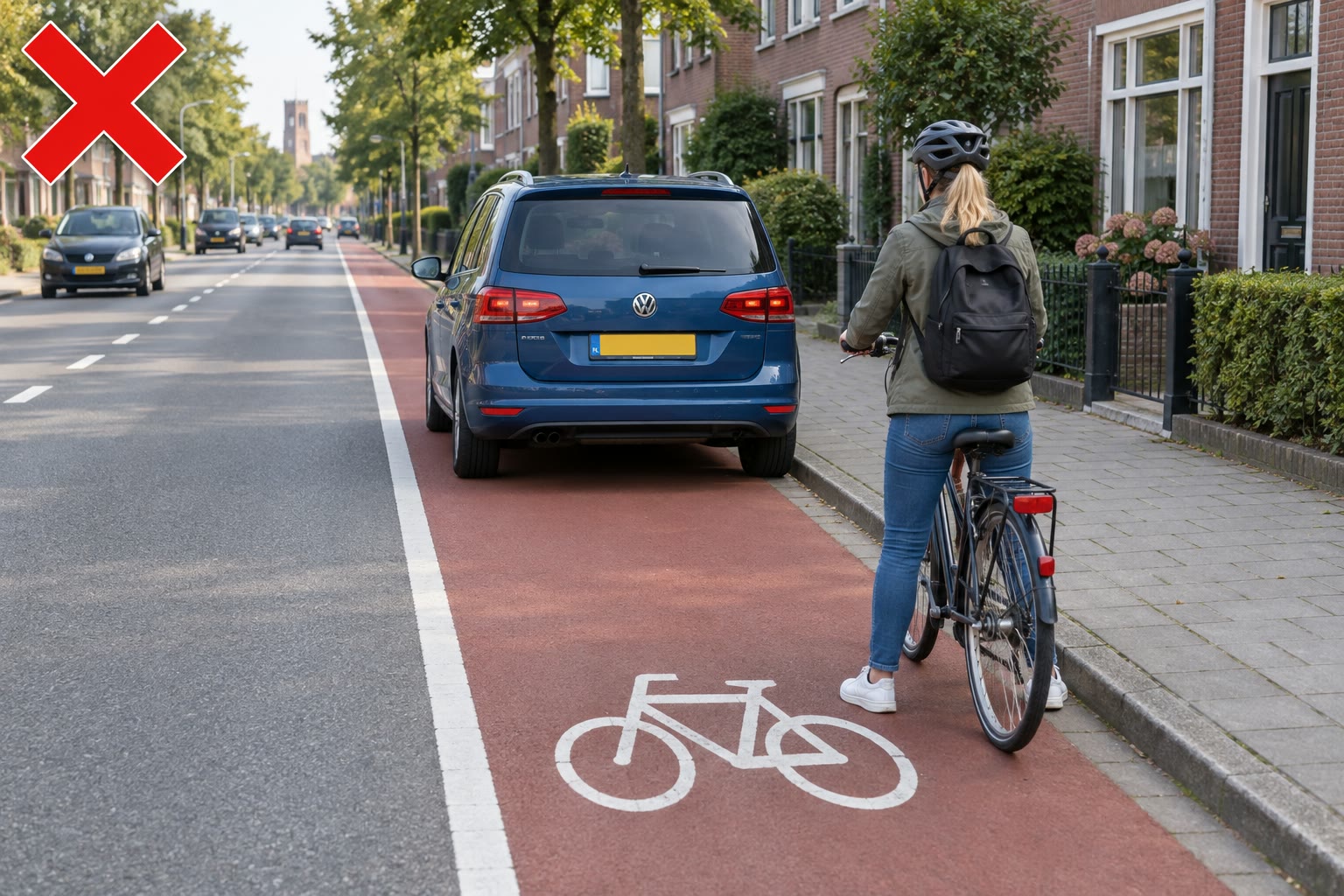
Bicycle lanes with a solid continuous line may not be used by any driver other than cyclists and disability vehicle drivers.
Pedestrians who form a column, procession or funeral cortège may use the carriageway. When they do, the vehicle rules of the road apply to them — including traffic lights and road markings.
§ 2 — Overtaking
The default direction of overtaking — and the exceptions.
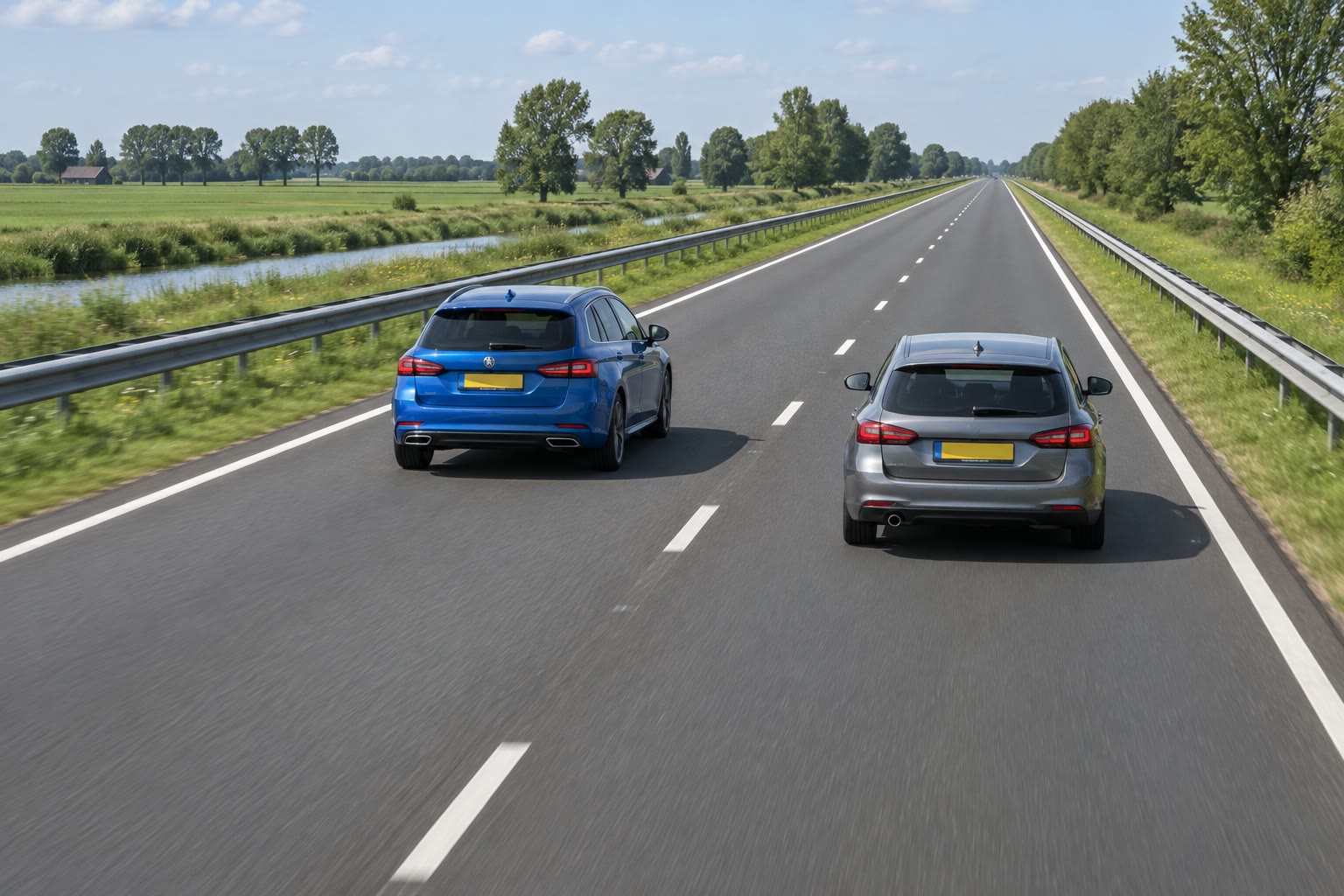
The standard rule: overtaking happens on the left. You move to the left, pass the slower vehicle, and return to the right.
There are specific exceptions:
- A driver who has moved to the left and signalled their intention to turn left is overtaken on the right.
- Cyclists must overtake other cyclists on the left — but may overtake other types of drivers on the right.
- A driver to the right of a block marking may overtake a driver to the left of that marking on the right.
- Trams may be overtaken on the right.
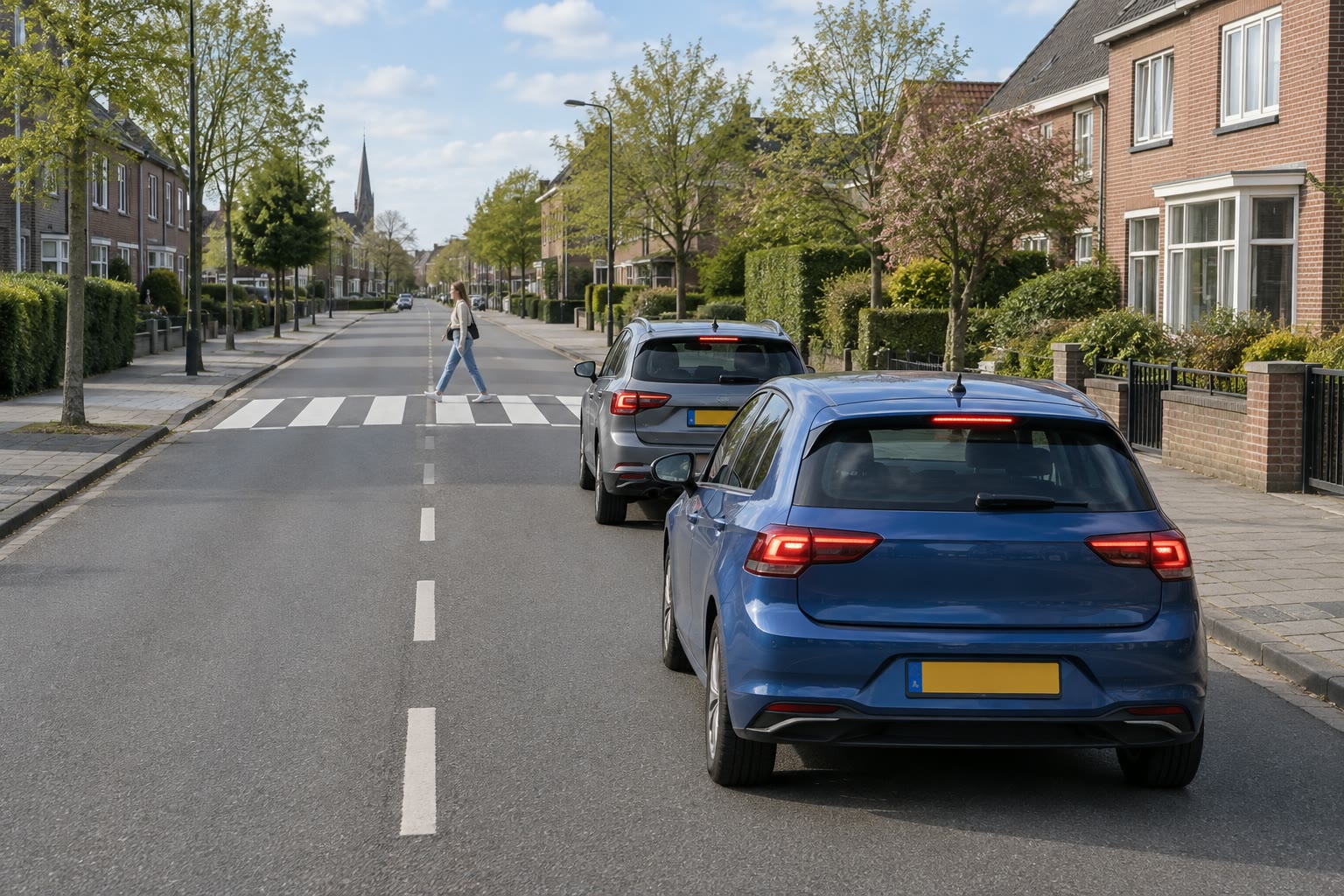
It is prohibited to overtake a vehicle immediately before or on a pedestrian crossing. The moment you approach a zebra crossing, overtaking must stop — regardless of how slow the vehicle ahead is moving.
§ 3 — Traffic Jams
Special rules that apply when traffic comes to a standstill.
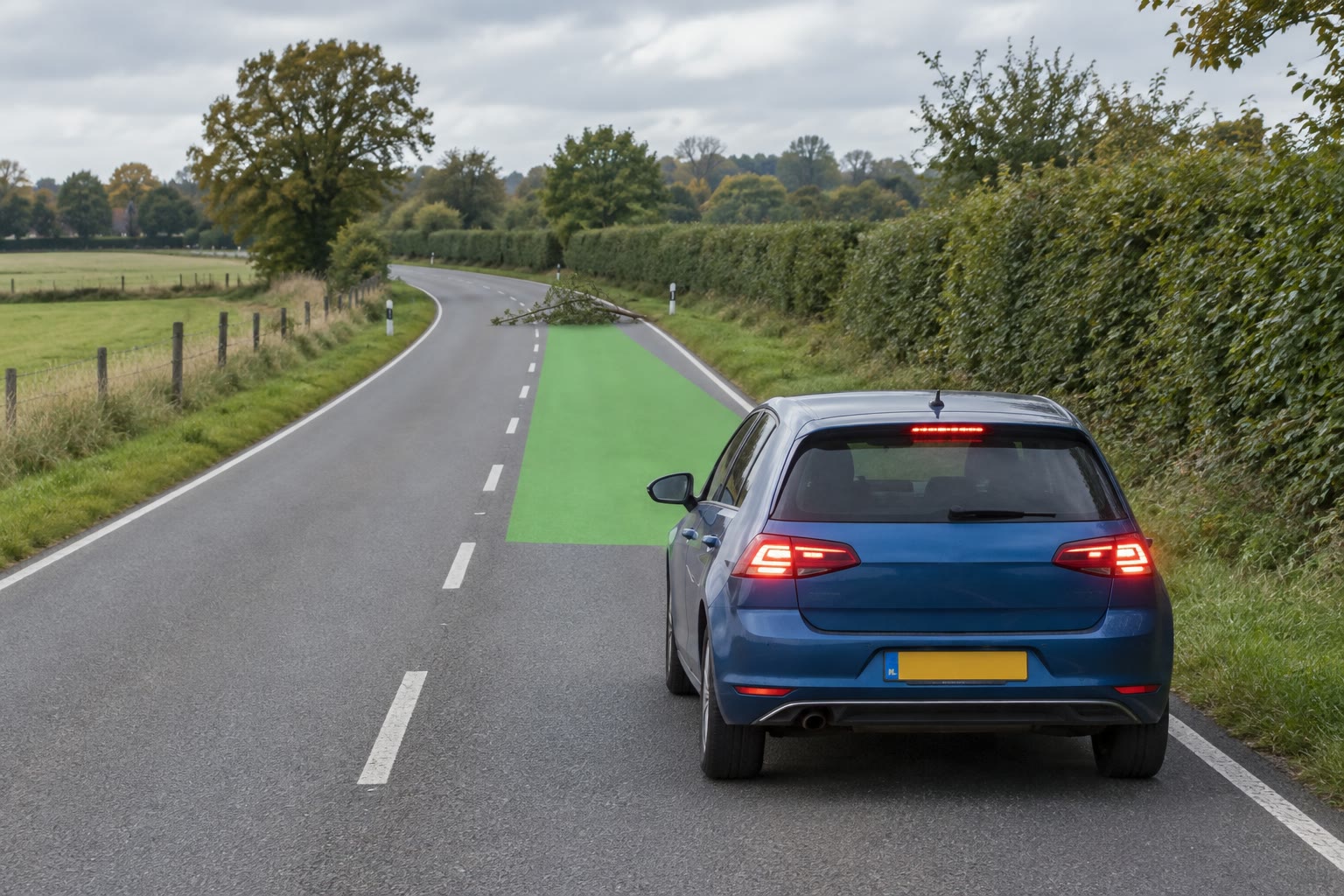
When traffic is at a standstill or moving very slowly and the carriageway is divided into lanes in the same direction, you are not required to use the rightmost lane. Stay in whichever lane you are in.
When traffic is moving in queues, drivers may pass a queue on the right. This is an exception to the normal rule that overtaking takes place on the left.
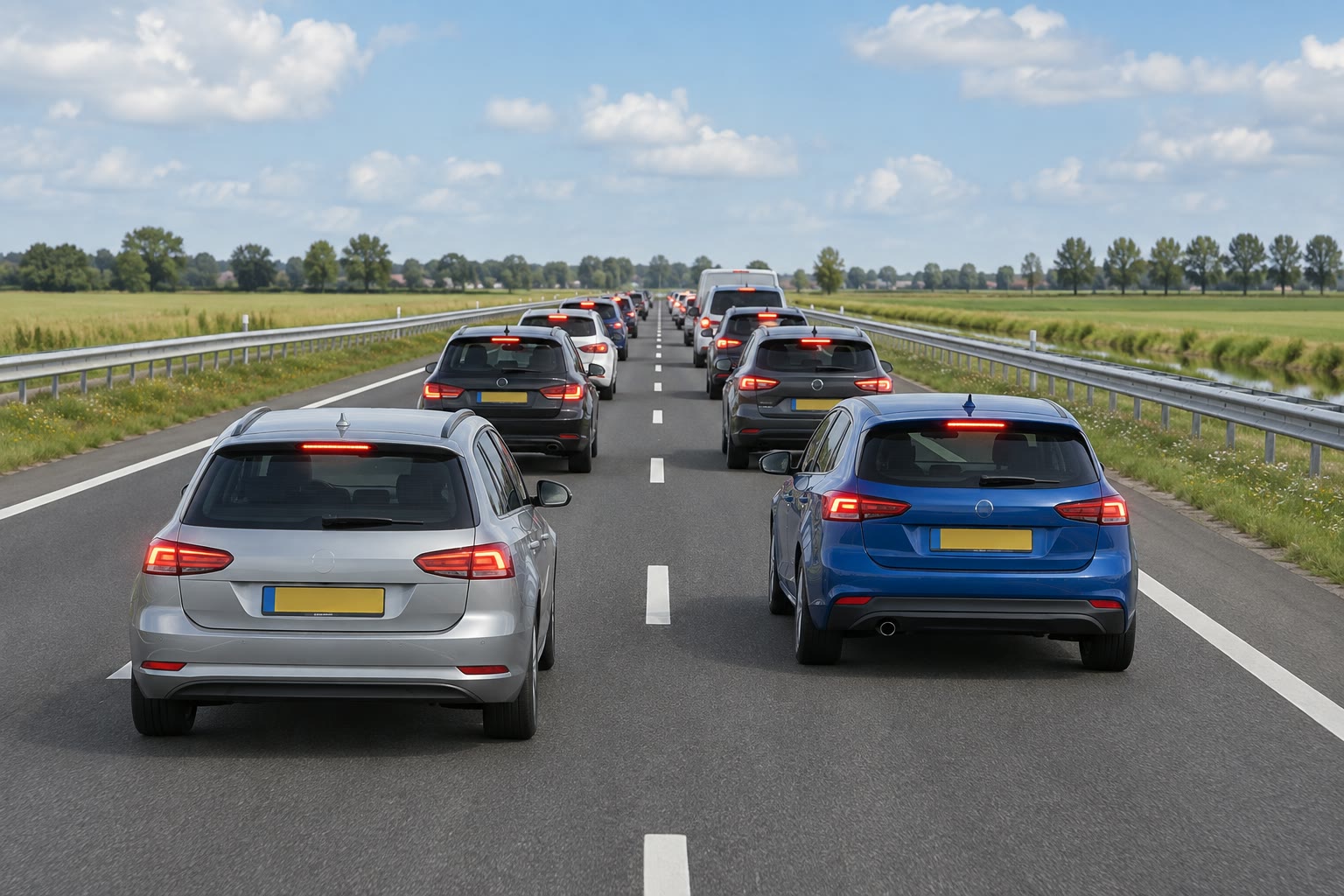
When a lane ends and traffic must merge, Dutch road culture expects drivers to use the full length of the ending lane before merging — one car at a time, alternating. This is not legally mandated in the RVV but is consistently applied in practice and reinforced by road markings.
§ 4 — Entering Intersections
The single most important rule about intersections.
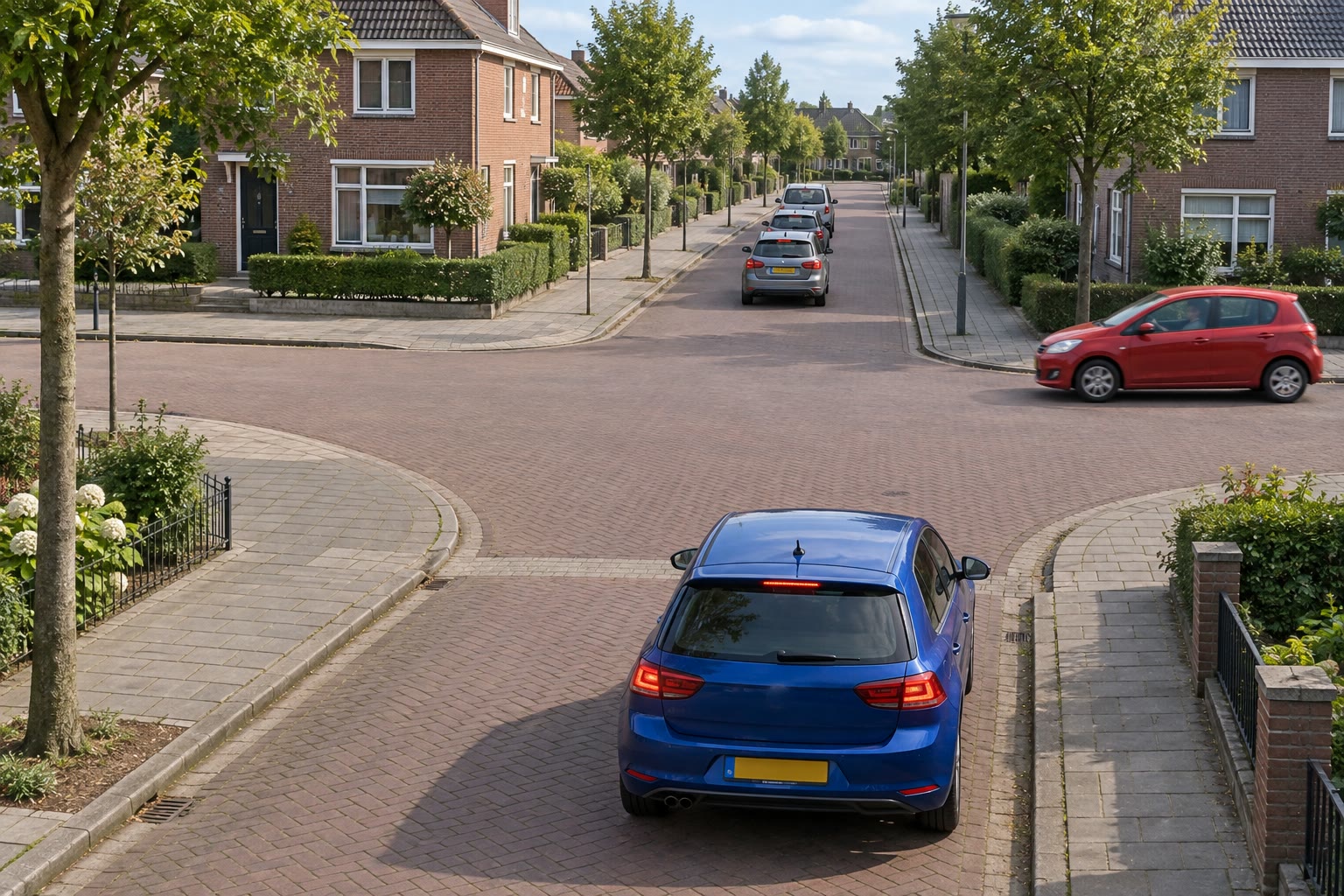
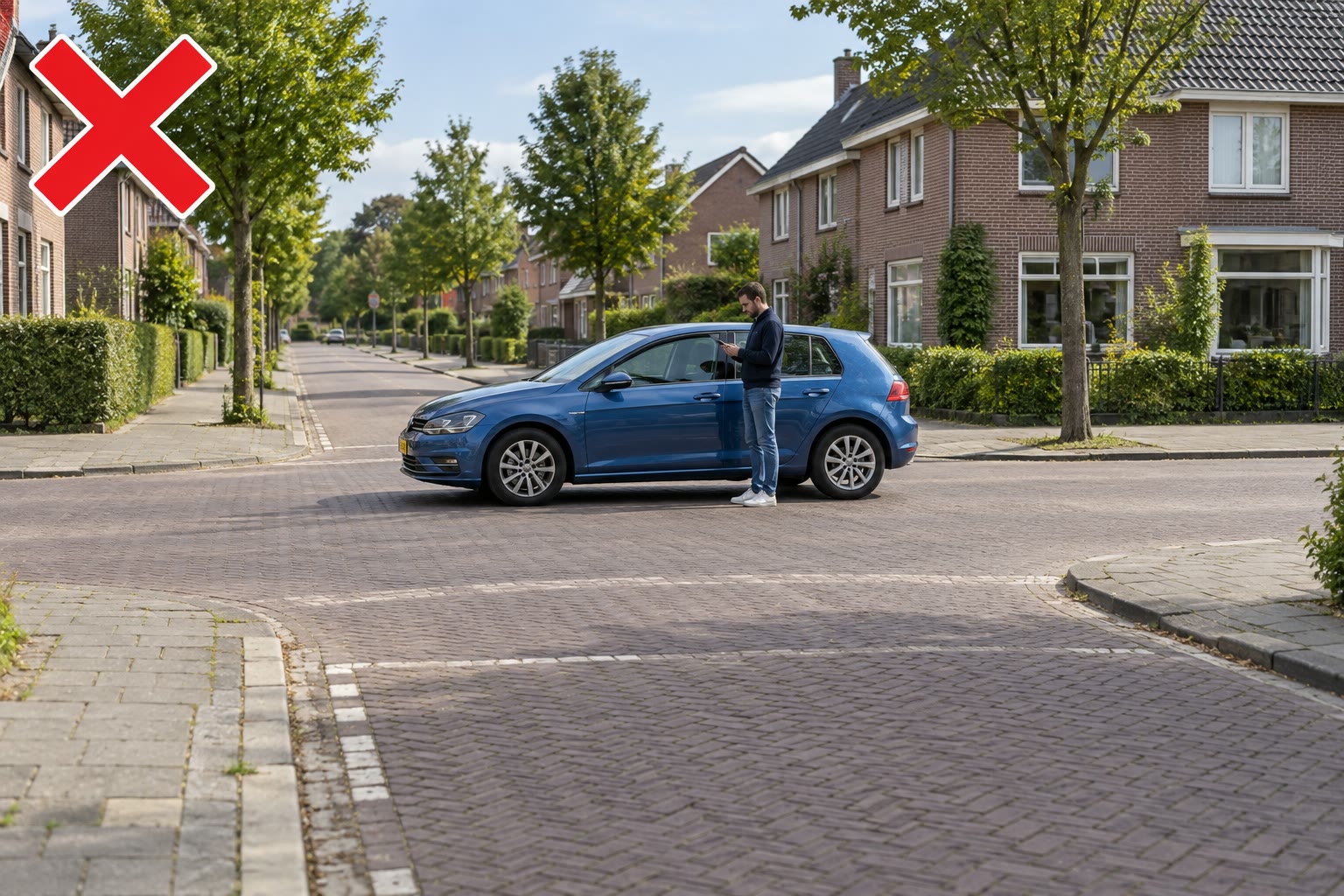
Drivers may not block an intersection. This means: do not enter an intersection unless you can completely clear it. If traffic ahead is slow or stationary and you cannot pass through, wait before the intersection until the way is clear.
Blocking an intersection prevents cross-traffic from moving and is one of the most common causes of gridlock in cities.
§ 5 — Right of Way
Who goes first — the fundamental priority rules at intersections and level crossings.
At intersections, all drivers must give way to drivers approaching from the right. This is the default rule when no signs, traffic lights or other rules indicate otherwise.
Two exceptions apply:
- Drivers on an unpaved road must give way to drivers on a paved road — regardless of which side they come from.
- At an otherwise unregulated intersection, drivers must give way to trams. Traffic lights, authorised traffic-controller instructions and applicable traffic signs can determine a different order.
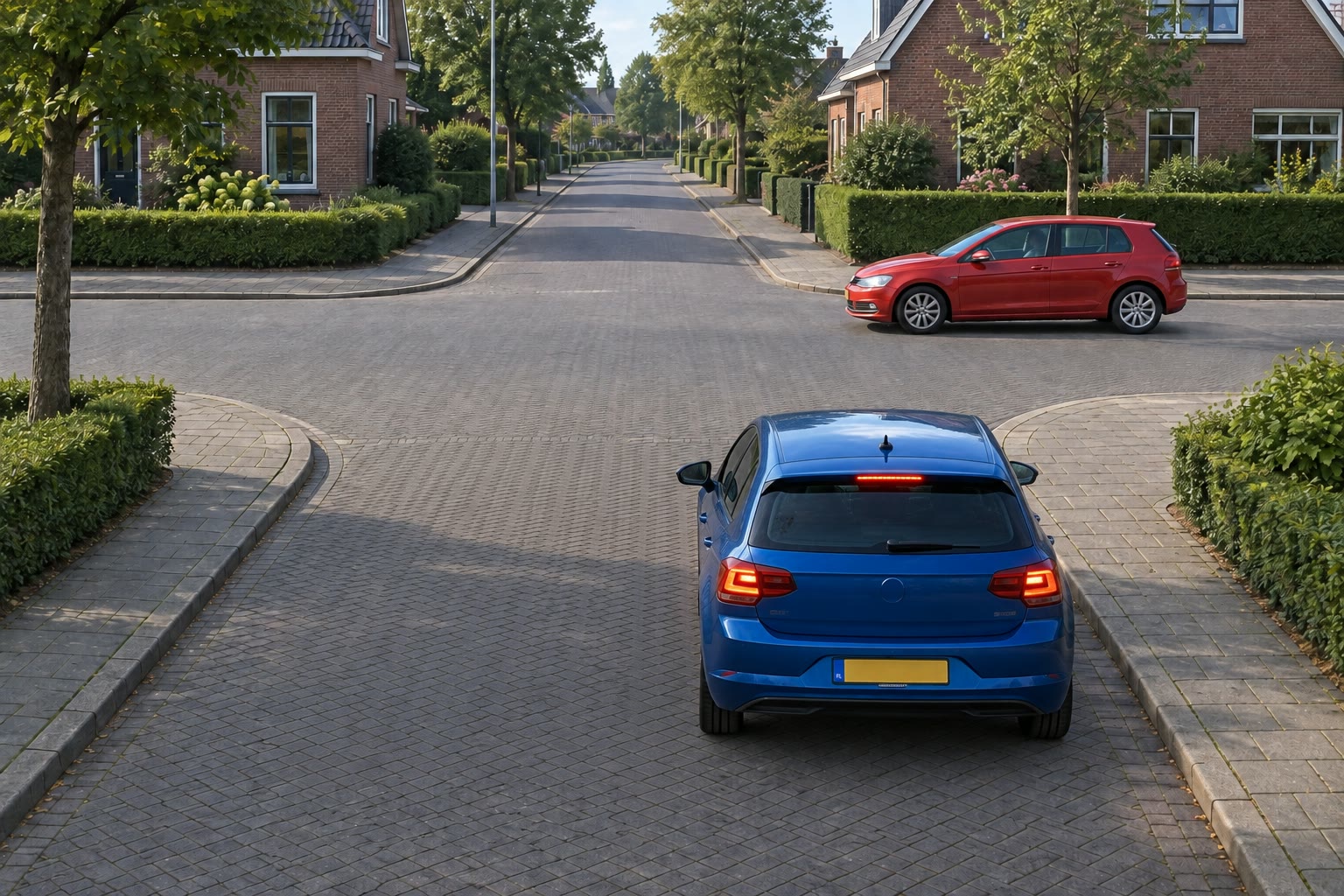
When you approach an unmarked intersection, ask yourself in this order: (1) Is there a traffic controller? Follow their instructions. (2) Are there traffic lights? Follow them. (3) Are there road signs (priority road, give way, stop)? Follow them. (4) None of the above? Apply the ordinary priority rules: give way to drivers from the right, with the statutory exceptions including trams and paved-versus-unpaved roads.
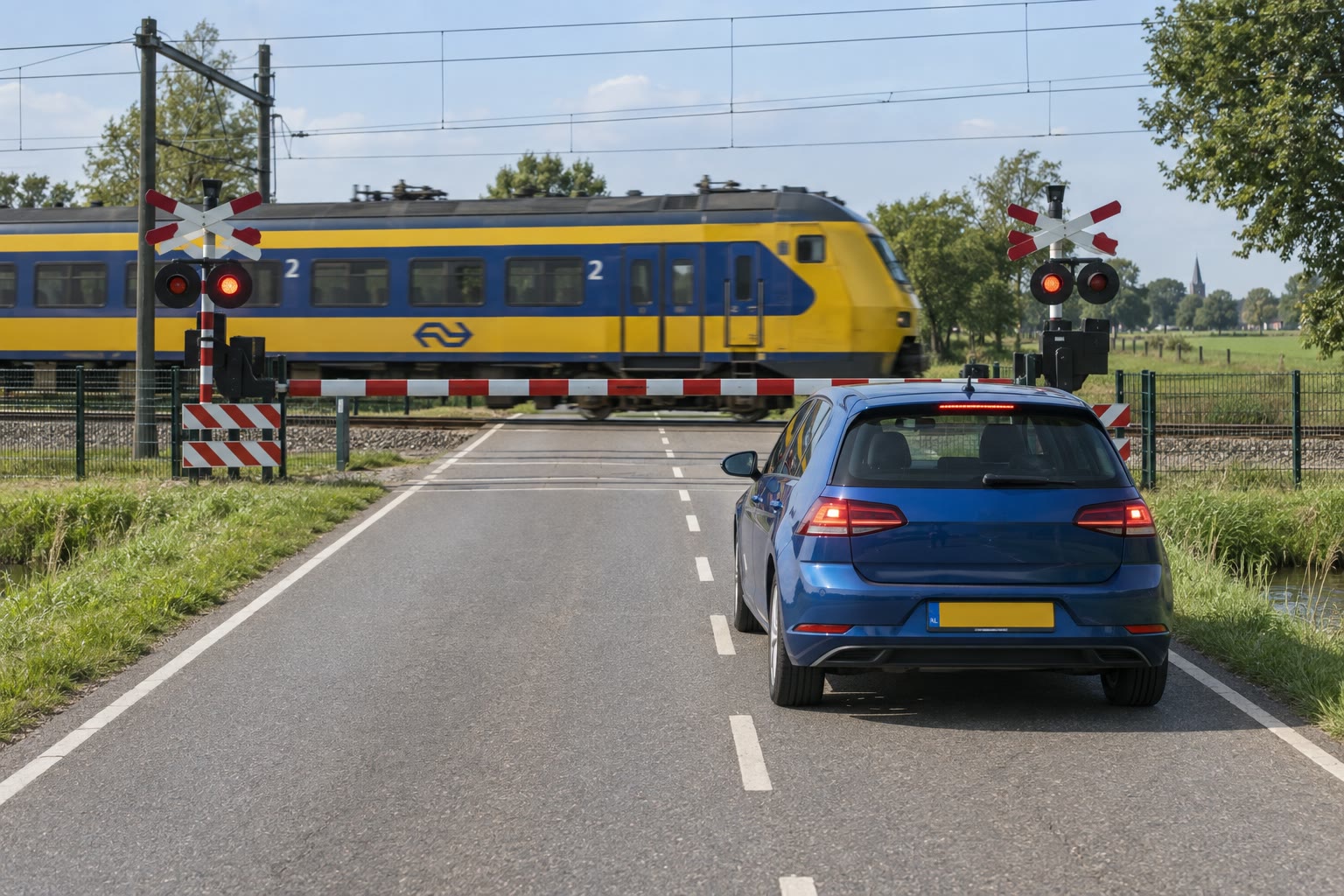
A road user may only proceed onto a level crossing if they can pass through immediately and clear the crossing completely. You must never enter a level crossing unless you are certain you can get all the way across without stopping.
At a level crossing, all road users must let any rail vehicle pass — train, tram, metro — and must keep the crossing completely free while doing so.
§ 6 — Military Convoys & Funeral Cortèges
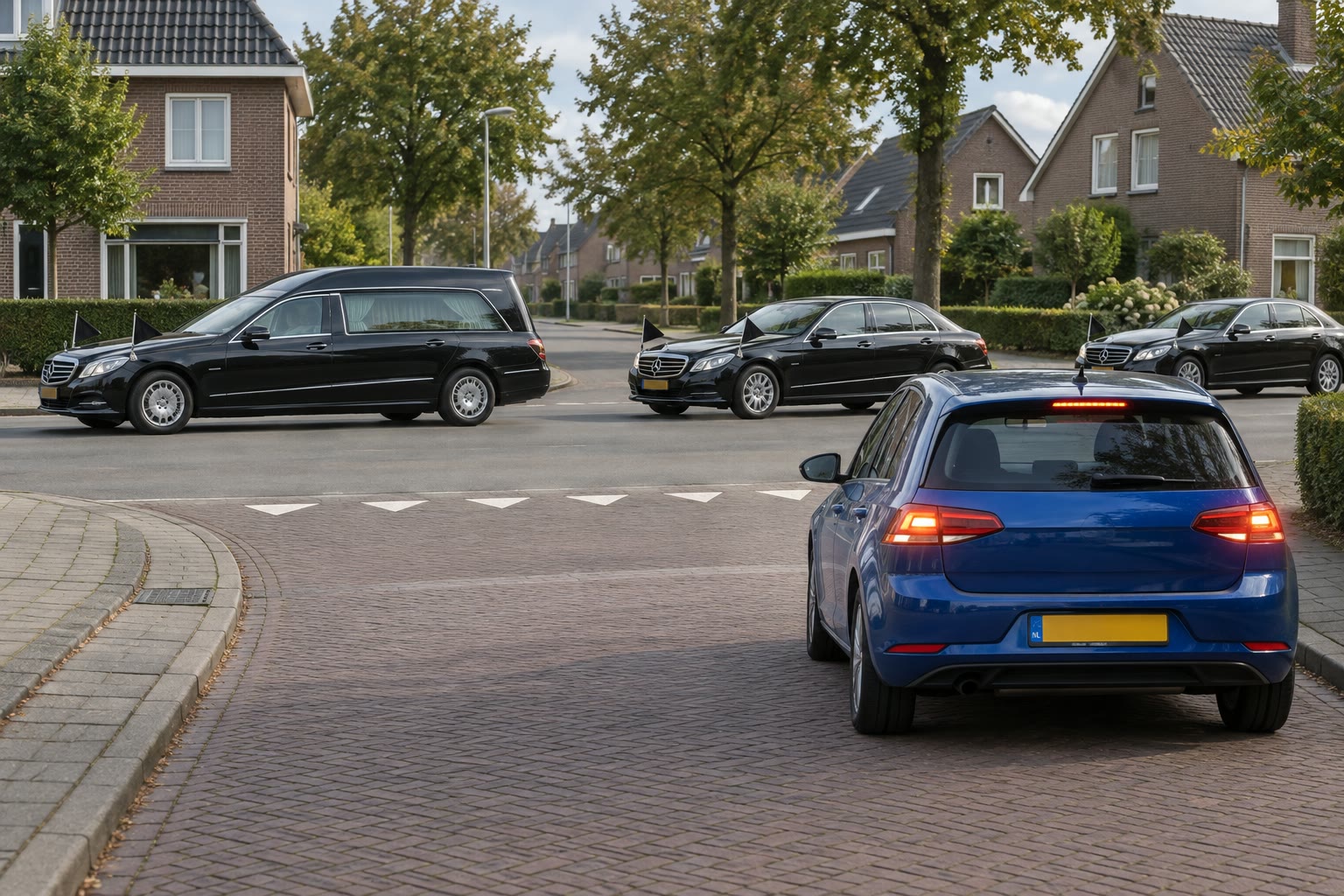
Road users are prohibited from cutting through a military convoy or a motor vehicle funeral cortège. If such a procession is crossing your path, you must wait until it has passed completely — even if you have right of way.
§ 7 — Turning
How to signal, position and yield when making a turn.
Before turning, a driver may move into the correct position:
- Turning right: Move as far to the right as possible, in good time before the turn.
- Turning left: Move as close to the centre line as possible — or, on a one-way road, as far to the left as possible.
Before turning, the driver must signal with their indicator or, if no indicator is fitted, with their arm.
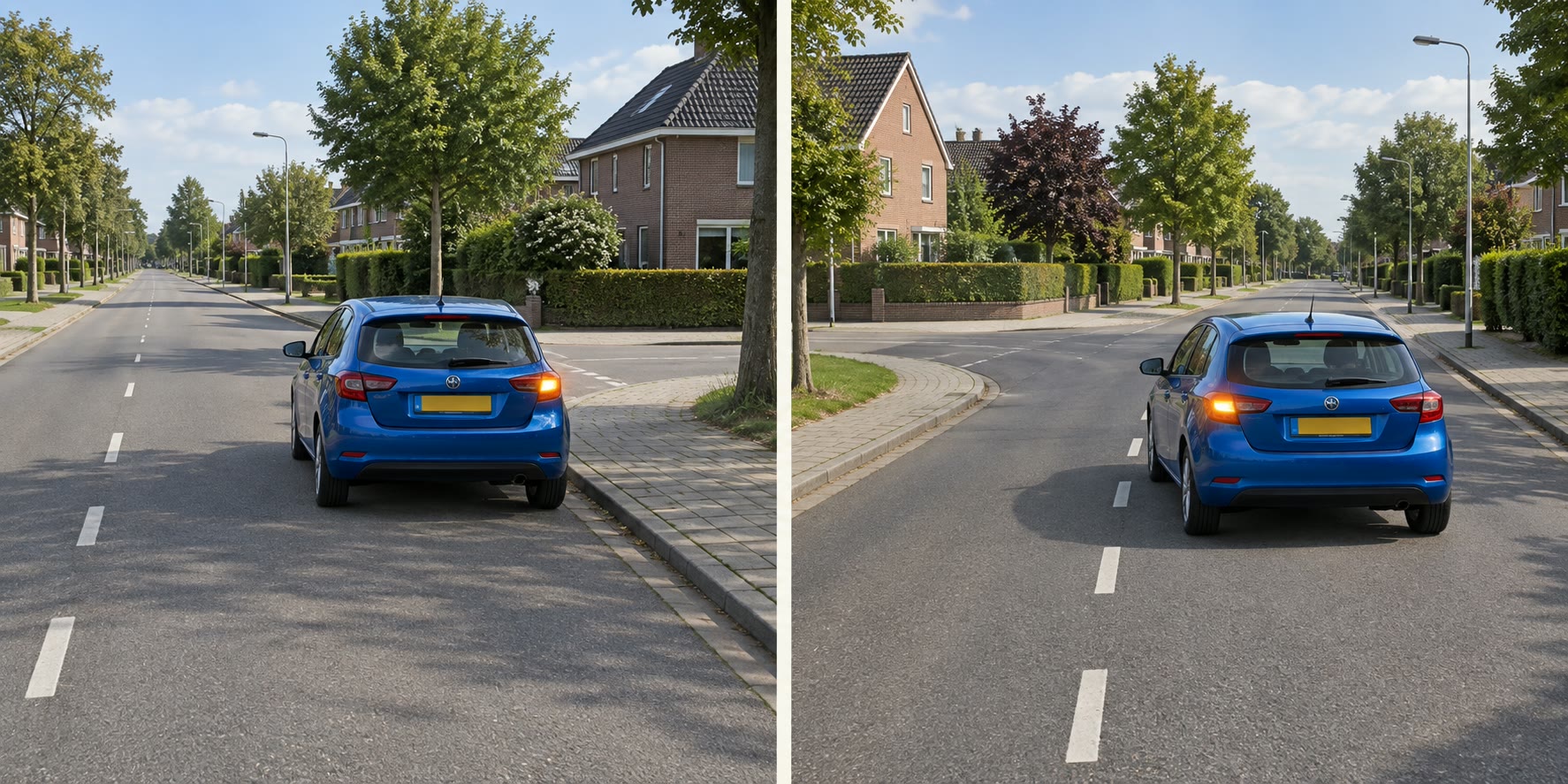
A driver who is turning must give way to:
- Traffic coming from the opposite direction on the same road.
- Traffic travelling alongside them on the same road — to the left or right, or close behind.
A driver turning left must also give way to an oncoming driver who is turning right at the same intersection.
§ 8 — Speed Limits
The general principle, the standard limits, and the special limits for specific vehicle types.
Before any specific speed limit applies, there is an overriding principle: a driver must always be able to stop within the distance they can see ahead of them — and within the distance that is clear. This means that even if you are within the speed limit, you are driving too fast if you cannot stop in time for what you can see.
Inside Built-Up Areas
on the road
on the carriageway
on bicycle/moped path
on bicycle path
on pavement / footpath
Outside Built-Up Areas
| Vehicle type | Motorway | Expressway | Other road |
|---|---|---|---|
| Motor vehicles (cars, vans) | Follow the posted limit — generally 100 km/h from 06:00–19:00 on almost all motorways; many sections allow 100, 120 or 130 km/h from 19:00–06:00 | 100 km/h unless signs indicate otherwise | 80 km/h unless signs indicate otherwise |
| Mopeds / motorised disability vehicles — carriageway | — | — | 45 km/h |
| Mopeds / disability vehicles — bicycle/moped path | — | — | 40 km/h |
| Disability vehicles — bicycle path | — | — | 40 km/h |
| Motorised disability vehicles & snorfiets — pavement | — | — | 6 km/h |
Special Speed Limits for Specific Vehicles
| Vehicle | Maximum speed | Notes |
|---|---|---|
| Trucks, regular buses (not T100), camper vans >3,500 kg | 80 km/h | Regardless of road type outside built-up areas |
| T100-bus | 100 km/h | On motorways and expressways |
| Brommobiel | 45 km/h | Always |
| Snorfiets | 25 km/h | Always |
| Car / van / motorcycle / 3-wheel motor vehicle / T100-bus towing trailer ≤3,500 kg | 90 km/h | With trailer |
| Other motor vehicles towing a trailer | 80 km/h | With trailer |
| Agricultural tractors, slow motor vehicles, mobile machines | 25 km/h | Default; 40 km/h on roads outside built-up area or specific urban roads |
The limits above must always be read together with the posted signs and electronic matrix signs. On Dutch motorways, the permitted speed depends on the road section and time of day. From 06:00 to 19:00, almost all motorways are limited to 100 km/h, with some sections at 80 or 130 km/h. From 19:00 to 06:00, many sections allow 100, 120 or 130 km/h. Always follow the limit shown for the road and time you are driving.
§ 9 — Stopping (Stilstaan)
Locations where stopping — even briefly — is prohibited.
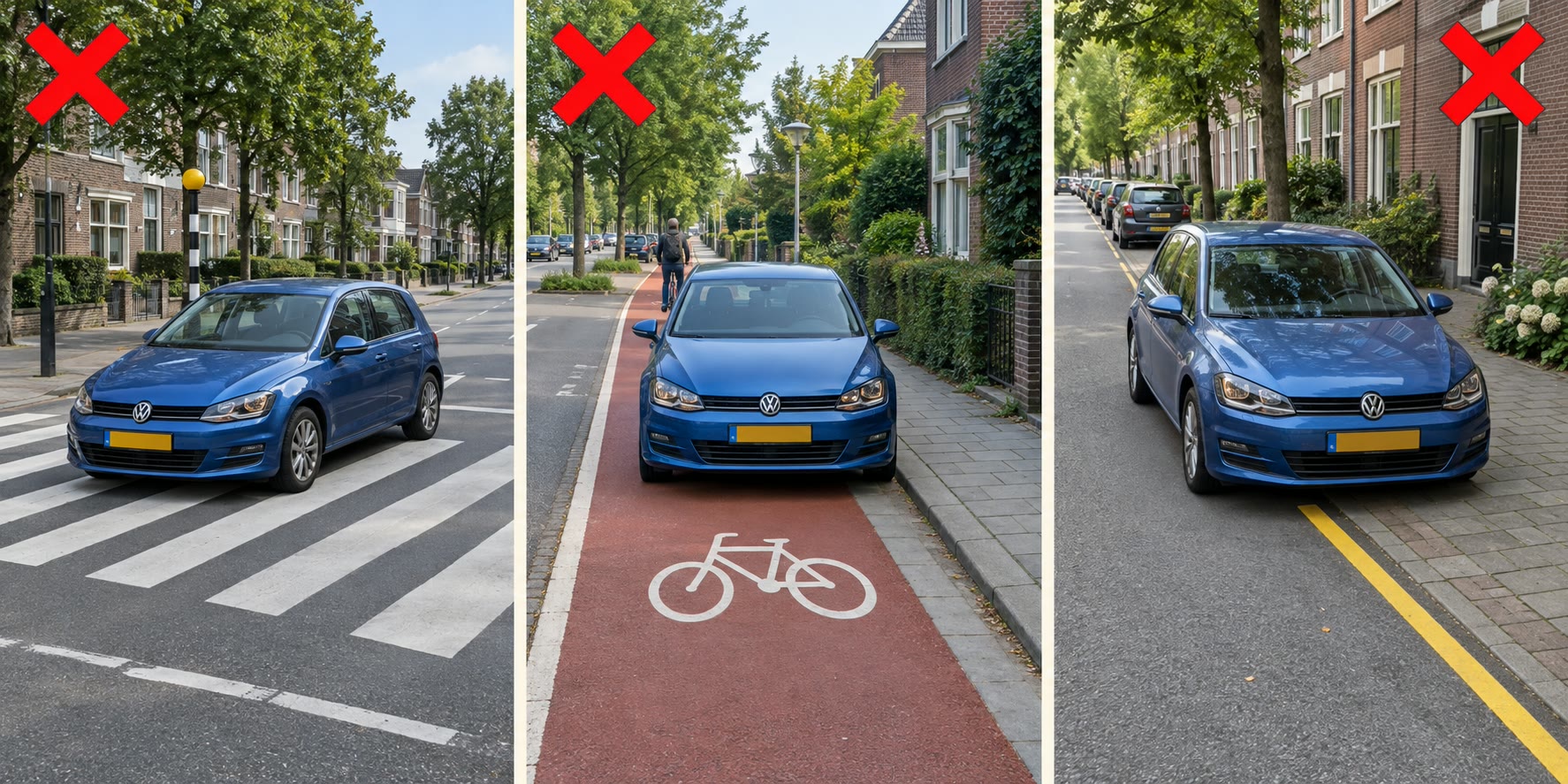
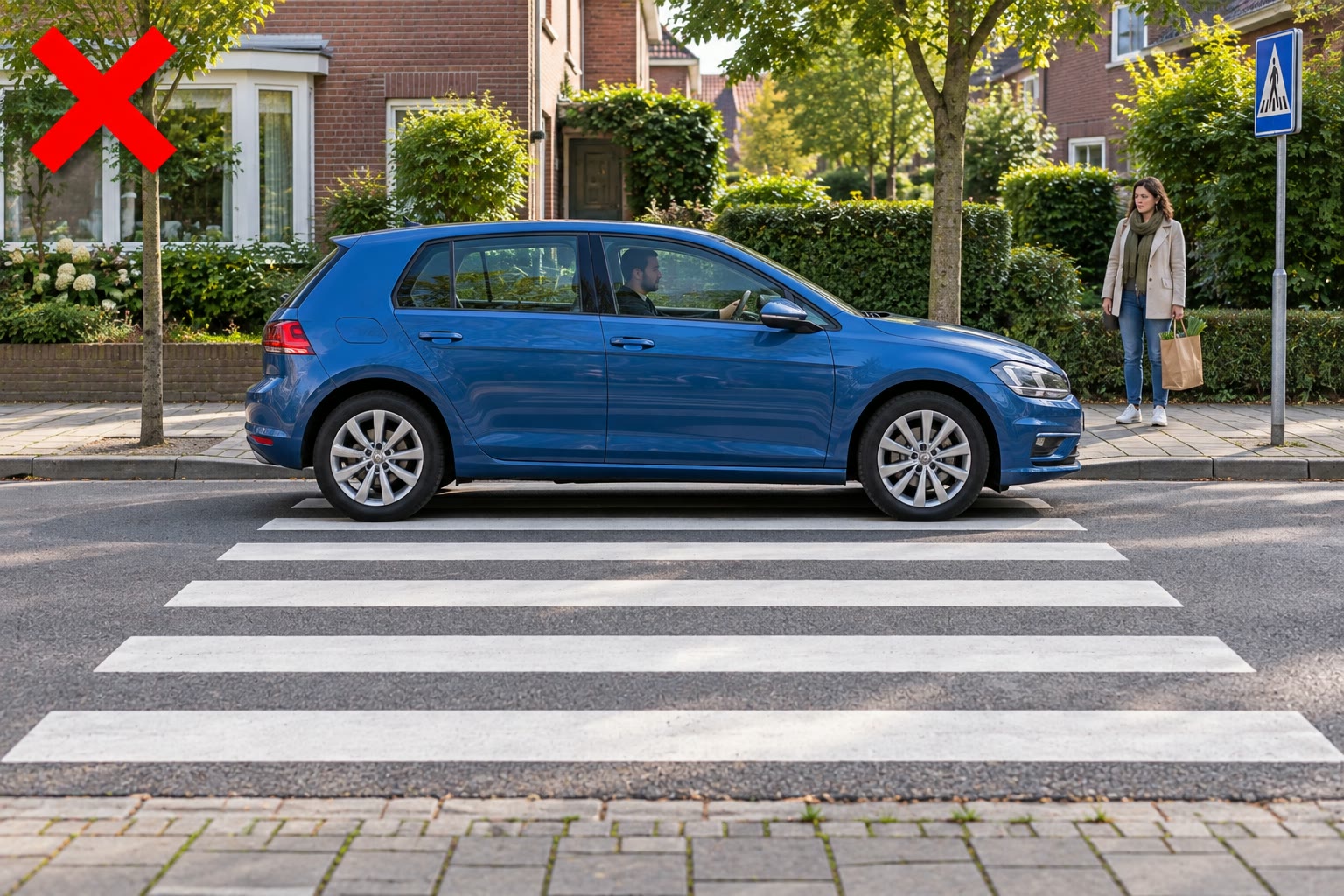
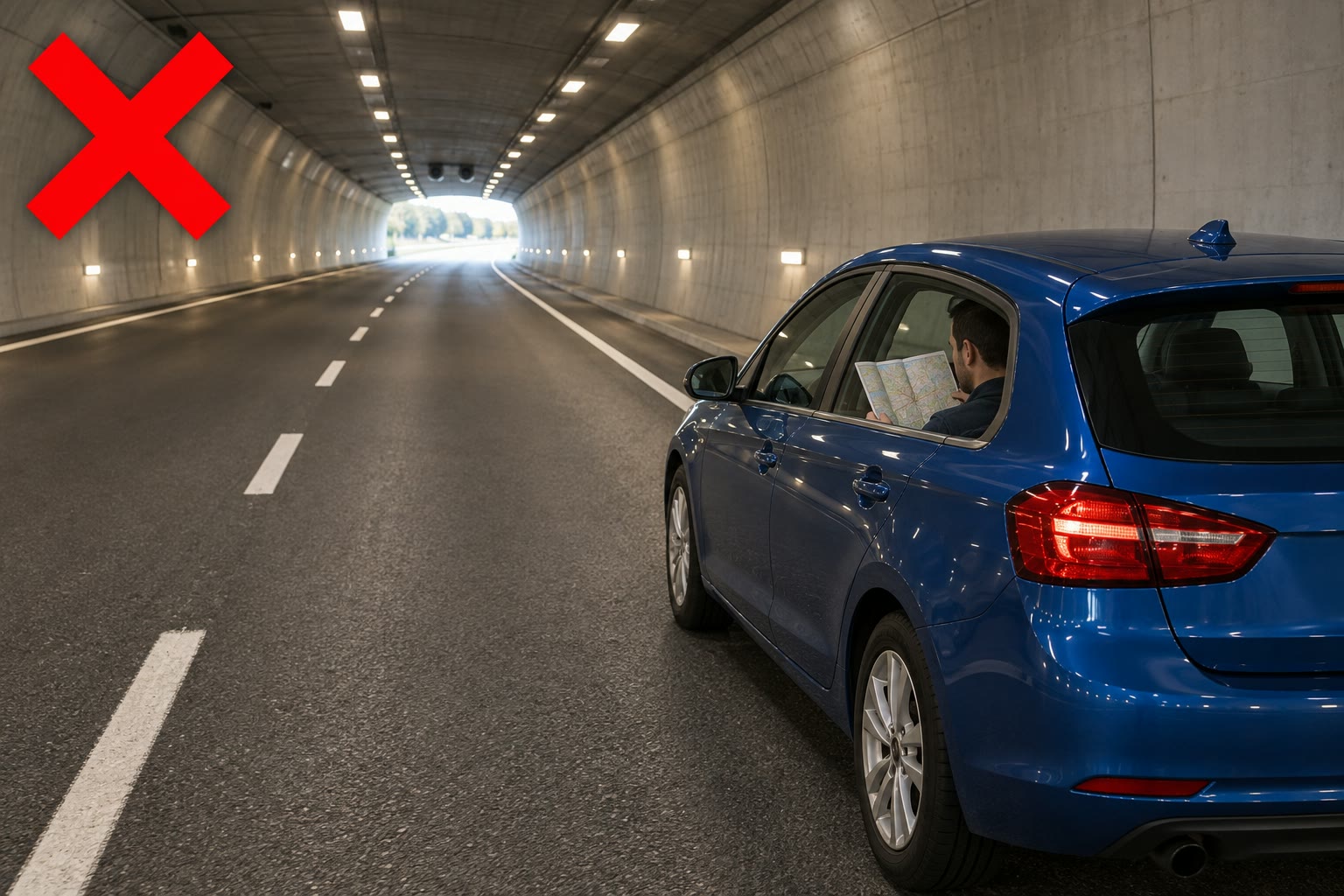
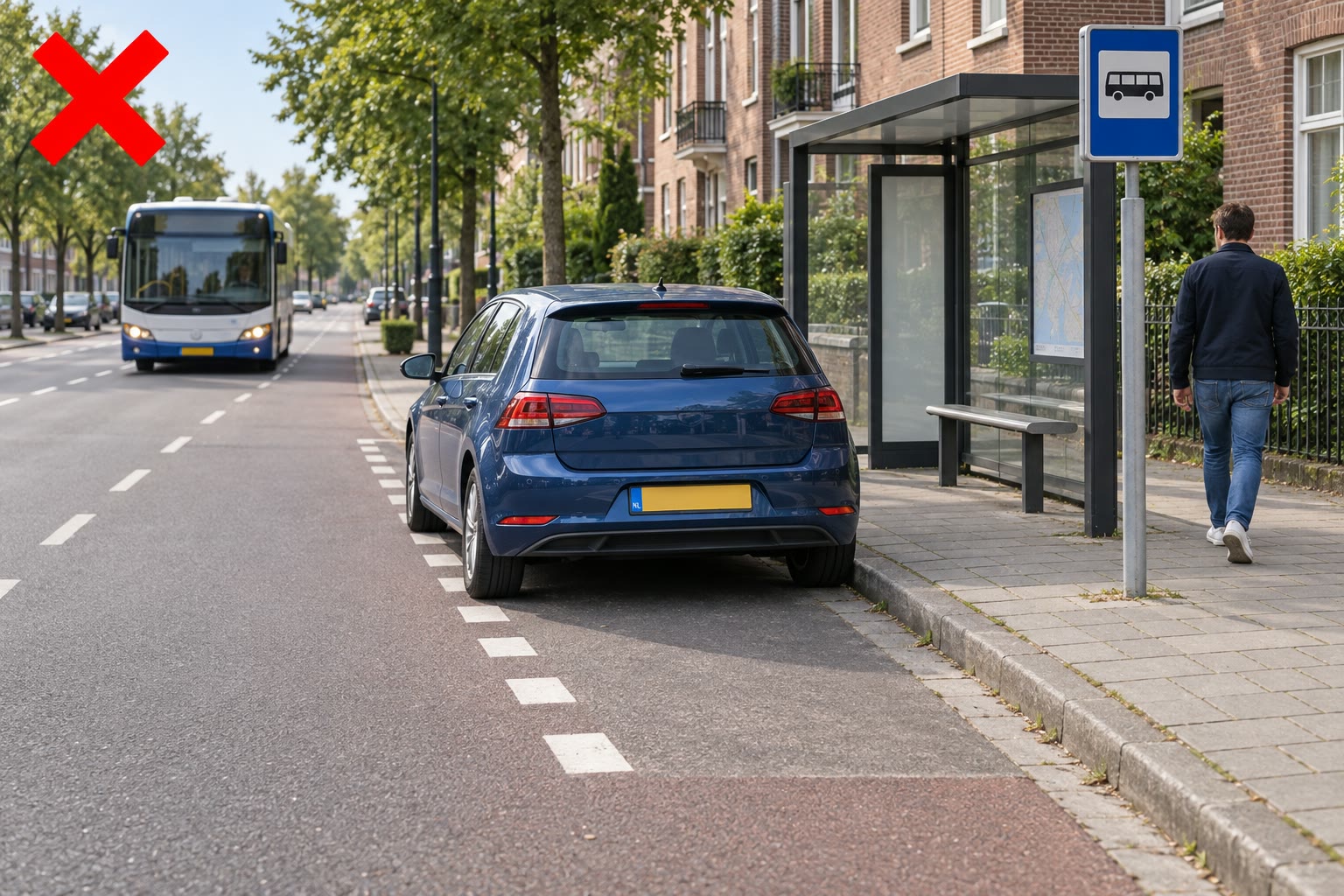
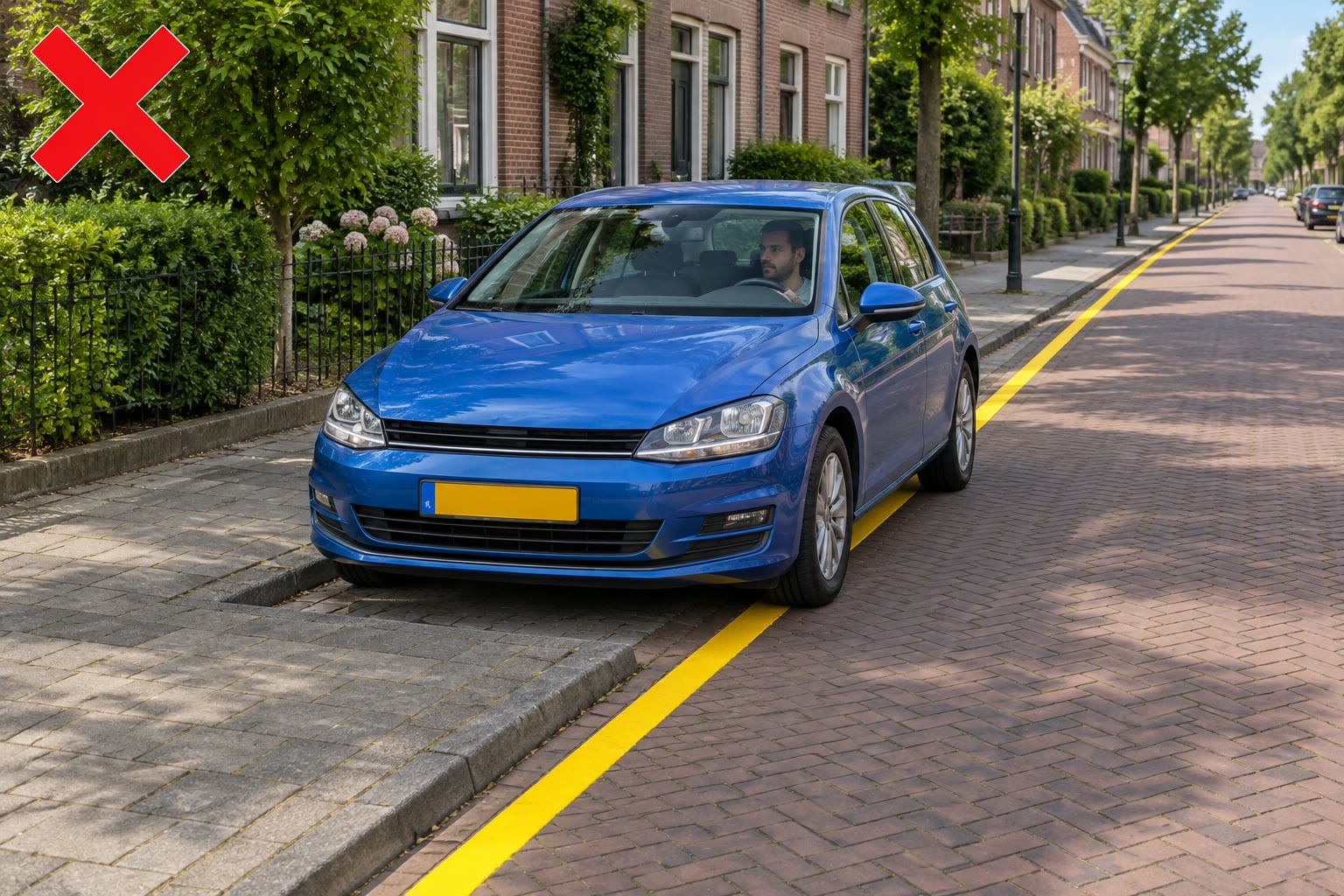
A driver may not stop their vehicle at any of the following locations:
- At an intersection or a level crossing
- On a bicycle lane, or on the carriageway alongside a bicycle lane
- On a pedestrian crossing, or within 5 metres of one
- Inside a tunnel
- At a bus stop sign — at the level of the block marking, or within 12 metres of the sign if no marking is present
- On the carriageway alongside a bus lane
- Alongside a solid yellow line
§ 10 — Parking
Where you may not leave your vehicle — and the rules for marked parking spaces.
Parking is prohibited at the following locations:
- Within 5 metres of an intersection
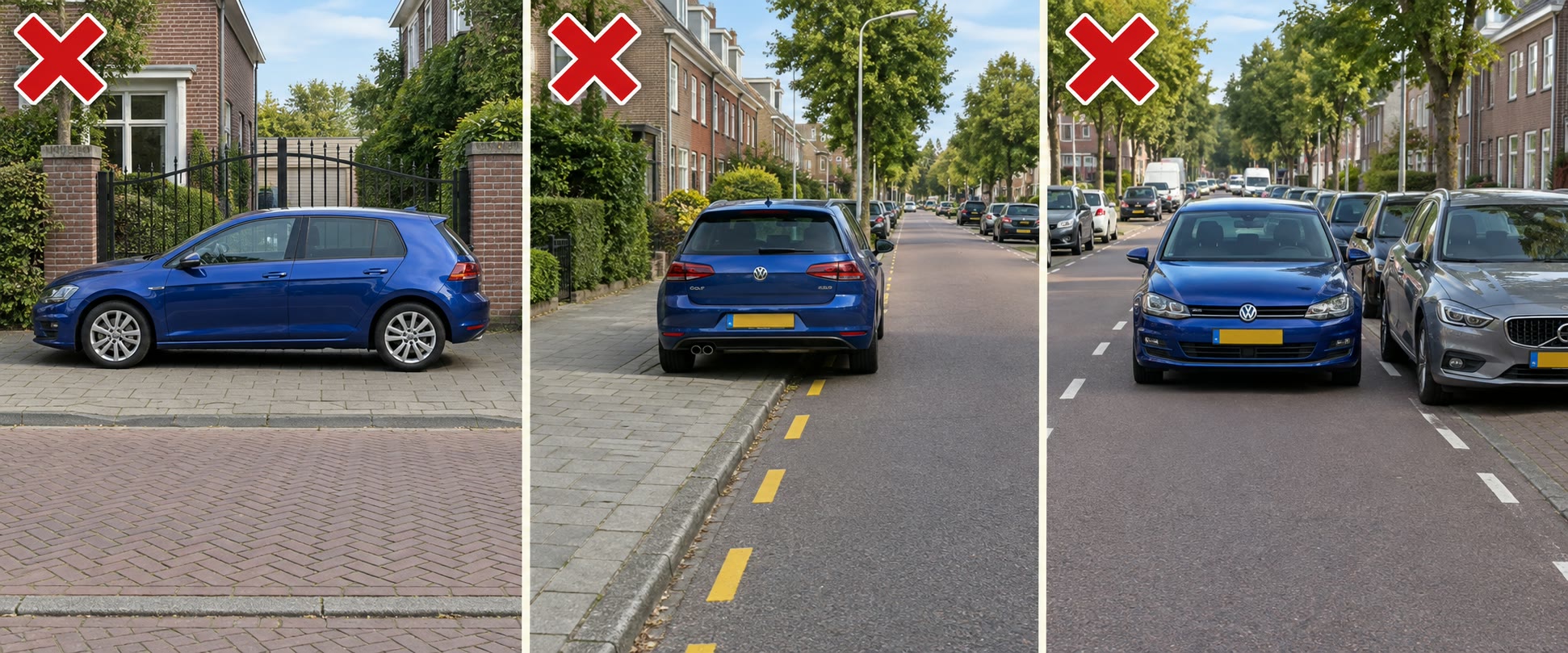
- In front of an entrance or exit (driveway)
- On a priority road carriageway outside a built-up area
- In a parking space, if your vehicle does not belong to the category shown on the sign
- In a parking space, in a manner or for a purpose different from what is shown on the sign
- At a location or time when parking is prohibited by a sign
- Along a broken yellow line (parking prohibited)
- On a pedestrian crossing or within 5 metres of one (same as stopping)
- On a cycle path or footpath
- Alongside another parked vehicle (double parking)
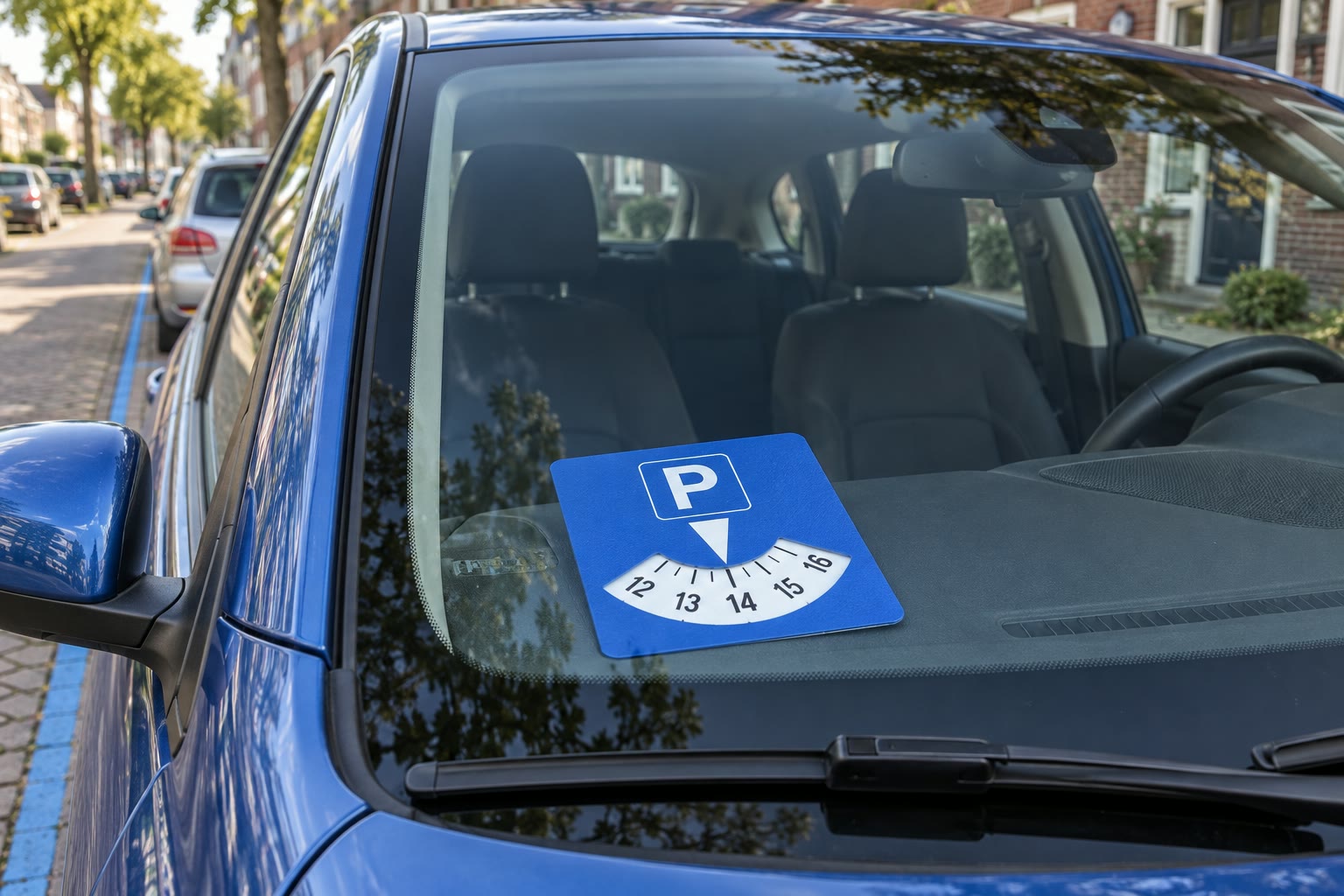
Where a sign indicates time-limited parking with a blue zone (blauwe zone), the driver must display a parking disc (parkeerschijf) showing the time of arrival. The disc must be clearly visible through the windscreen. Parking beyond the permitted time shown on the sign is prohibited.
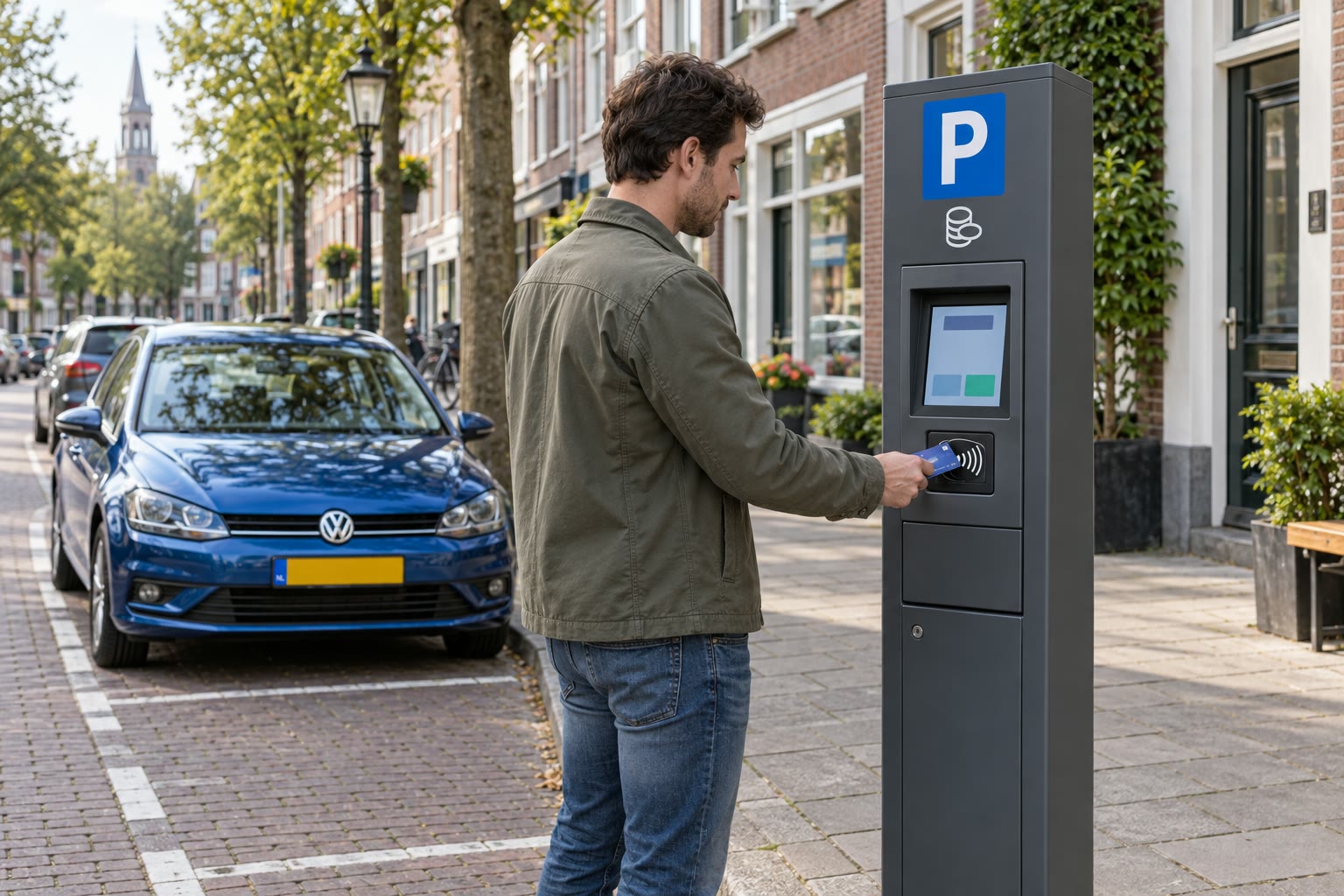
Where paid parking applies, the driver must comply with the payment method and conditions indicated for that location. Payment may be made by a parking machine, parking app or another authorised method. A paper ticket only needs to be displayed when the local system requires it. Parking without valid payment, or beyond the paid period, is prohibited.
Everything in §9 (stopping) is also prohibited for parking. But parking has many additional prohibited locations on top of those. A location that allows brief stopping may still prohibit parking. Always check for signs.
§ 11 — Placing Bicycles & Mopeds
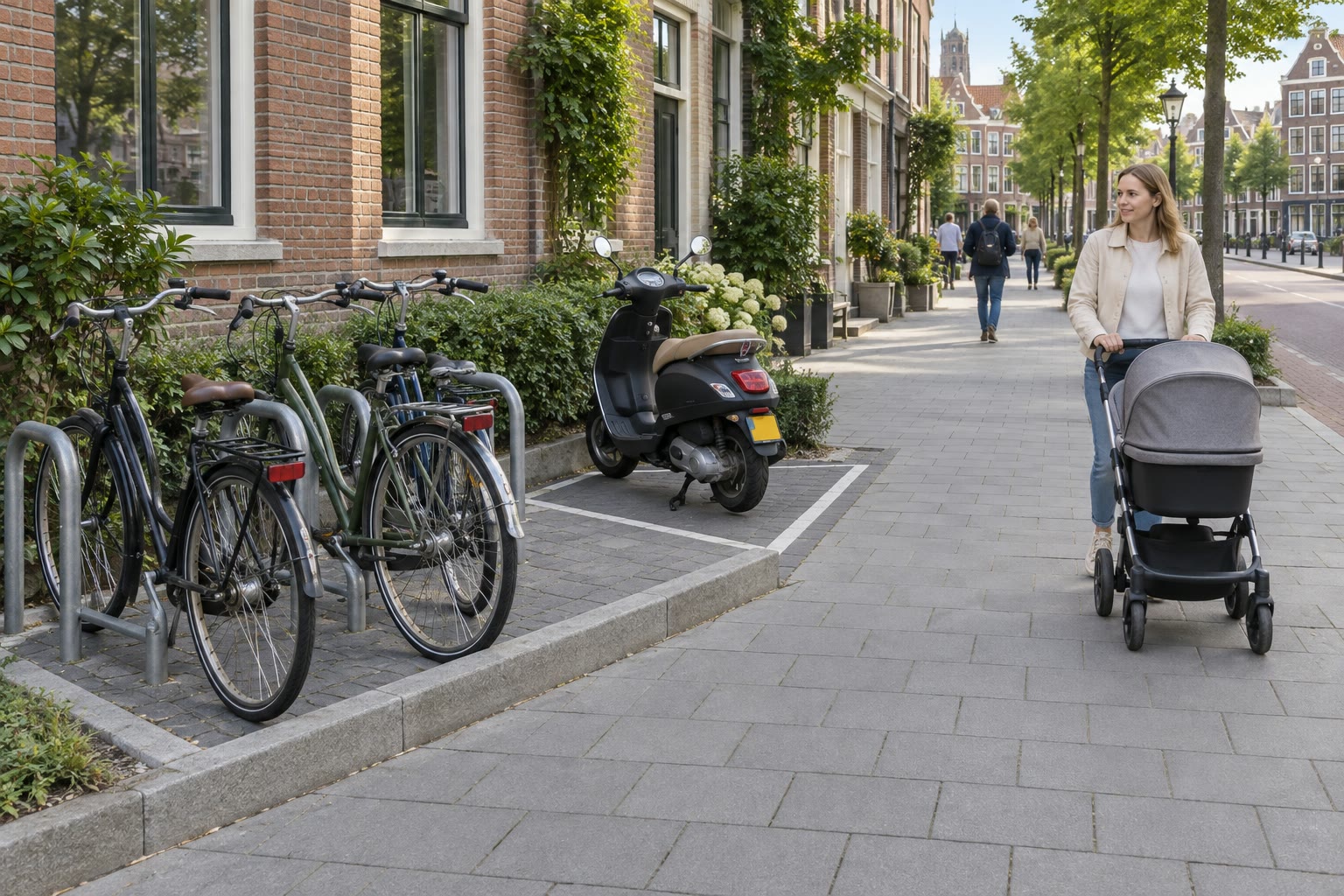
Bicycles and mopeds must be placed in a way that does not obstruct other road users. They may not be placed on a carriageway, cycle path, pavement or footpath in a manner that prevents pedestrians, cyclists or other users from passing freely. Where dedicated bicycle parking areas exist, they must be used.
§ 12 — Signals & Identification Markings
How to signal your intentions — and the legally prescribed signals and identification markings used in special situations.
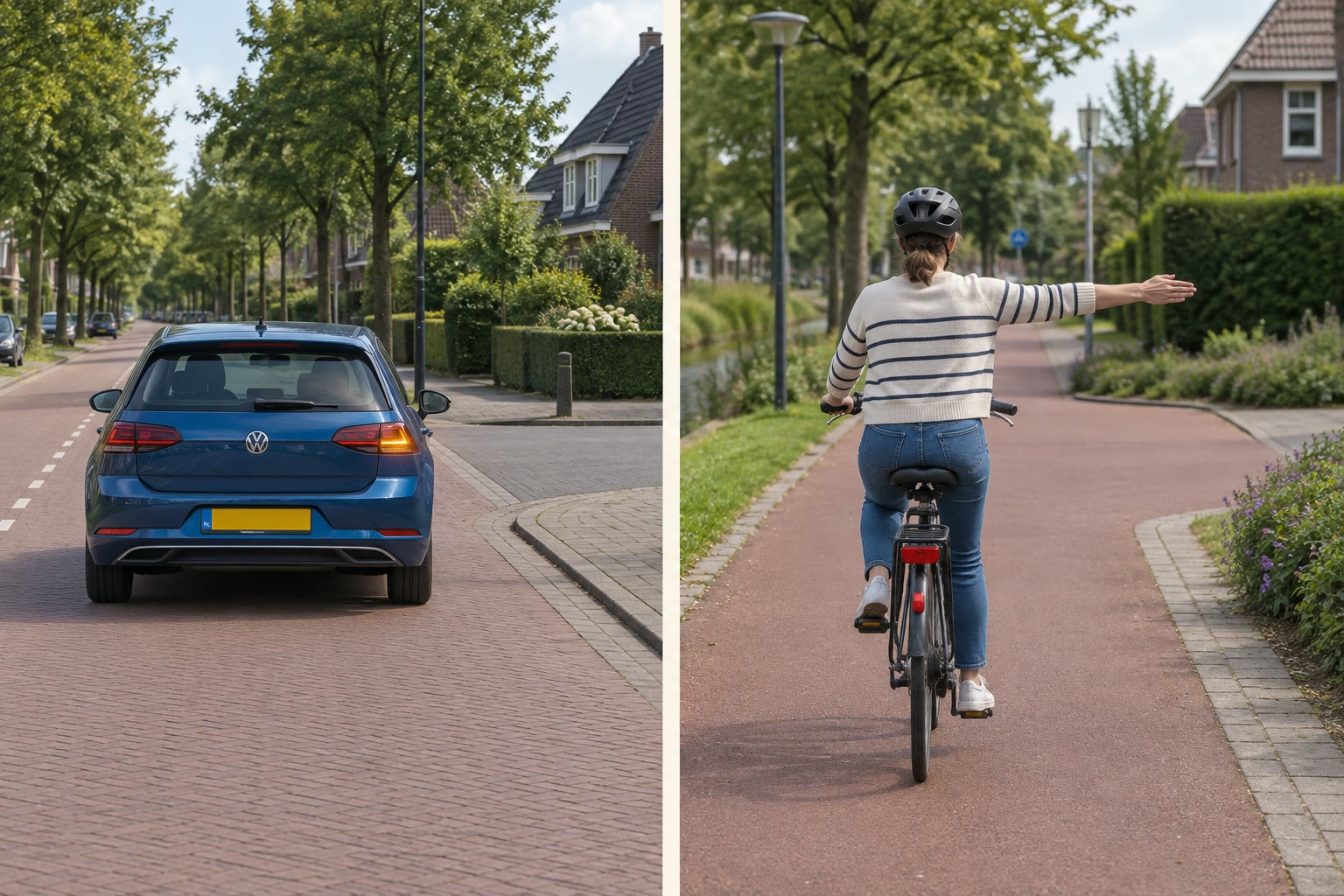
Drivers must give clear, timely signals when they intend to change direction or position. Signals are given using the indicator (richtingaanwijzer). If no indicator is fitted, an arm signal must be used instead. Signals must be given before the manoeuvre begins — not during it.
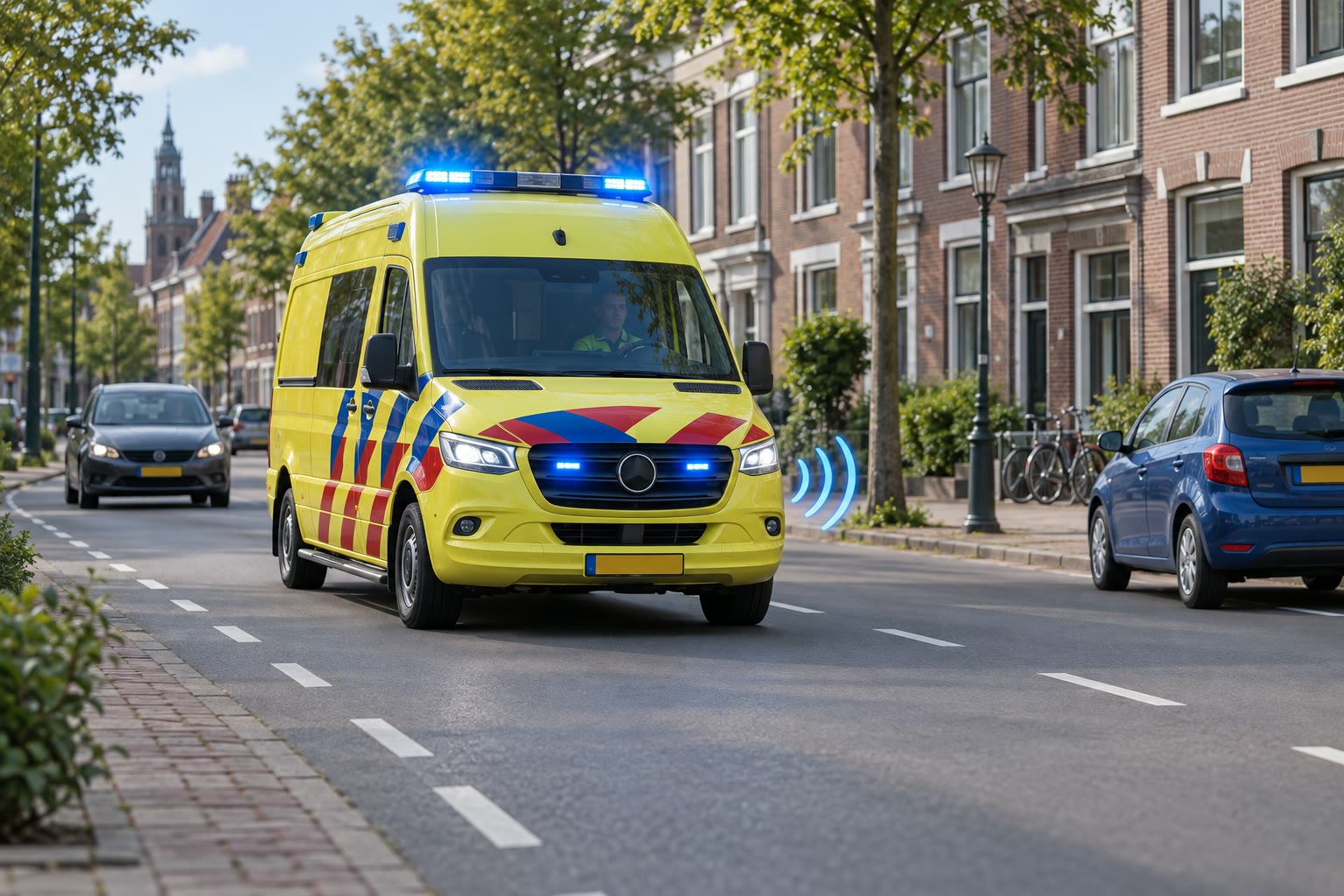
A priority vehicle uses both a flashing blue light and a siren simultaneously. These signals may only be used when the vehicle is responding to an emergency. All other road users must give way immediately and completely to a vehicle displaying both signals.
The blue flashing light and siren may also be used without the vehicle qualifying as a priority vehicle — for example, a police vehicle stopping someone. In that case, the full priority vehicle rules do not automatically apply, but road users must still respond appropriately.
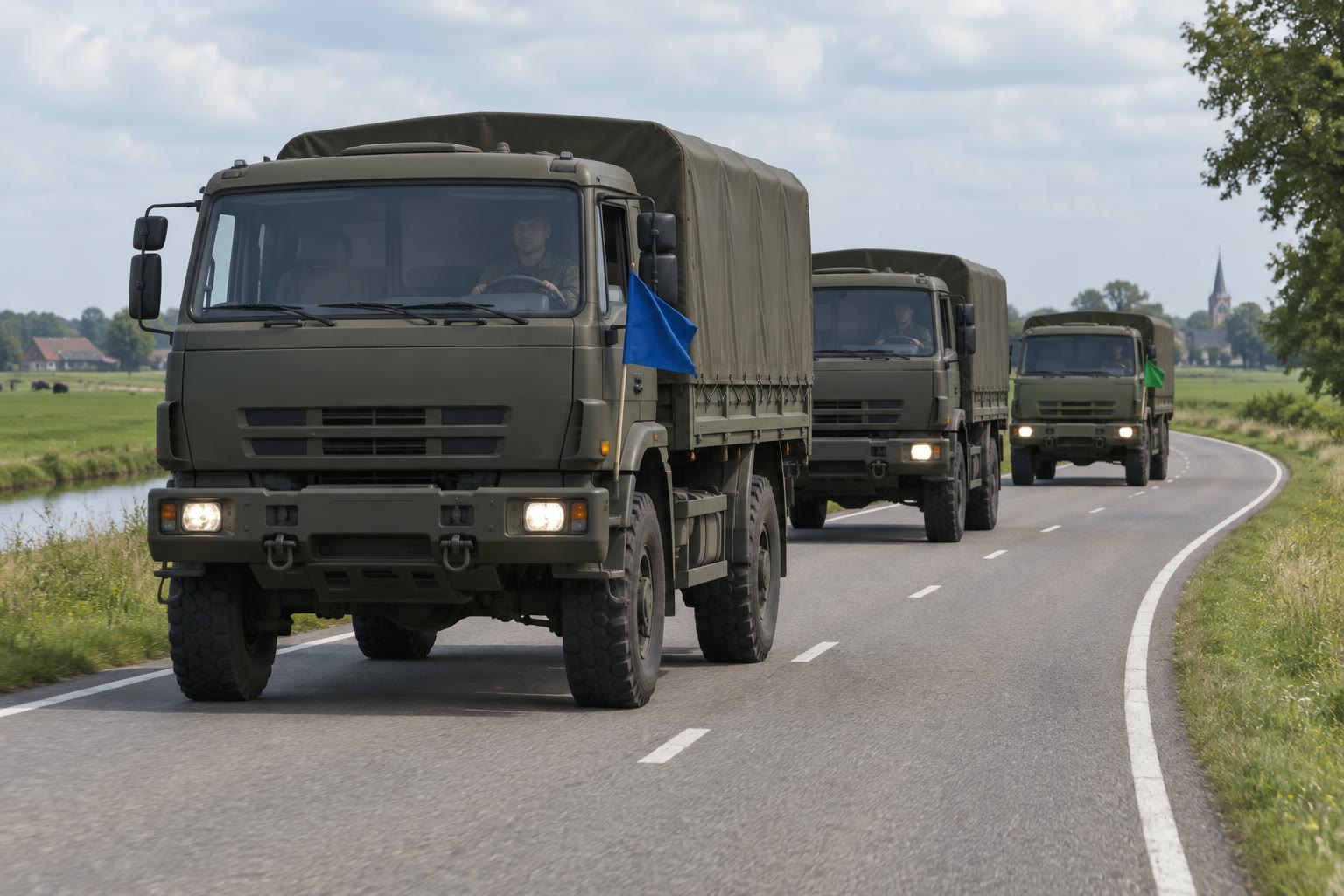
Military convoys display officially designated identification markings agreed upon by the Minister of Infrastructure and the Minister of Defence. These markings distinguish a military convoy from regular traffic and alert other road users that the convoy may not be cut through.
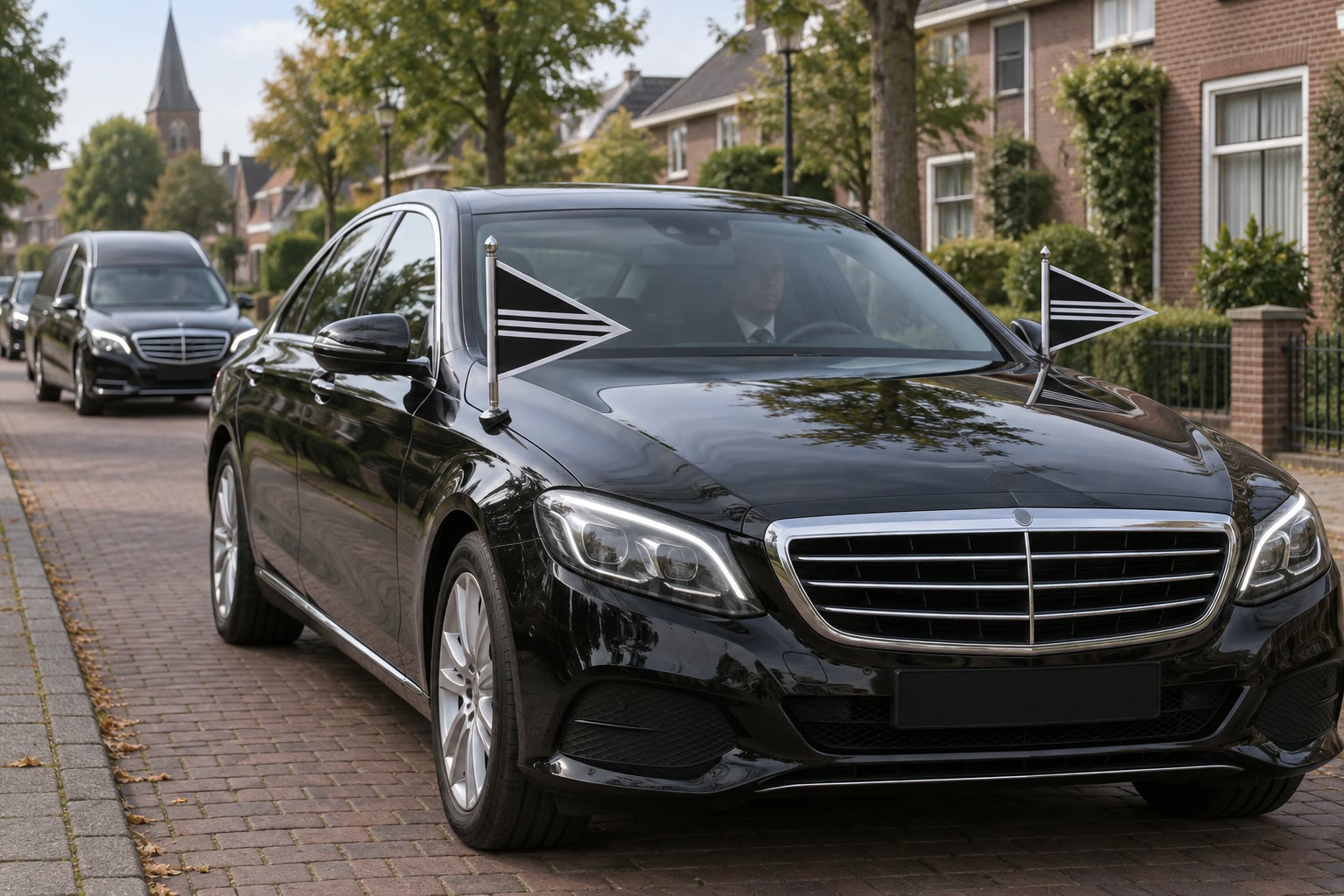
A recognised motor-vehicle funeral cortège uses the legally prescribed identification signs. These consist of two black triangular flags fitted to the participating vehicles in the prescribed manner. Do not confuse these markings with orange or purple rotating lights.
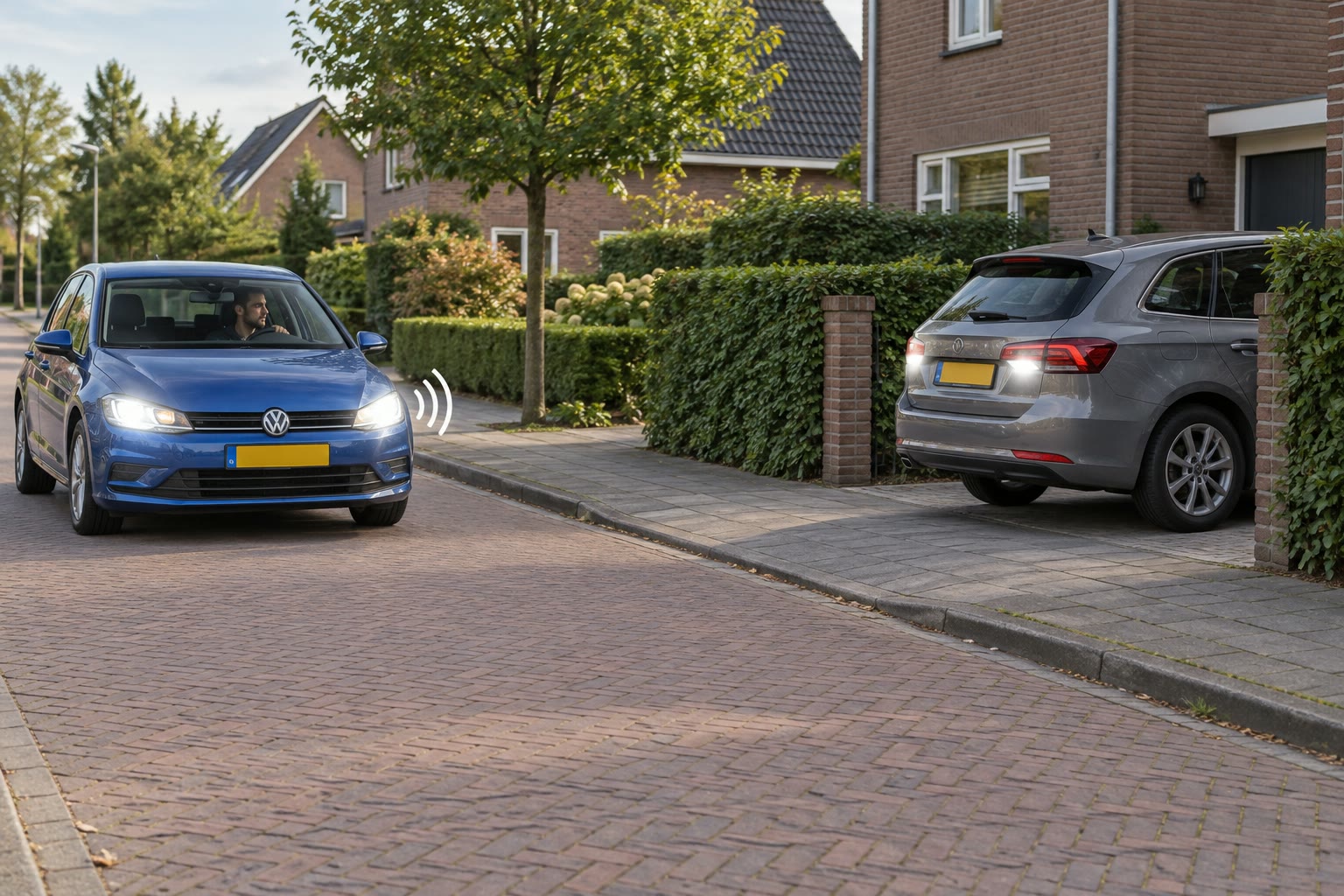
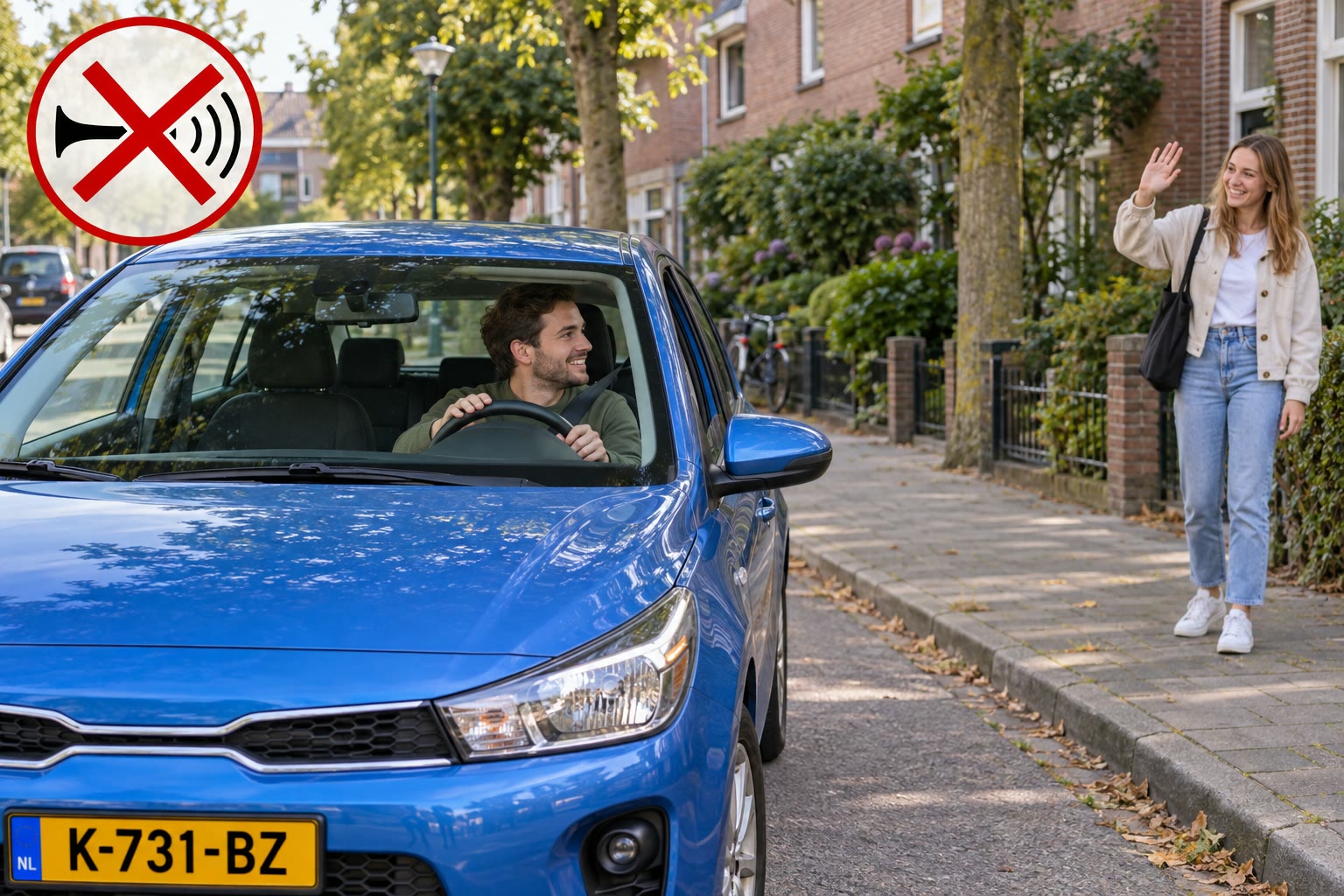
Drivers may use sound signals or flashing-light signals only to avert imminent danger. The rule applies both inside and outside built-up areas. The horn or headlight flash must therefore not be used merely as a greeting, to express frustration, or simply to announce an intention to overtake.
§ 13 — Lights While Moving
Which lights must be on, and when, while the vehicle is in motion.
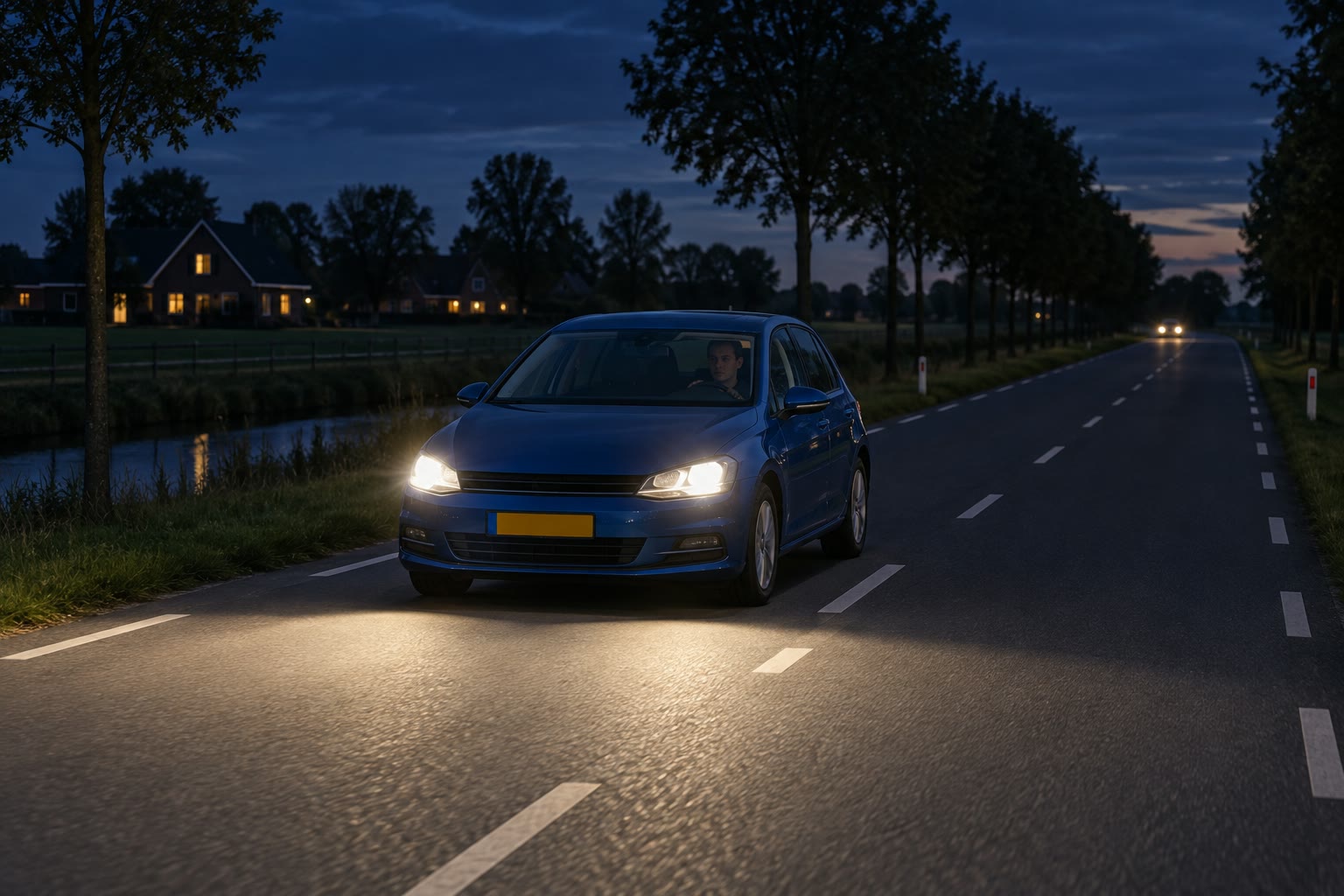
Motor vehicles must use dipped headlights (dimlichten) during the night and in conditions of reduced visibility — fog, rain, snow, or dusk. During the day in good visibility, daytime running lights (dagrijverlichting) are sufficient if the vehicle is equipped with them. Headlights must not blind other road users.
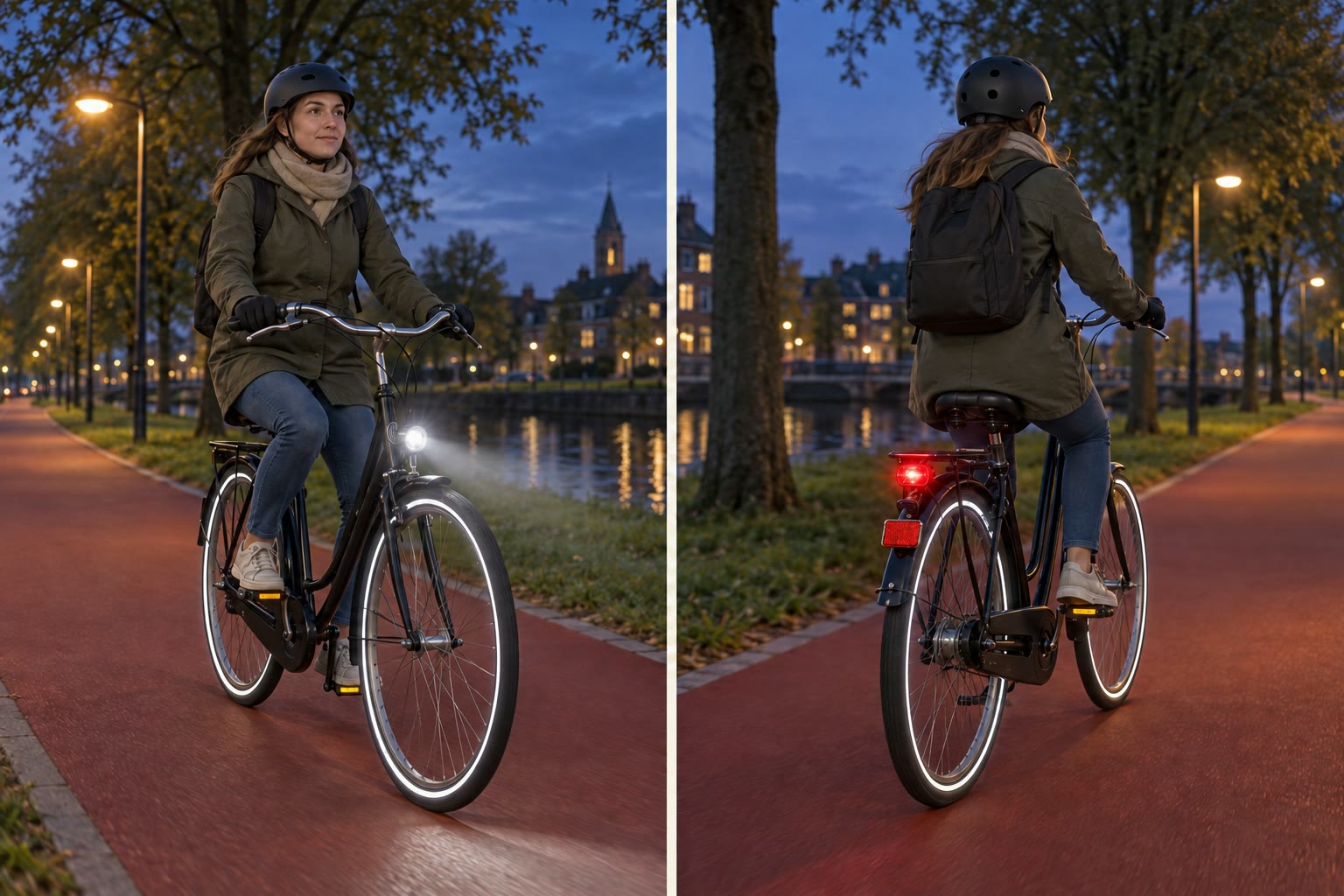
A bicycle being ridden at night or in poor visibility must have:
- A white or yellow front light that does not flash
- A red rear light that does not flash
- A red rear reflector (not triangular)
- Amber/yellow pedal reflectors
- White or yellow reflectors on the wheels/rims or tyres
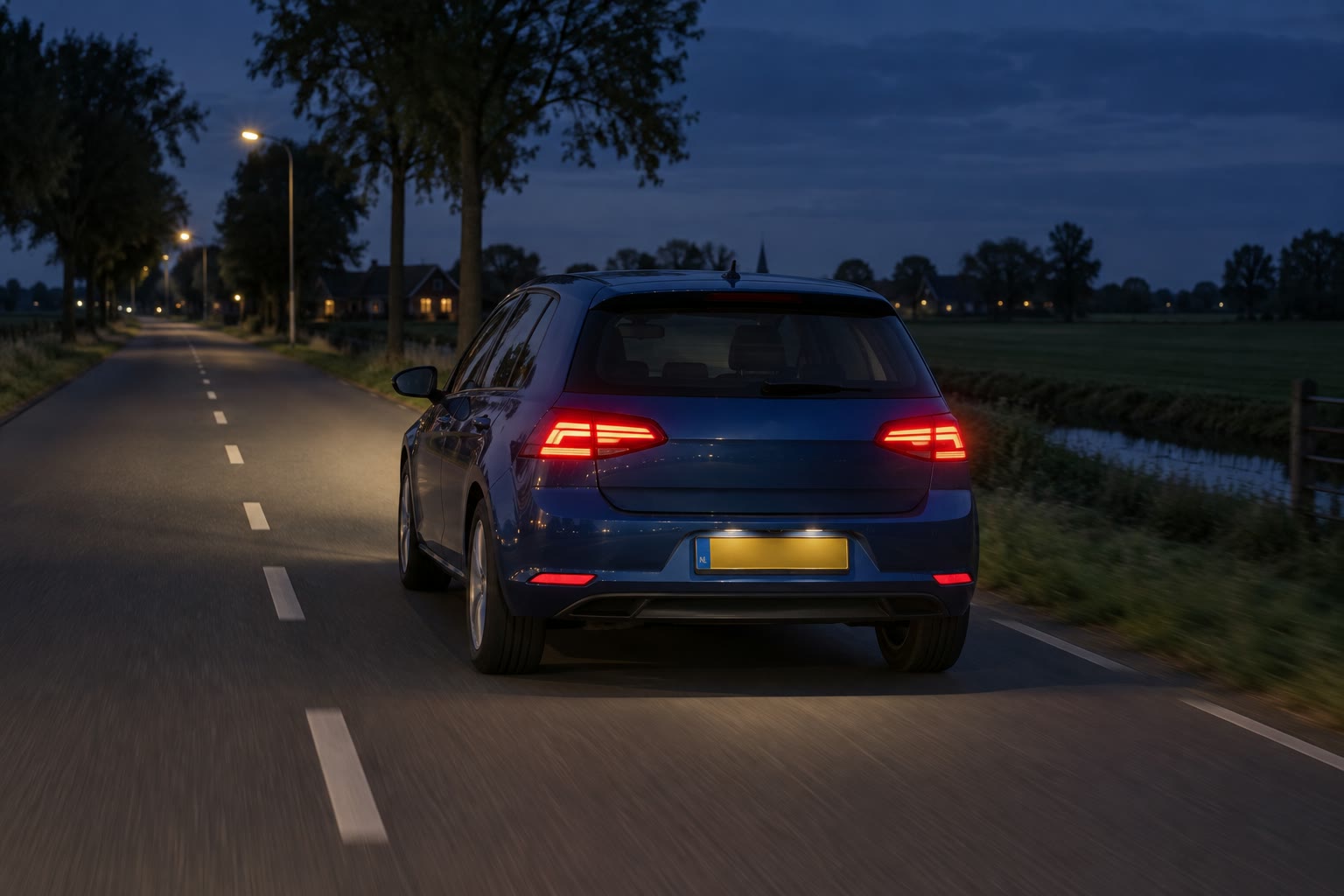
All vehicles must display red rear lights during the night and in poor visibility. In addition, they must carry the required reflectors — positions and colours vary by vehicle type but the principle is universal: your vehicle must be visible from behind.
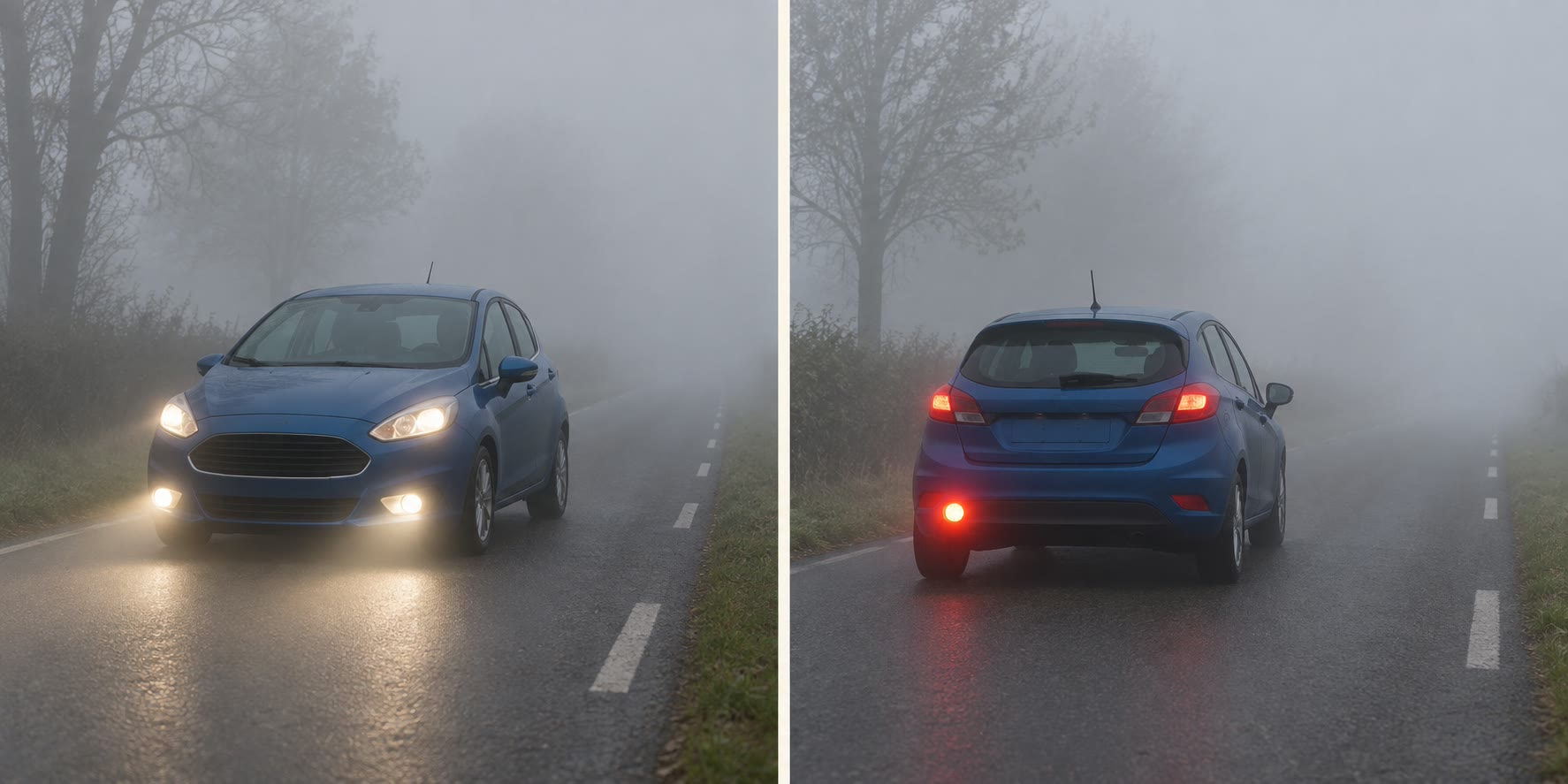
Front fog lights may be used when fog, snowfall or rain seriously reduces visibility. Rear fog lights may only be used when fog or snowfall reduces visibility to less than 50 metres; they may not be used merely because of heavy rain. Switch fog lights off when the conditions no longer justify their use.
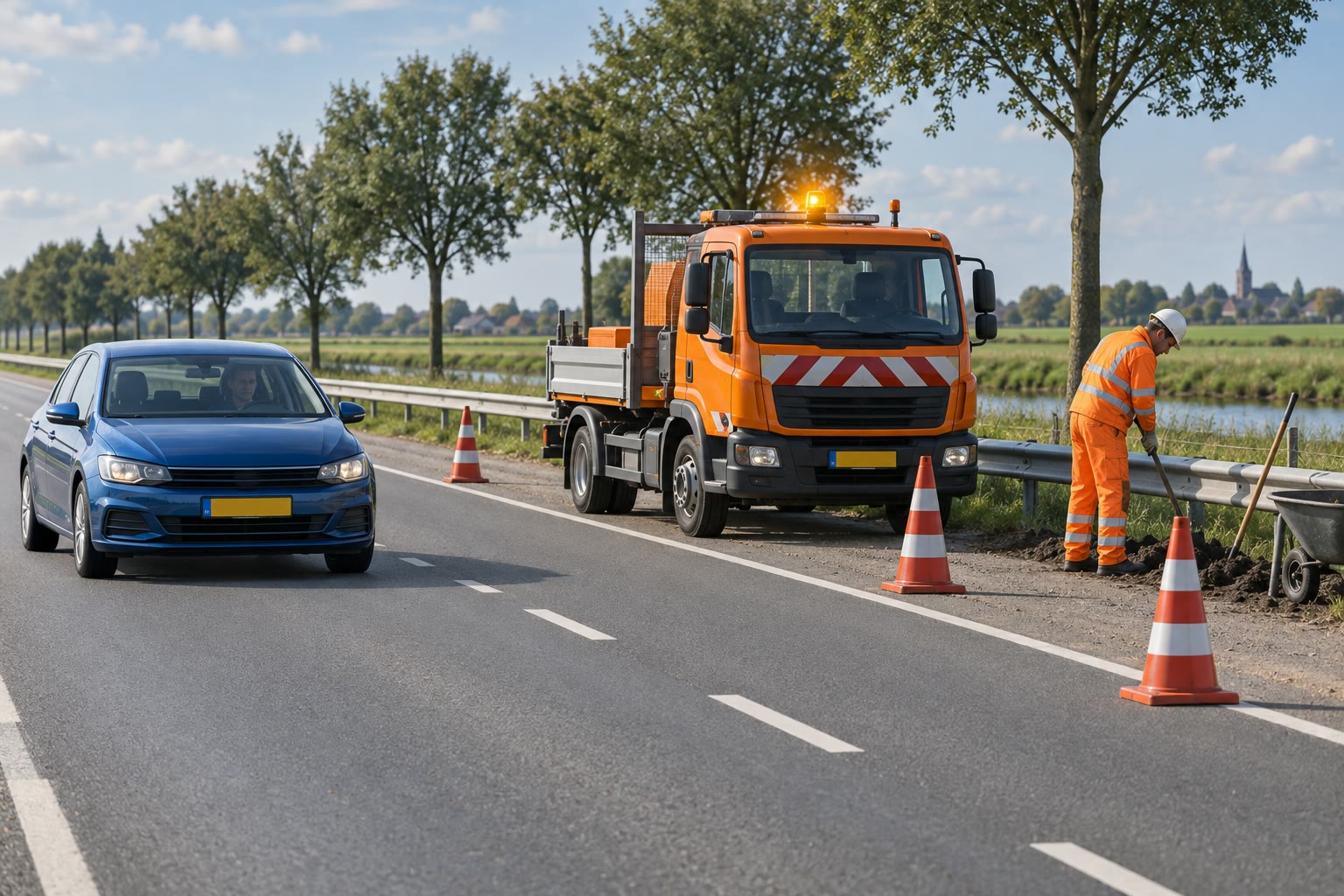
An amber/yellow rotating or flashing light is used in legally specified situations to warn other road users of a special or dangerous situation, for example certain road works, recovery operations or exceptional transports. It does not give the vehicle priority.
§ 14 — Lights While Stationary
Lighting obligations when your vehicle is stopped or parked.
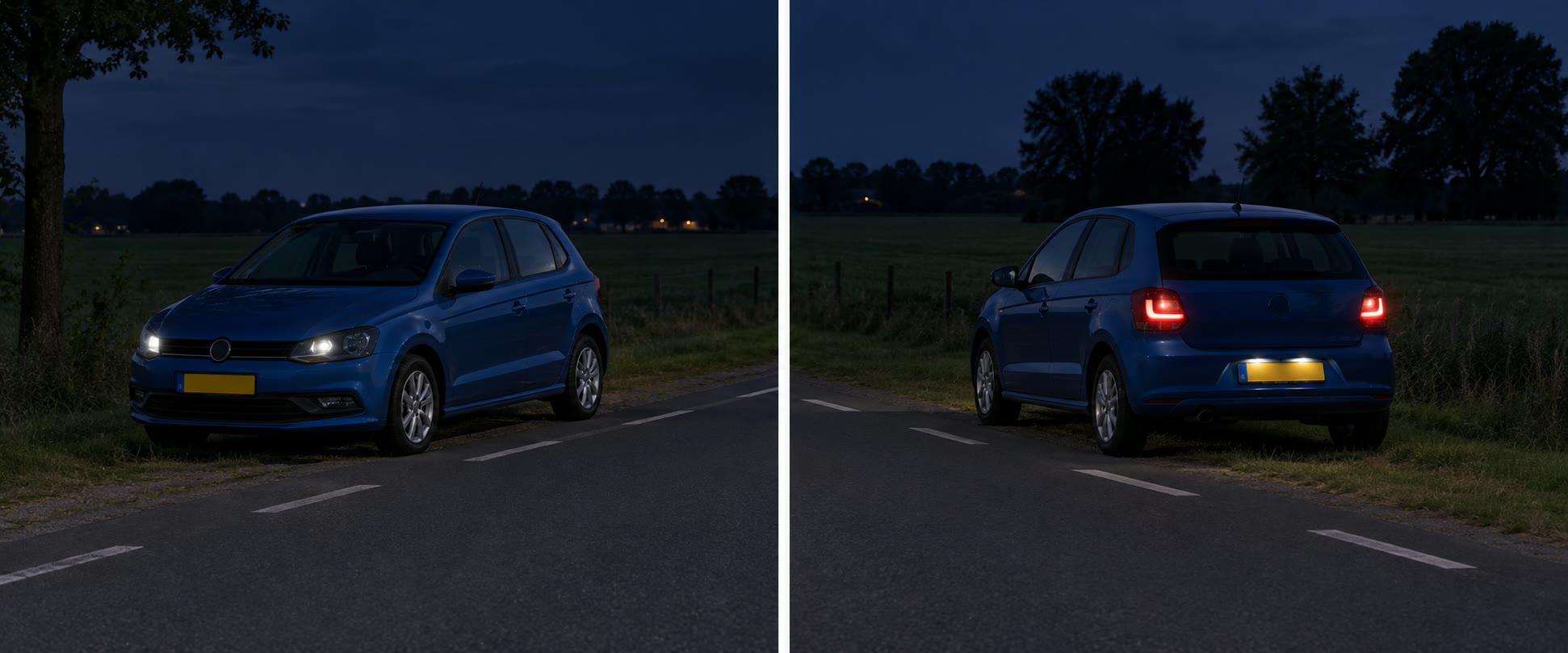
At night — and during the day when visibility is seriously reduced — a motor vehicle that is stationary outside a built-up area on the carriageway must show the prescribed front and rear parking/position lights. The same lighting obligation applies on parking strips, parking bays, emergency lanes and emergency bays along motorways and expressways.
Inside built-up areas, the specific stationary-lighting obligation above does not apply in the same way; always make sure the vehicle is safely and lawfully positioned and sufficiently visible.
§ 15 — Special Lights
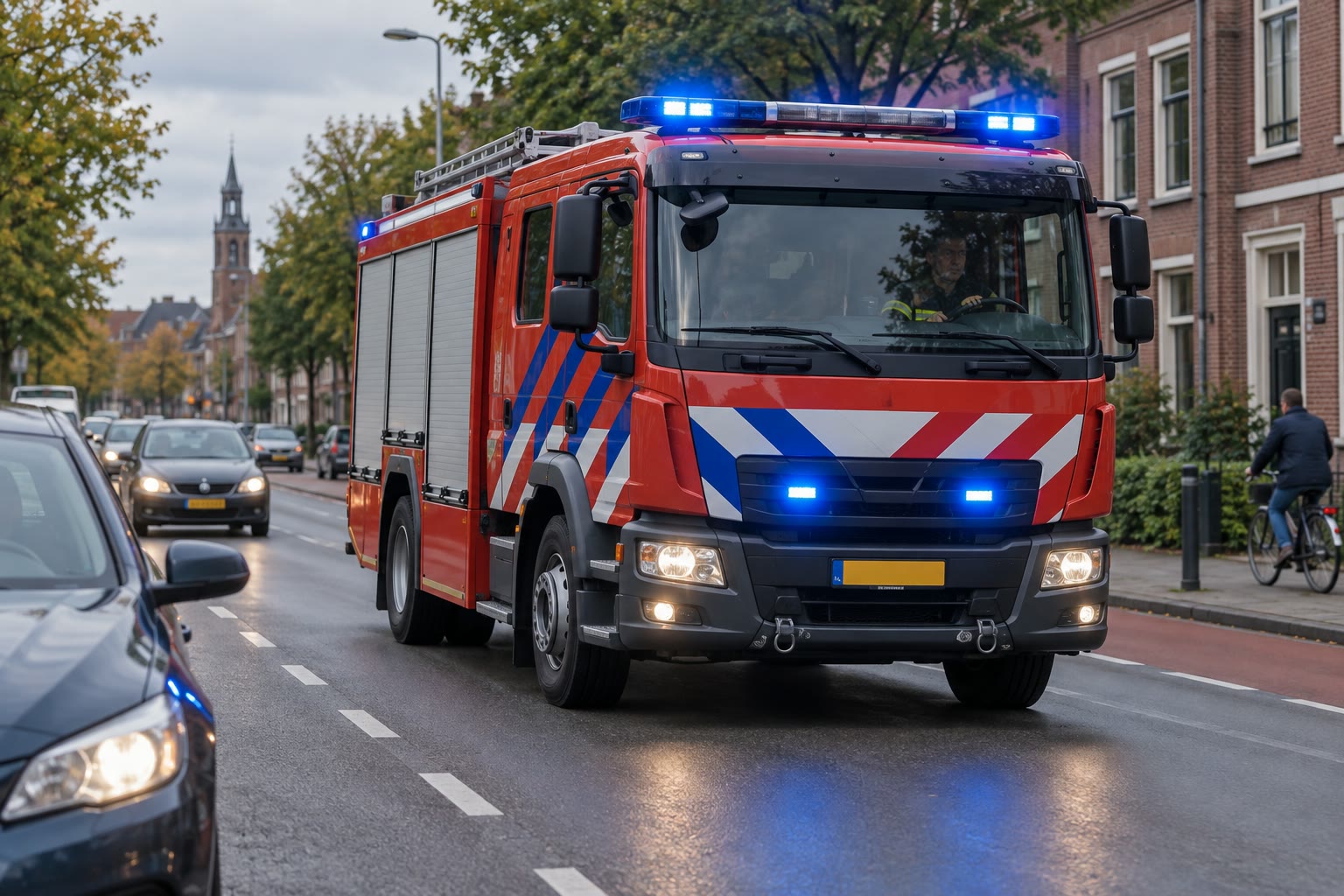
A blue flashing or rotating light may only be used by vehicles for which this is officially authorised — principally ambulances, fire trucks and police vehicles. It signals an emergency and, combined with a siren, creates a priority vehicle.
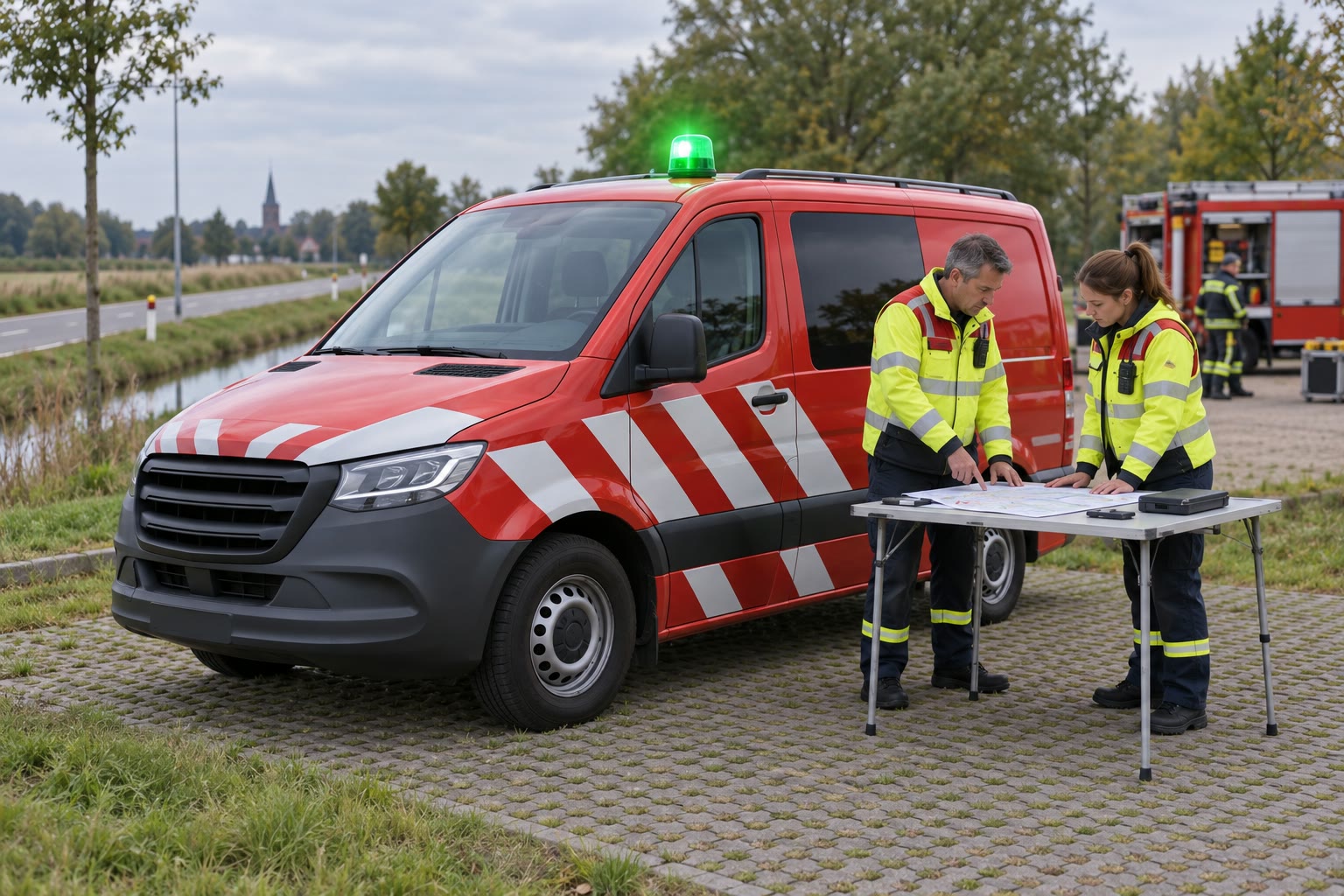
A green flashing light is reserved for the command vehicle associated with authorised police, fire-brigade or ambulance operations. It identifies a command function; it does not by itself make the vehicle a priority vehicle or create a right of way.
§ 16 — Motorways & Expressways
Special rules that apply only on autosnelwegen (motorways) and autowegen (expressways).
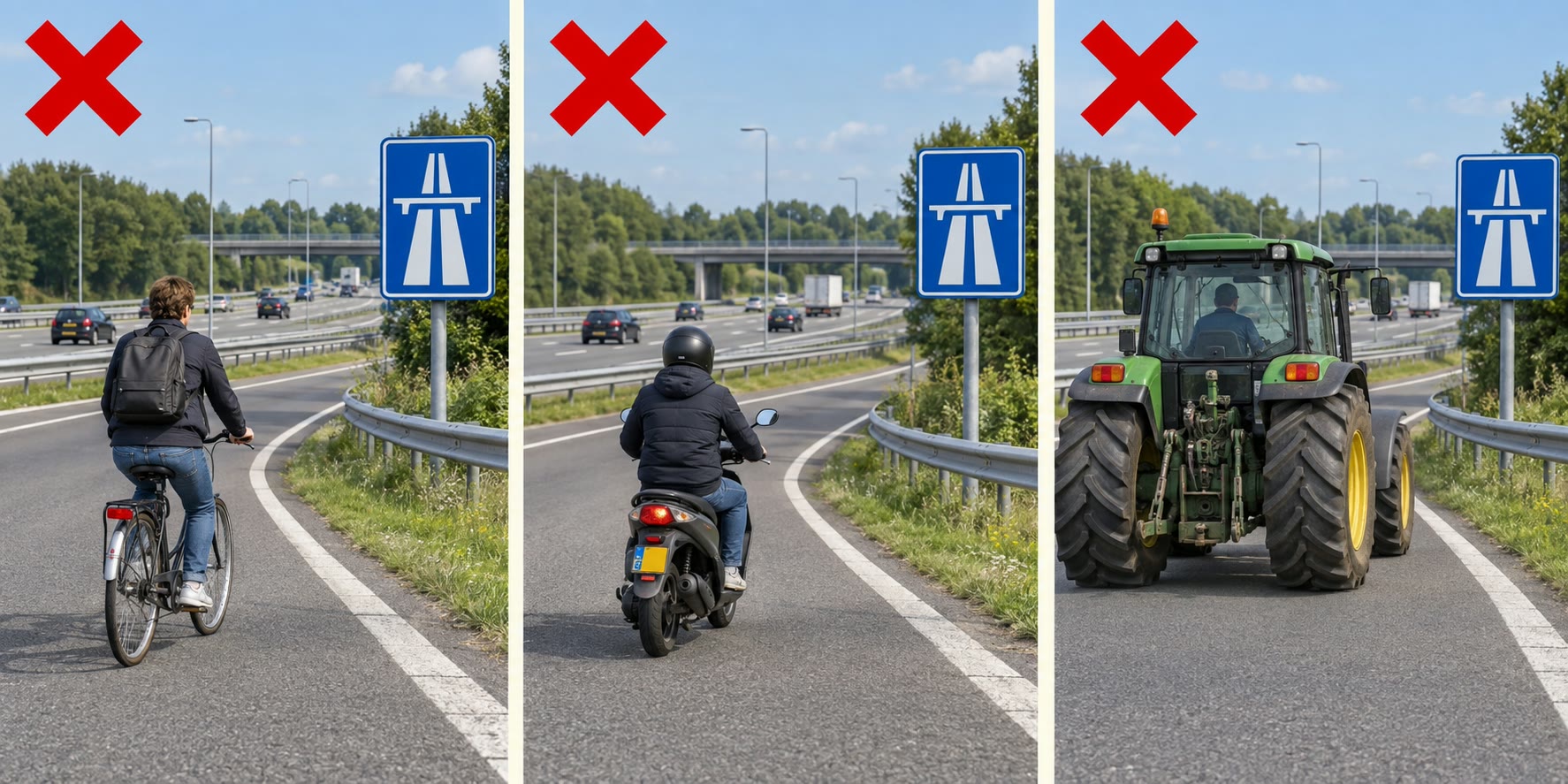
The following road users are prohibited from using a motorway:
- Pedestrians
- Cyclists
- Moped riders (both bromfiets and snorfiets)
- Disability vehicle drivers
- Horse riders and animal handlers
- Vehicles that, by construction, cannot or may not travel at least 60 km/h
- Agricultural vehicles and slow motor vehicles
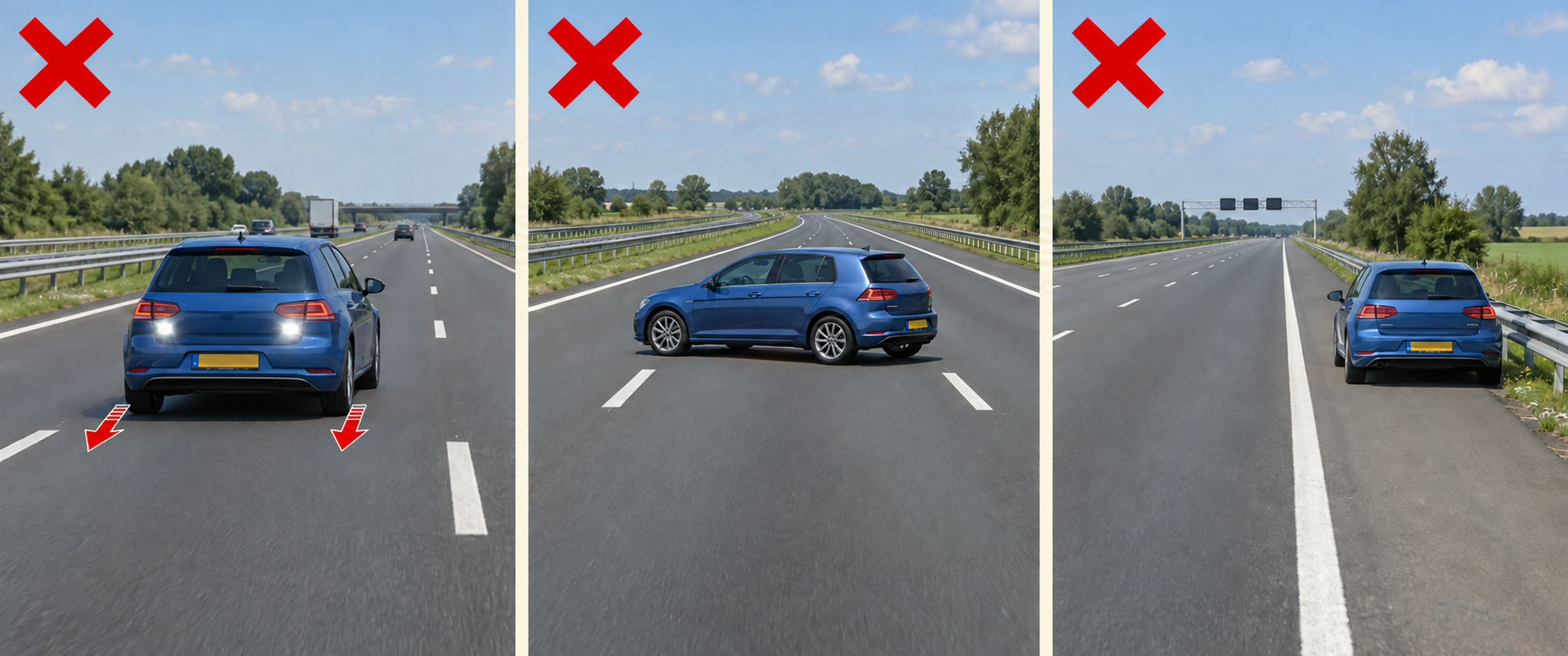
On a motorway, the following are prohibited:
- Stopping, turning around or reversing
- Crossing the central reservation
- Driving on the emergency shoulder — except in an emergency, or when it is officially opened as a rush-hour lane
- Driving on or over a diversion area (verdrijvingsvlak)
Entry and exit may only happen via the designated entry lanes (invoegstroken) and exit lanes (uitrijstroken).
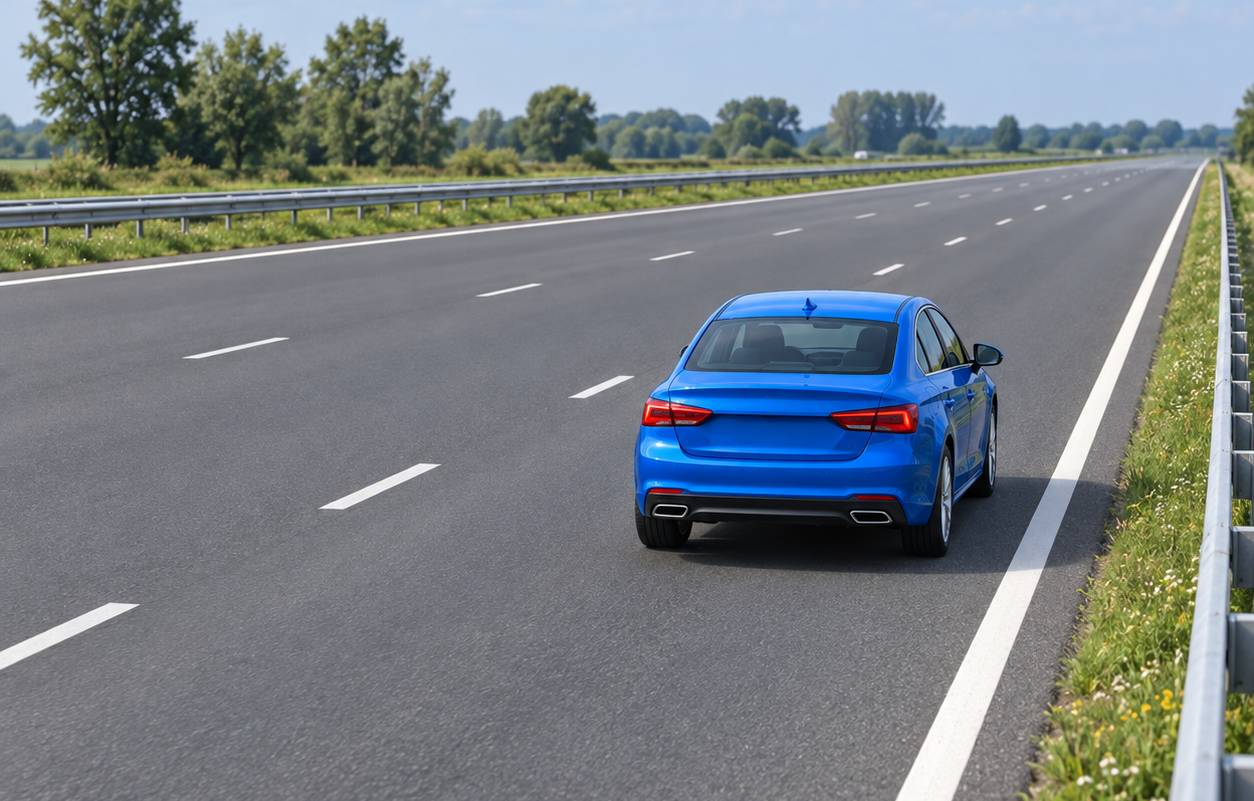
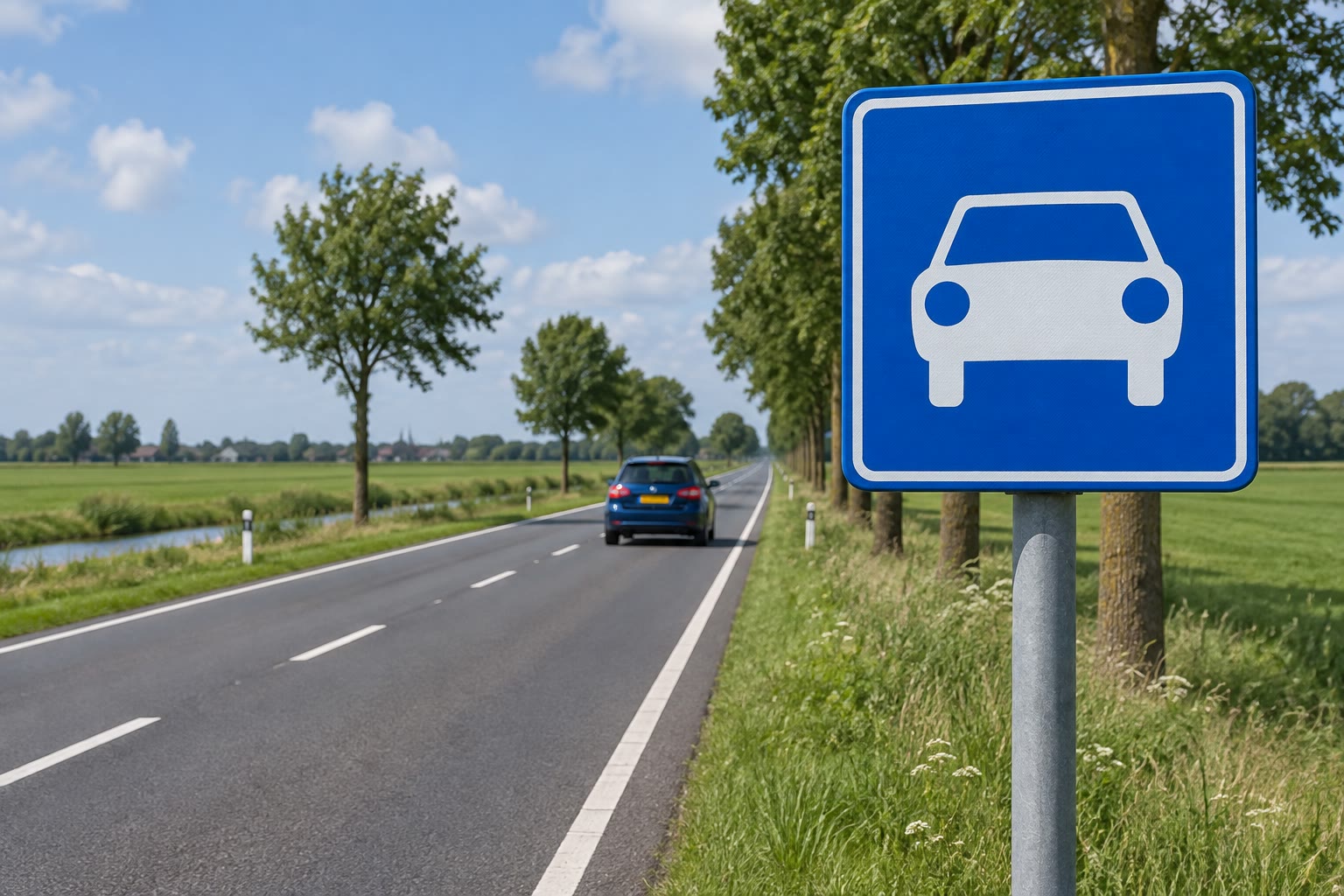
An autoweg (sign G3) is intended for motor vehicles that, by construction, can and may travel at least 50 km/h. It is not the same as a motorway and may have at-grade intersections or different access arrangements. Always follow the signs and markings that apply to the particular road.
During peak hours, the emergency shoulder on certain motorways is opened as an additional driving lane — the spitsstrook. Electronic signs above the road confirm whether it is open. When it is open, you may use it as a normal lane. When the signs show a red cross, the lane is closed and you must not drive on it.
§ 17 — Residential Zones (Erven)
Special rules for areas where pedestrians and vehicles share the same space.
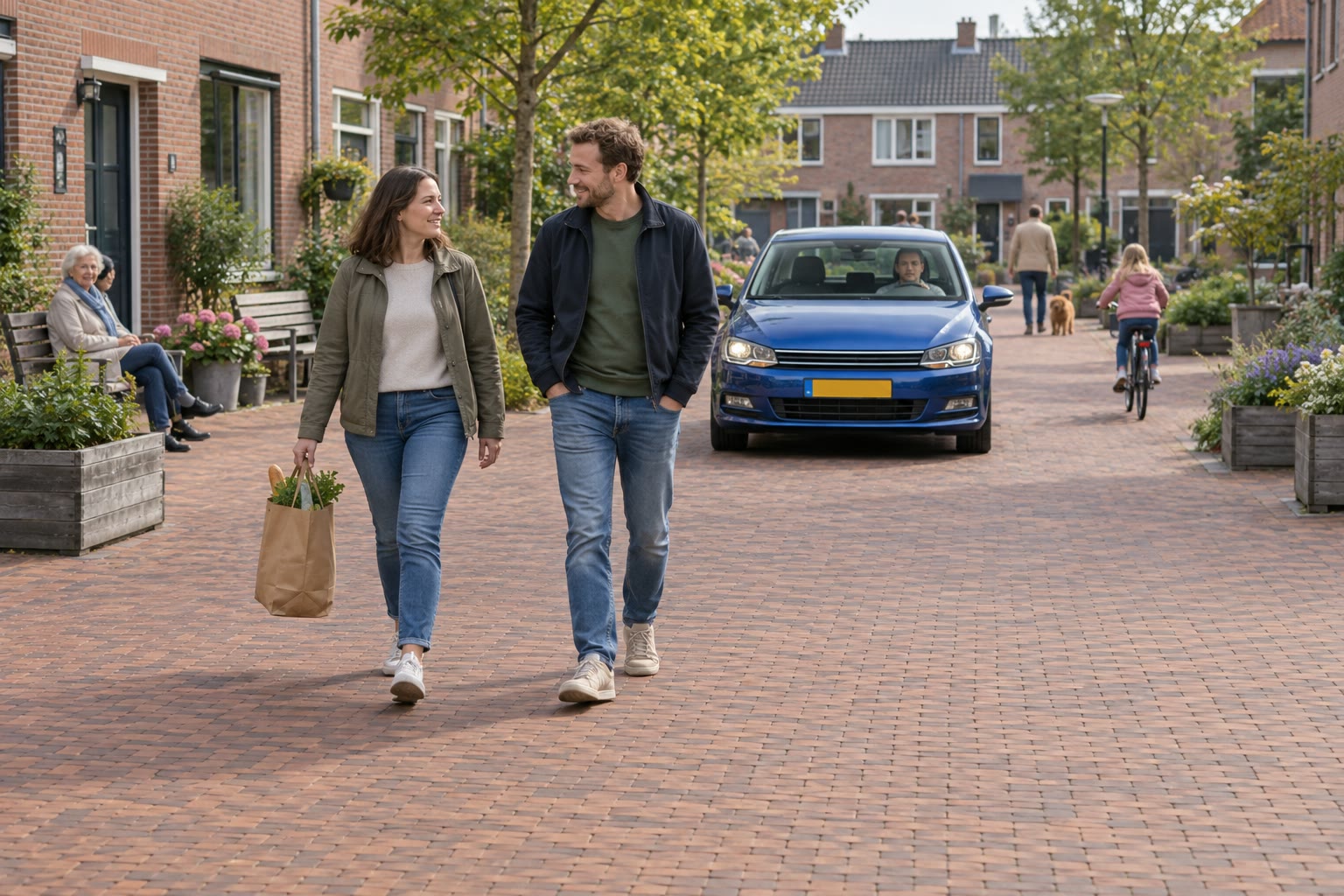
Inside an erf, drivers may not travel faster than 15 km/h. This is the statutory maximum speed. Because pedestrians may use the full width of the road, drivers must remain especially alert and be able to respond safely.
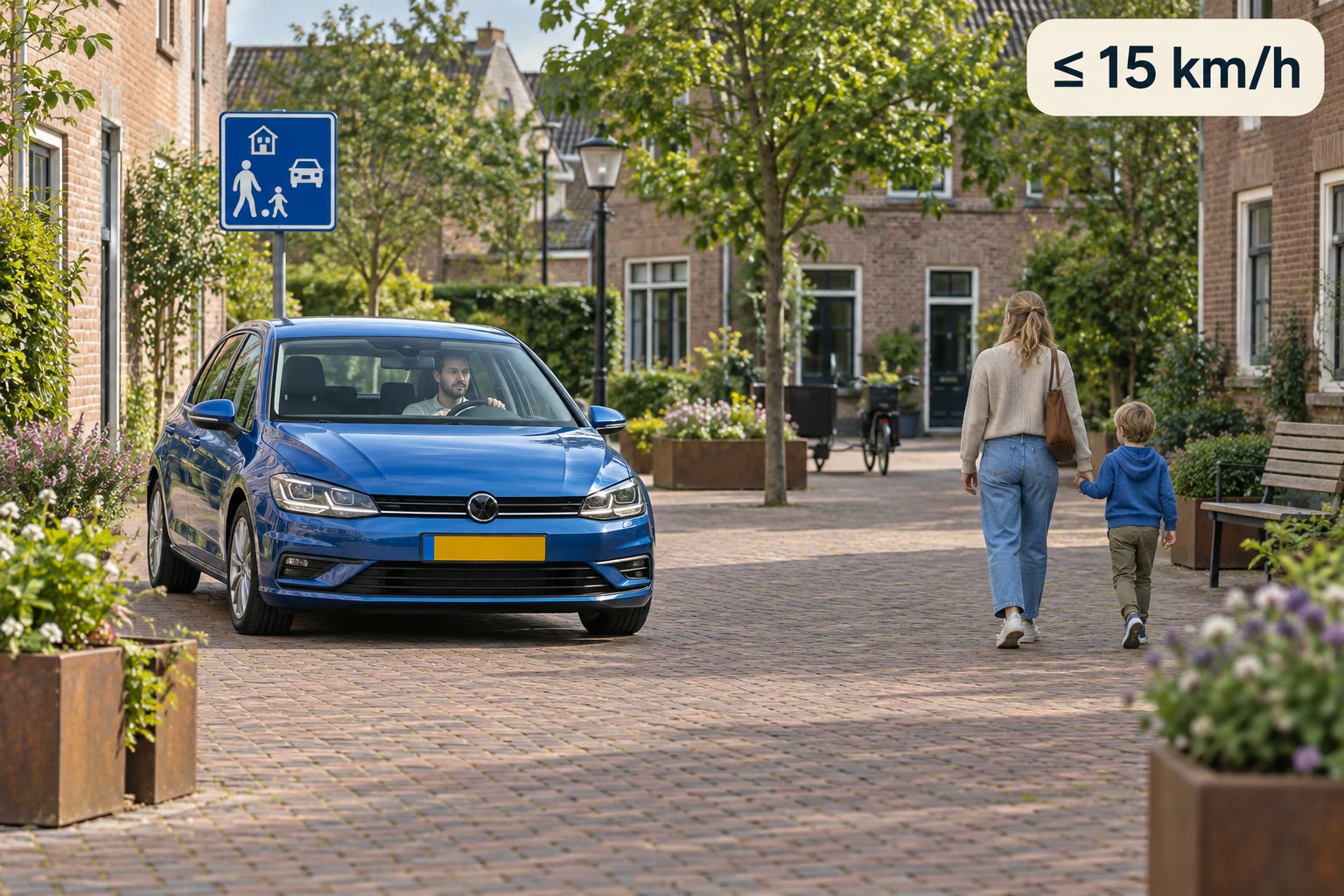
Inside an erf, pedestrians may use the full width of the road. This does not create a blanket rule that pedestrians automatically have right of way over every driver; the normal priority and manoeuvre rules still matter. Drivers must nevertheless adapt their behaviour to the shared-space character of the erf and avoid creating danger.
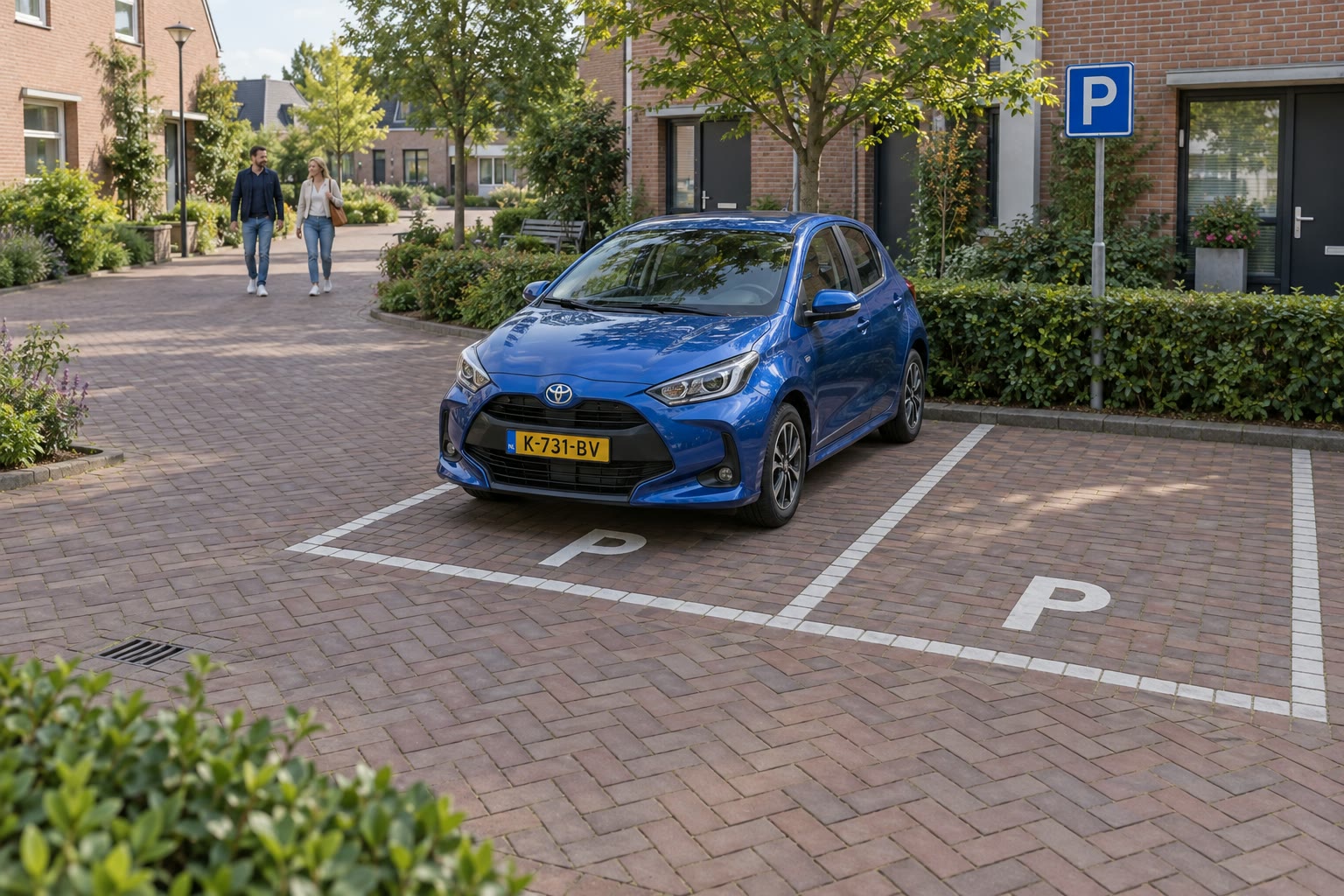
Parking inside an erf is only permitted in designated marked parking spaces. You may not park on any other part of the erf — not on the road surface, not on the shared walking area.
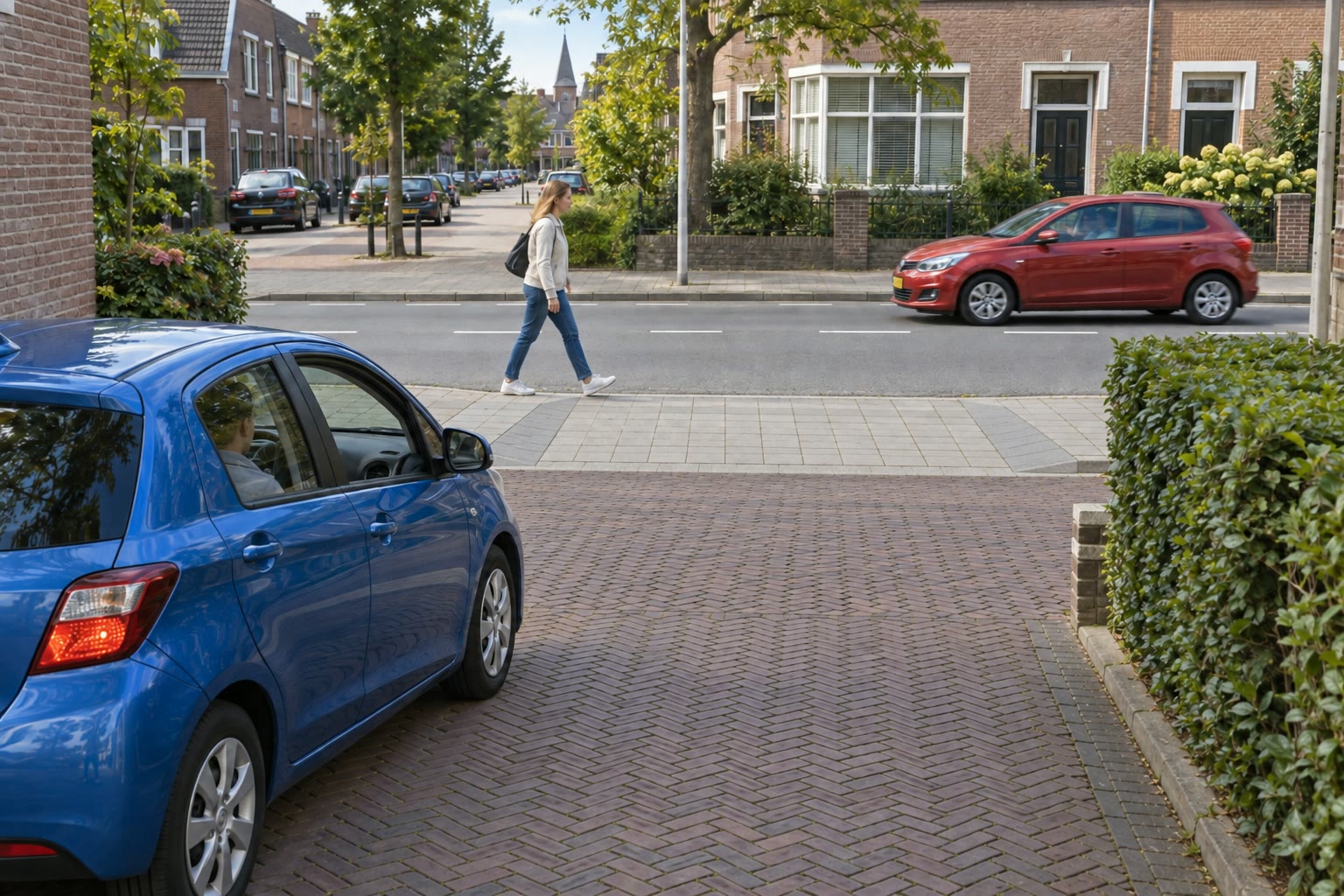
When leaving a residential zone (erf) onto a normal road, drivers must give way to all traffic on that road — both from the left and from the right.
The erf zone begins at a white sign showing a house and a pedestrian figure. The zone ends at the same sign with a diagonal red line through it. Inside the zone, all the special rules above apply.
§ 18 — Roundabouts
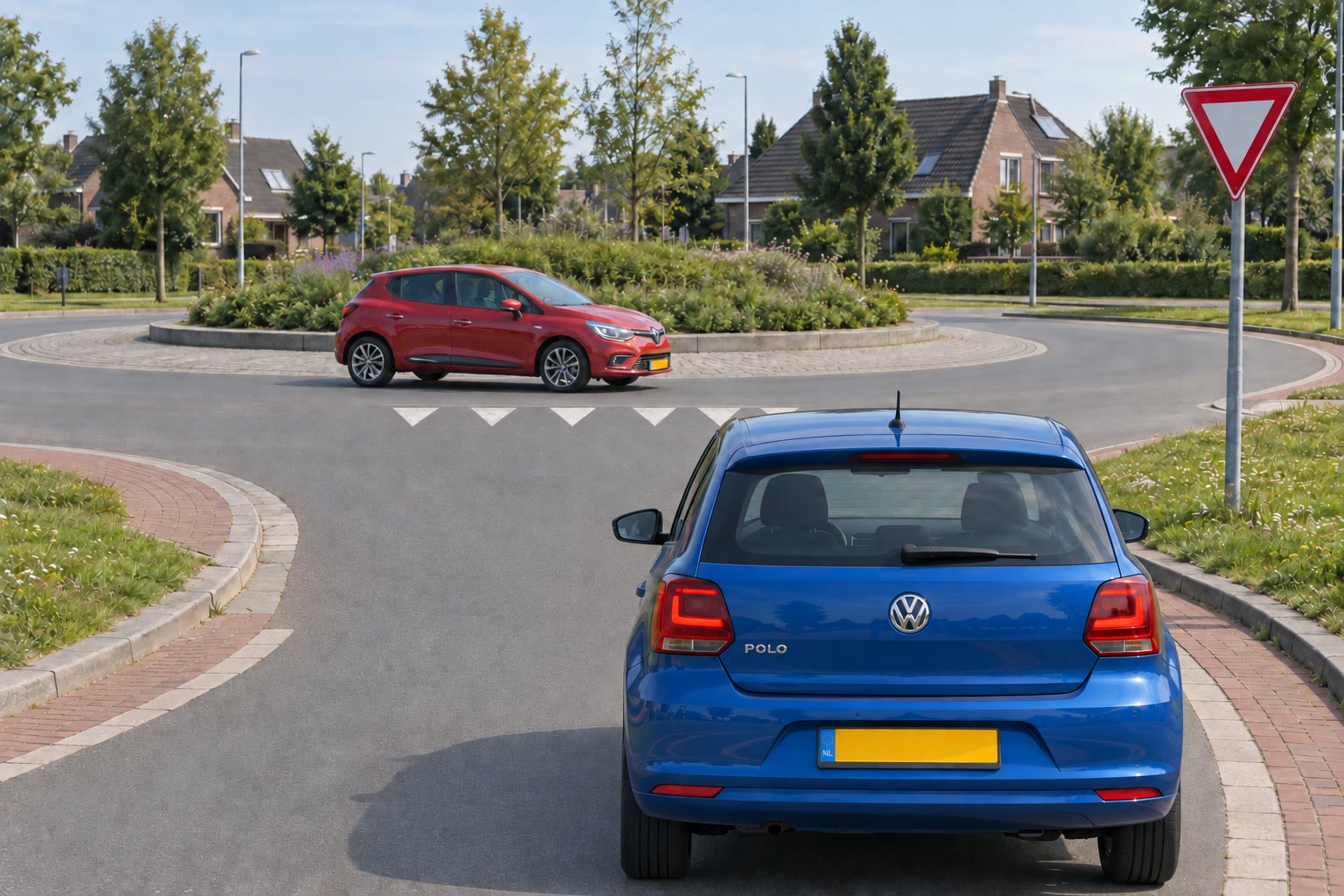
Priority at a roundabout is determined by the signs and road markings. On most Dutch roundabouts, give-way signs and shark's teeth require entering drivers to give way to traffic already on the roundabout. If no priority signs or markings regulate the roundabout, the ordinary rule of giving way to drivers approaching from the right applies; in that situation, traffic entering from the right can have priority.
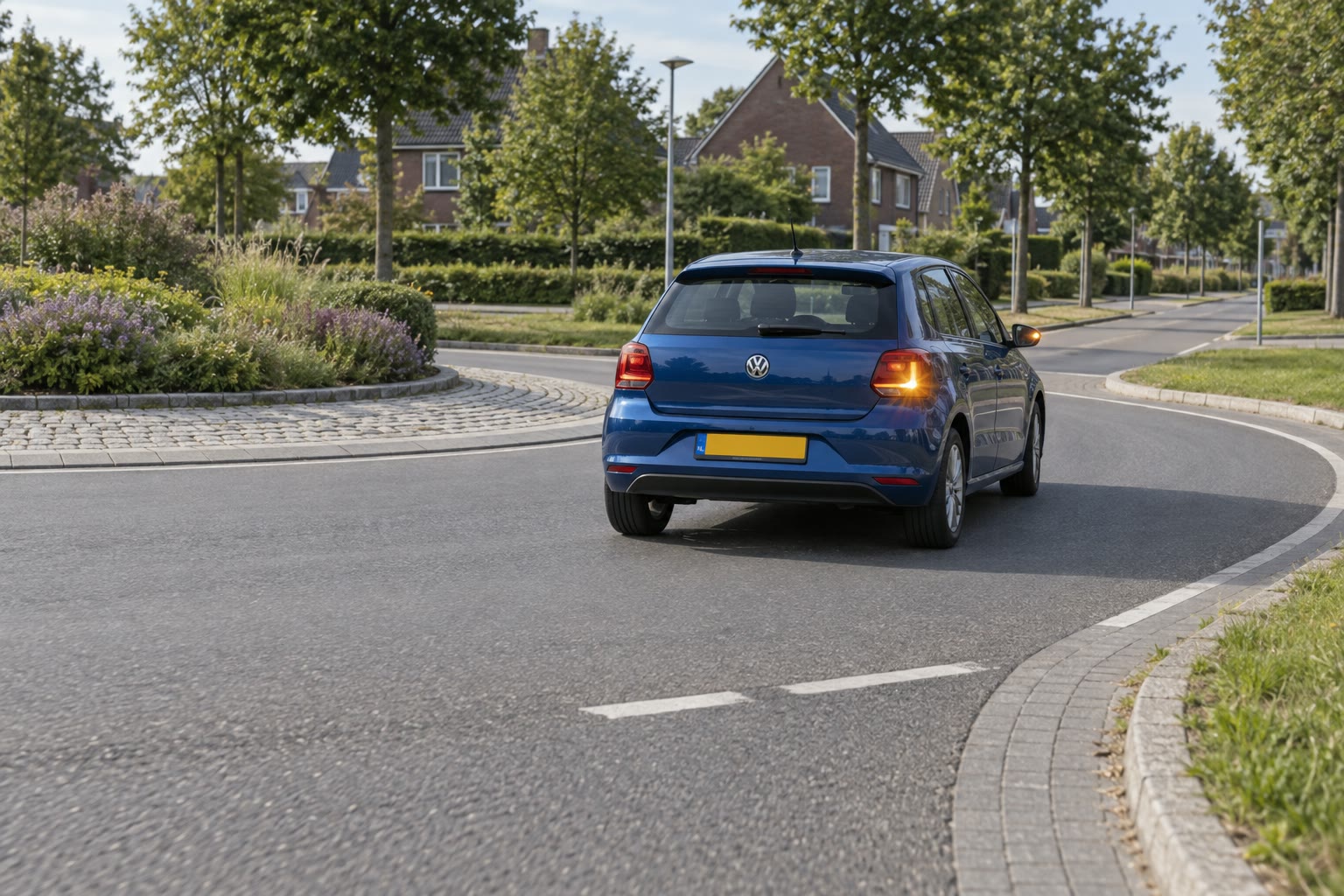
When leaving a roundabout, signal right before your exit. You do not need to signal when entering or when passing exits you are not taking. The key moment to signal is just before you exit, so drivers waiting to enter know you are leaving.
§ 19 — Pedestrians
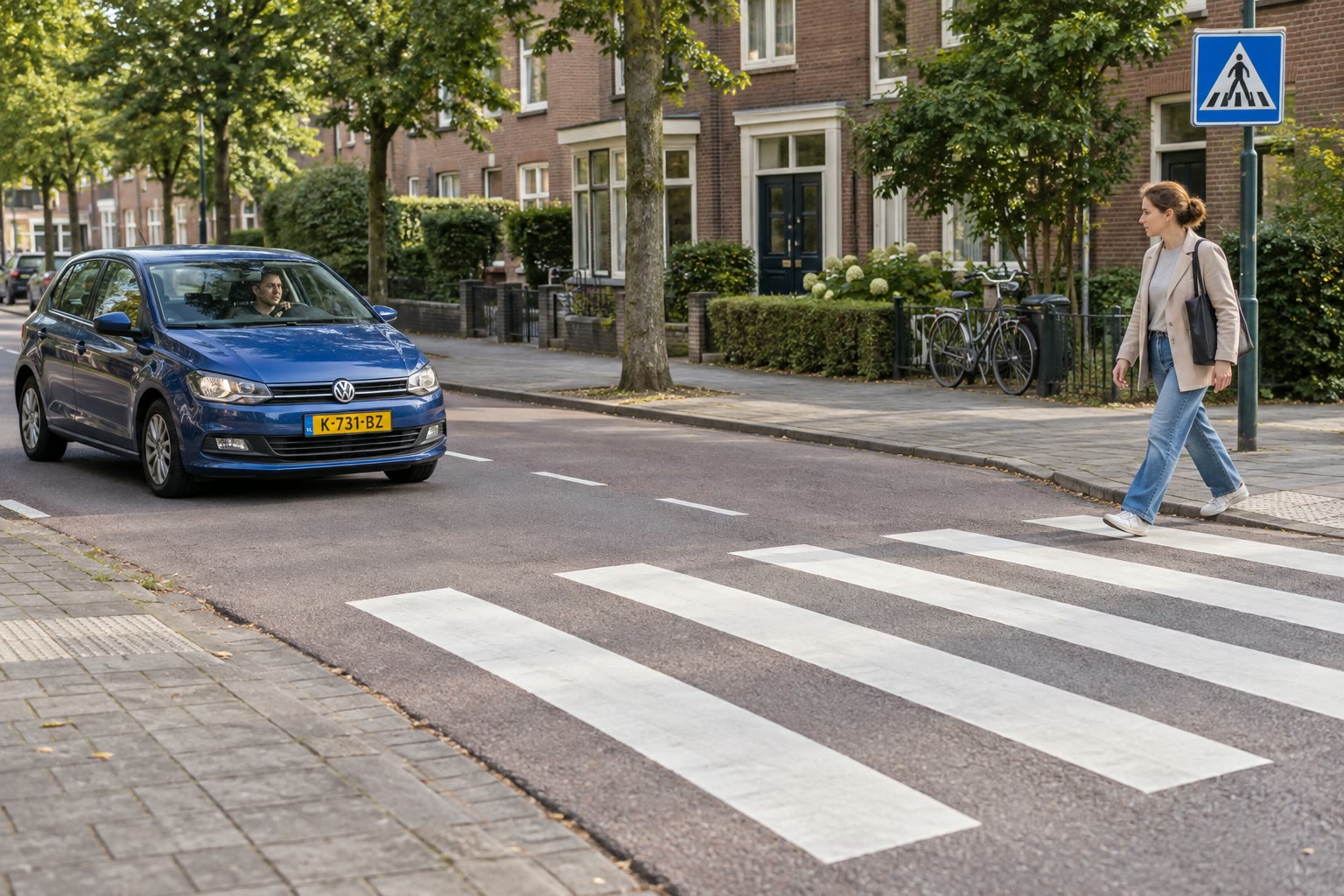
Drivers must give way to pedestrians who are on a pedestrian crossing or who are clearly about to step onto one. This applies to all zebra crossings. A pedestrian who has stepped onto the crossing, or who is standing at the edge clearly waiting to cross, has priority.
Cyclists also have priority at crossings marked with both zebra stripes and bicycle symbols (combined crossing).
§ 20 — Priority Vehicles
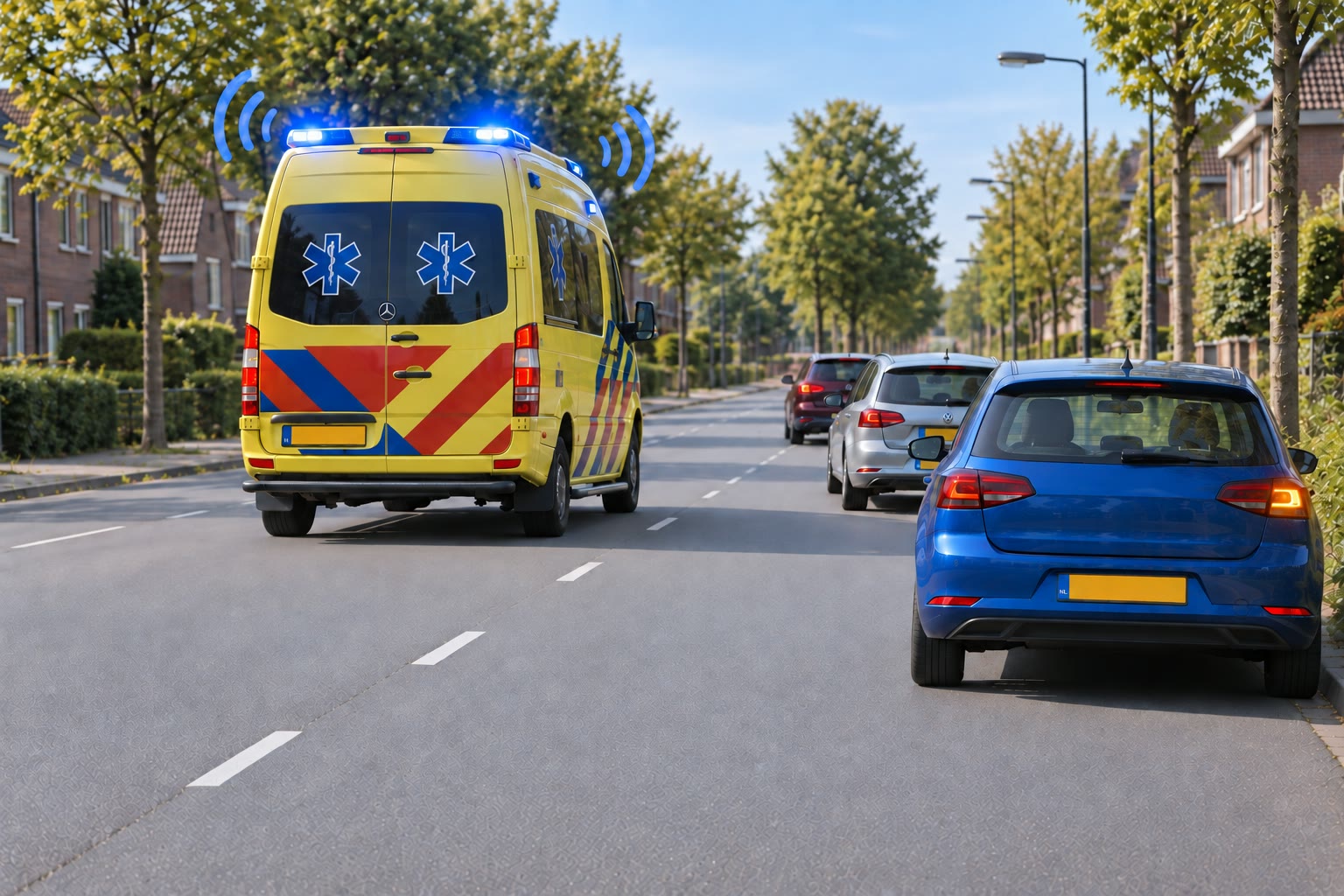
When a priority vehicle — one displaying both a blue flashing light and a siren — approaches, all other road users must give way immediately. This means:
- Move to the side as quickly as safely possible
- Stop if necessary
- Do not block the path of the priority vehicle
- This applies even if it means briefly stopping on a yellow line or in another location where stopping is normally prohibited
§ 21 — Loose Animals on the Road
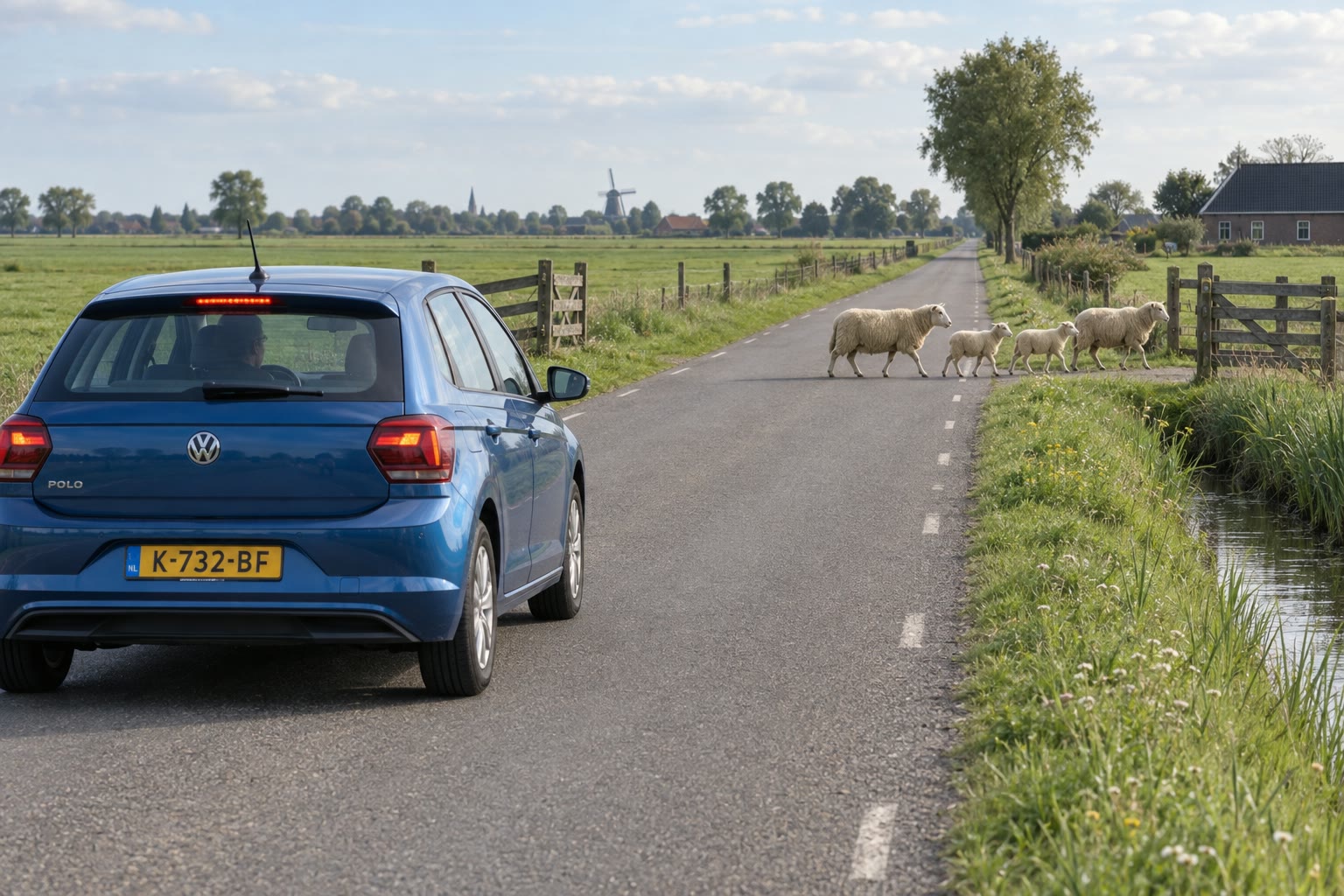
When encountering loose animals on or near the road — livestock, horses, dogs — all road users must slow down and take precautions. Animals are unpredictable; sudden movements are common. Pass slowly and give as much space as possible. Do not use the horn near animals as this can startle them further.
§ 22 — Boarding & Alighting Passengers
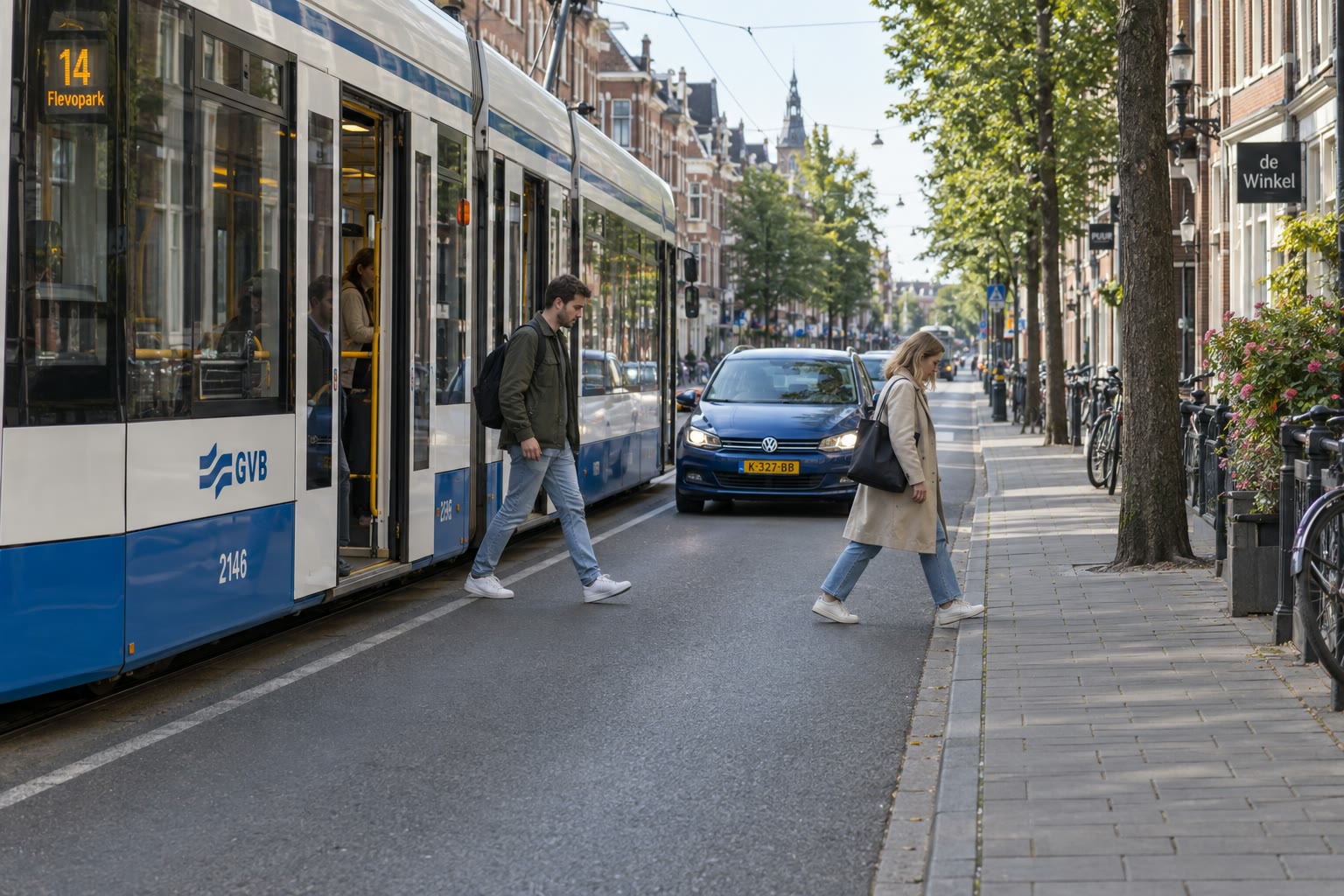
When a tram or bus is stopped and passengers are boarding or alighting, other road users must give way to those passengers. Passengers stepping off a tram or bus and crossing the road have priority — even if they are not at a formal pedestrian crossing.
§ 23 — Towing a Vehicle
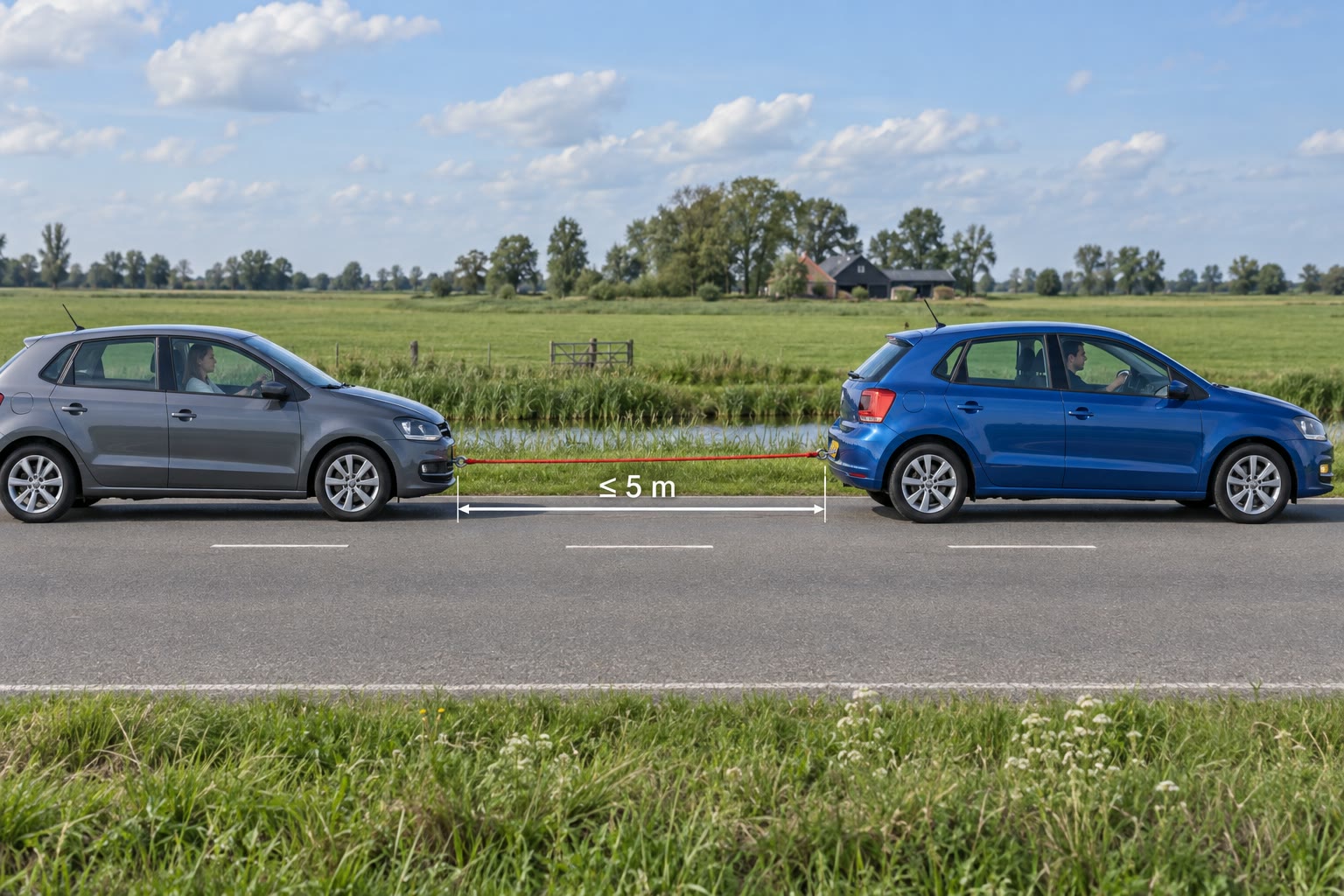
When one motor vehicle tows another, the distance from the rear of the towing vehicle to the front of the towed vehicle may be no more than 5 metres. The towing arrangement must be safe and the towed vehicle must remain controllable.
The RVV provision on towing does not set a general 25 km/h towing limit. Do not memorise 25 km/h as a universal Dutch towing rule. On motorways and expressways, the separate access and safety rules must also be respected; an unsafe or unsuitable towing situation should be handled by professional recovery services.
§ 24 — Special Manoeuvres
Reversing, turning around, and other manoeuvres that require extra care.
Before performing any special manoeuvre — reversing, turning around (U-turn), moving from a parking space, pulling away from the kerb, changing lanes — the driver must first give way to all other traffic. No special manoeuvre may be started if it would force another road user to change speed or direction.
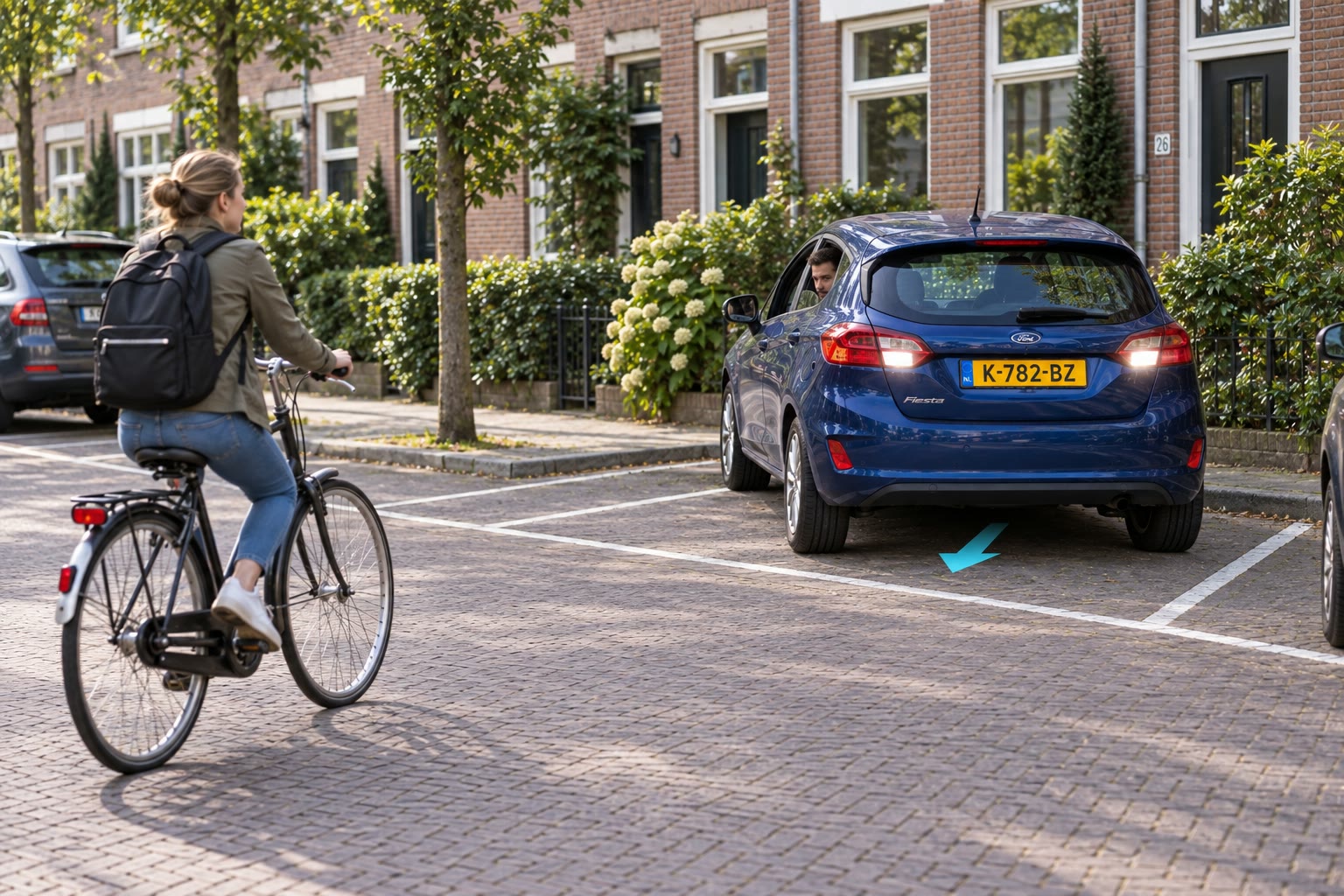
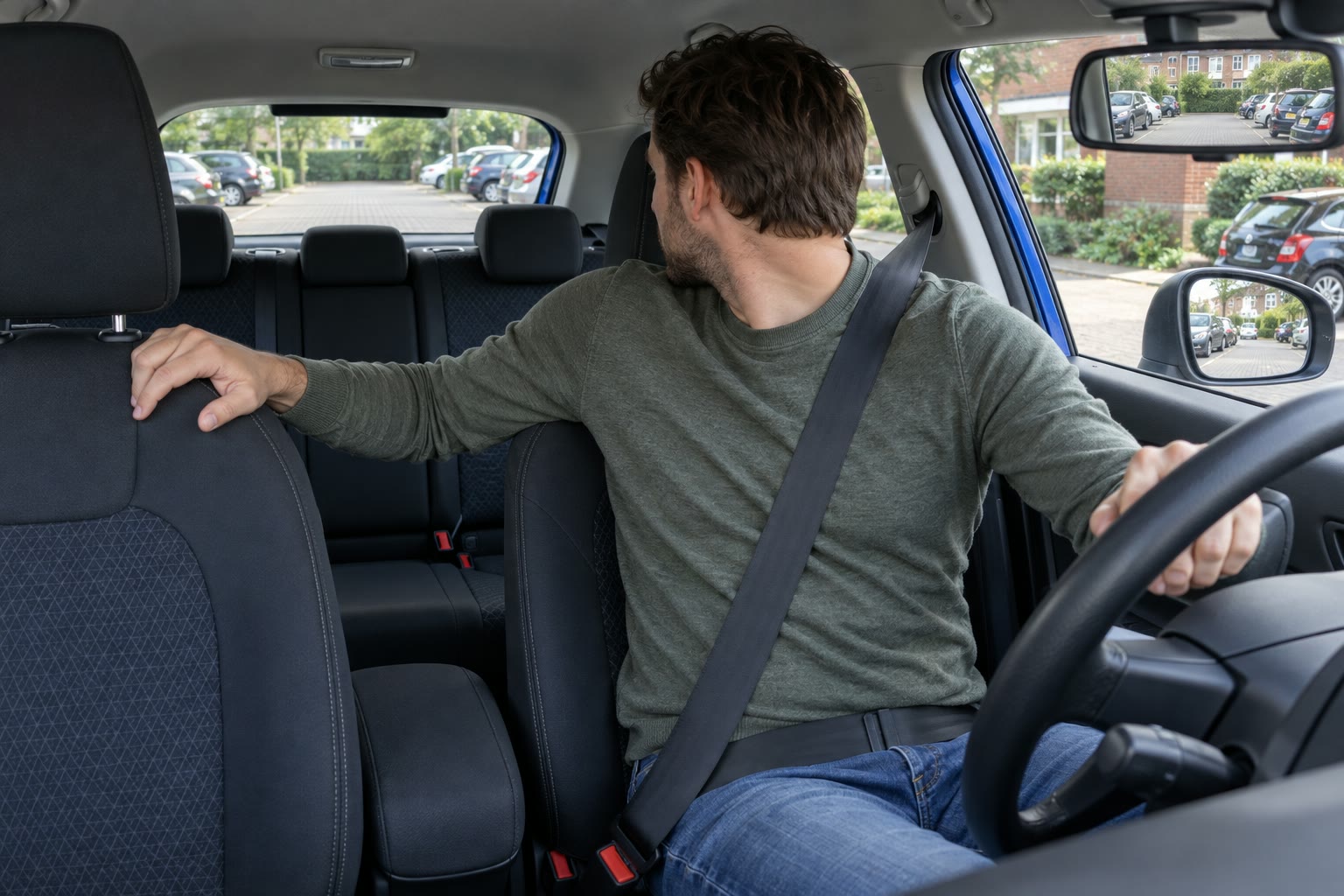
Reversing is only permitted when it can be done safely and without hindering other road users. You must check behind you — use mirrors and look over your shoulder. Reversing at speed or over a long distance on a public road is generally not permitted.
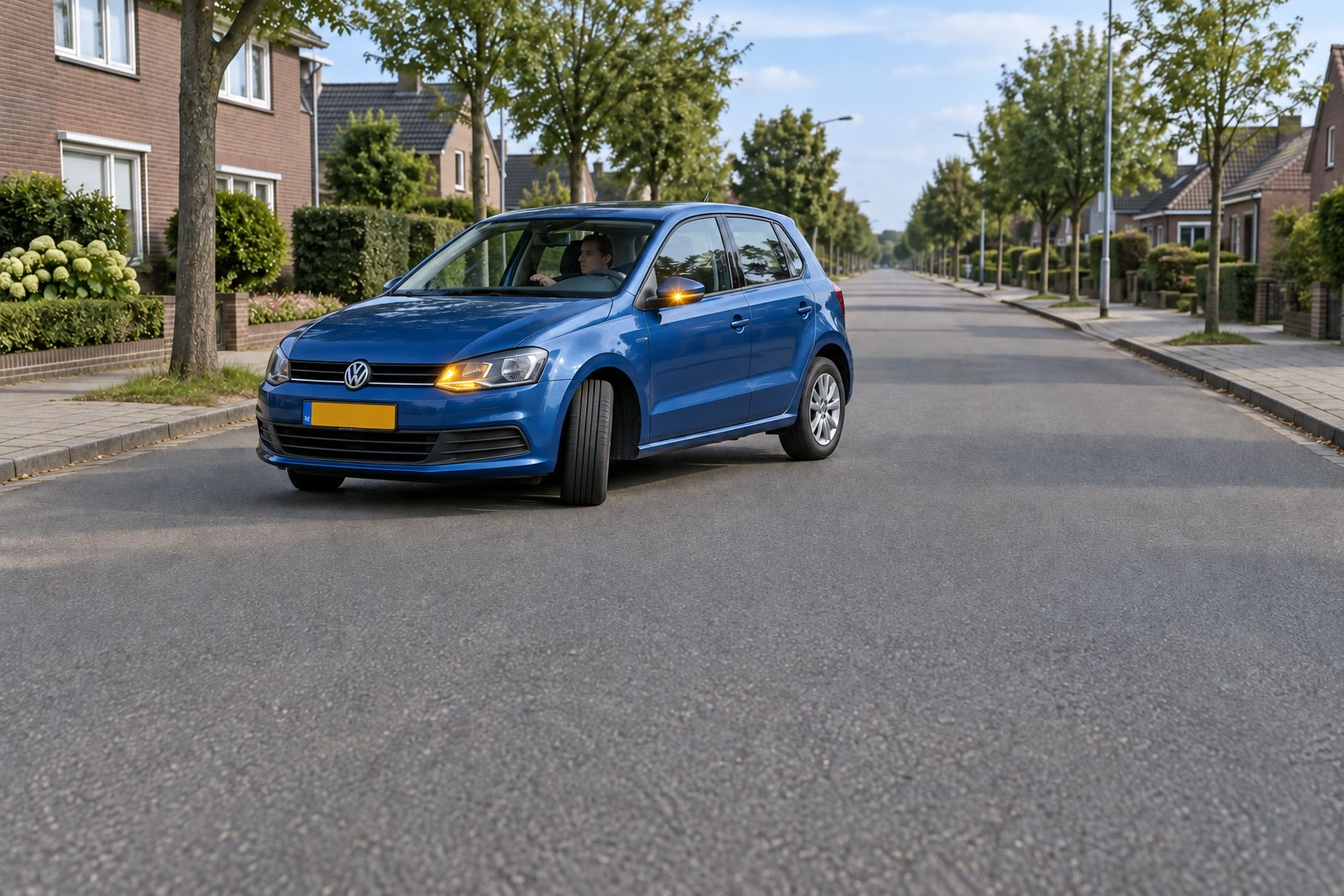
A U-turn (keermanoeuvre) is only permitted when it can be completed safely, without obstructing other road users, and without endangering anyone. It is prohibited on motorways and expressways. It may also be prohibited by specific road signs.
§ 25 — Unnecessary Noise
It is prohibited to make unnecessary noise with a vehicle. This includes unnecessary revving of the engine, repeated horn use for non-safety reasons, and unnecessarily loud exhaust systems. The horn exists solely as a safety warning device — not as a communication tool or expression of frustration.
§ 26 — Warning Triangle
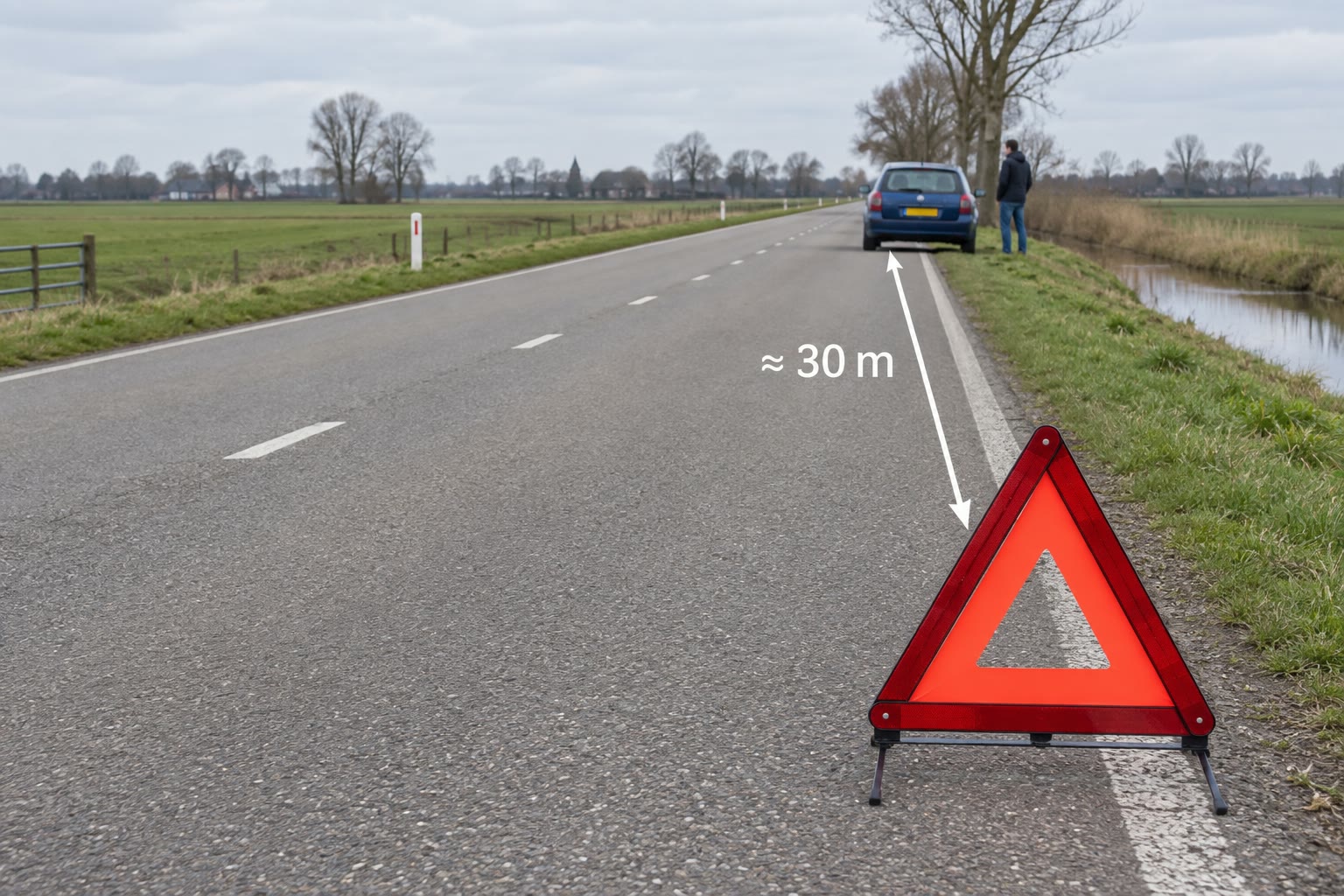
A warning triangle is not mandatory equipment to carry in a car in the Netherlands. If a stationary motor vehicle with more than two wheels, or a trailer, forms an obstacle that approaching drivers may not notice in time, those drivers must be warned. This can be done with the vehicle's hazard warning lights or with a warning triangle. If the hazard warning lights are operating, a triangle is not required. When a triangle is used, place it about 30 metres from the vehicle in the direction from which traffic approaches.
§ 26a — Seating
Passengers may only occupy designated seats in or on a vehicle. Standing in a moving vehicle, sitting in the boot, or occupying a position not designed for passengers is prohibited unless the vehicle is specifically designed for that purpose (e.g. certain buses).
§ 27 — Seatbelts & Child Restraints
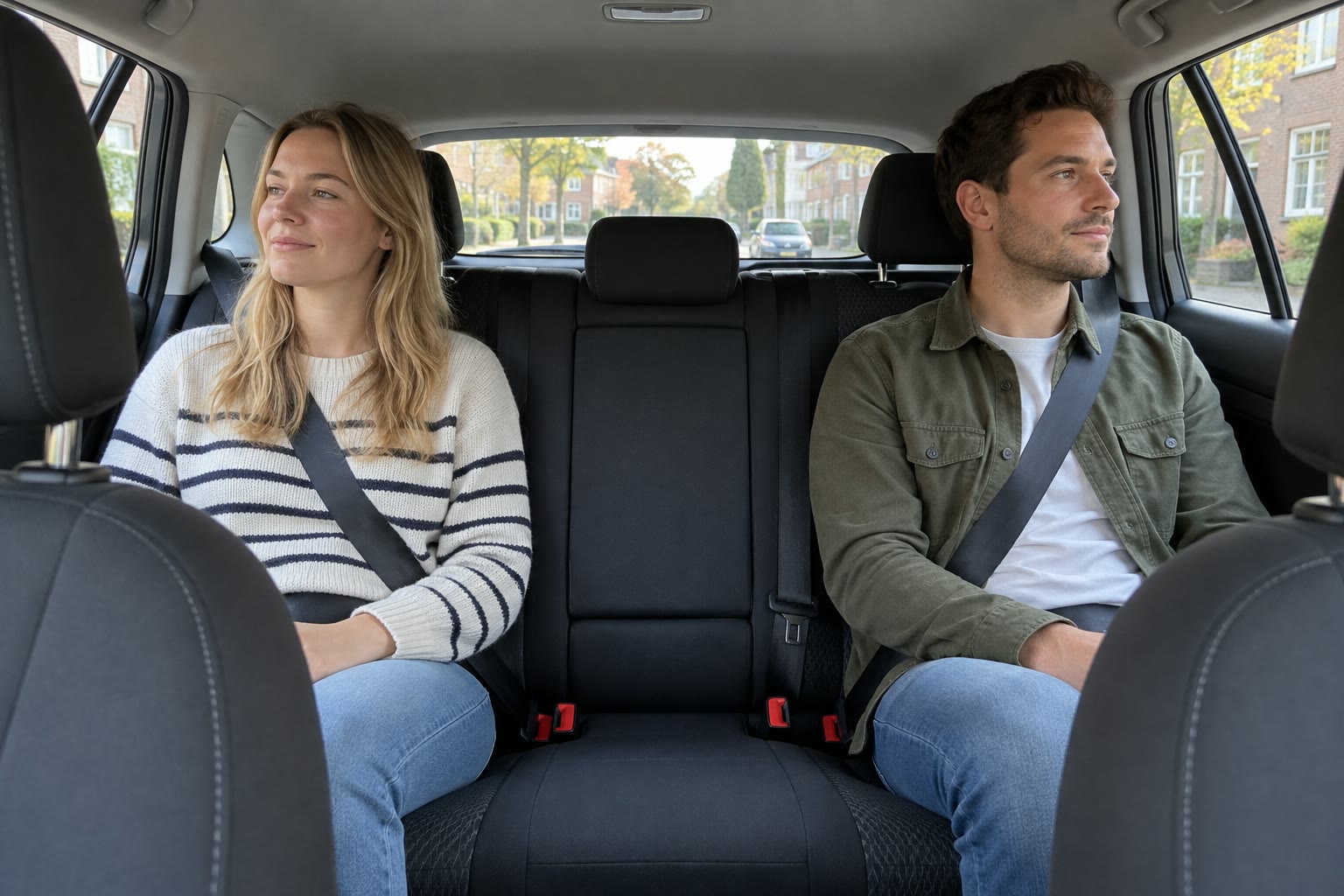
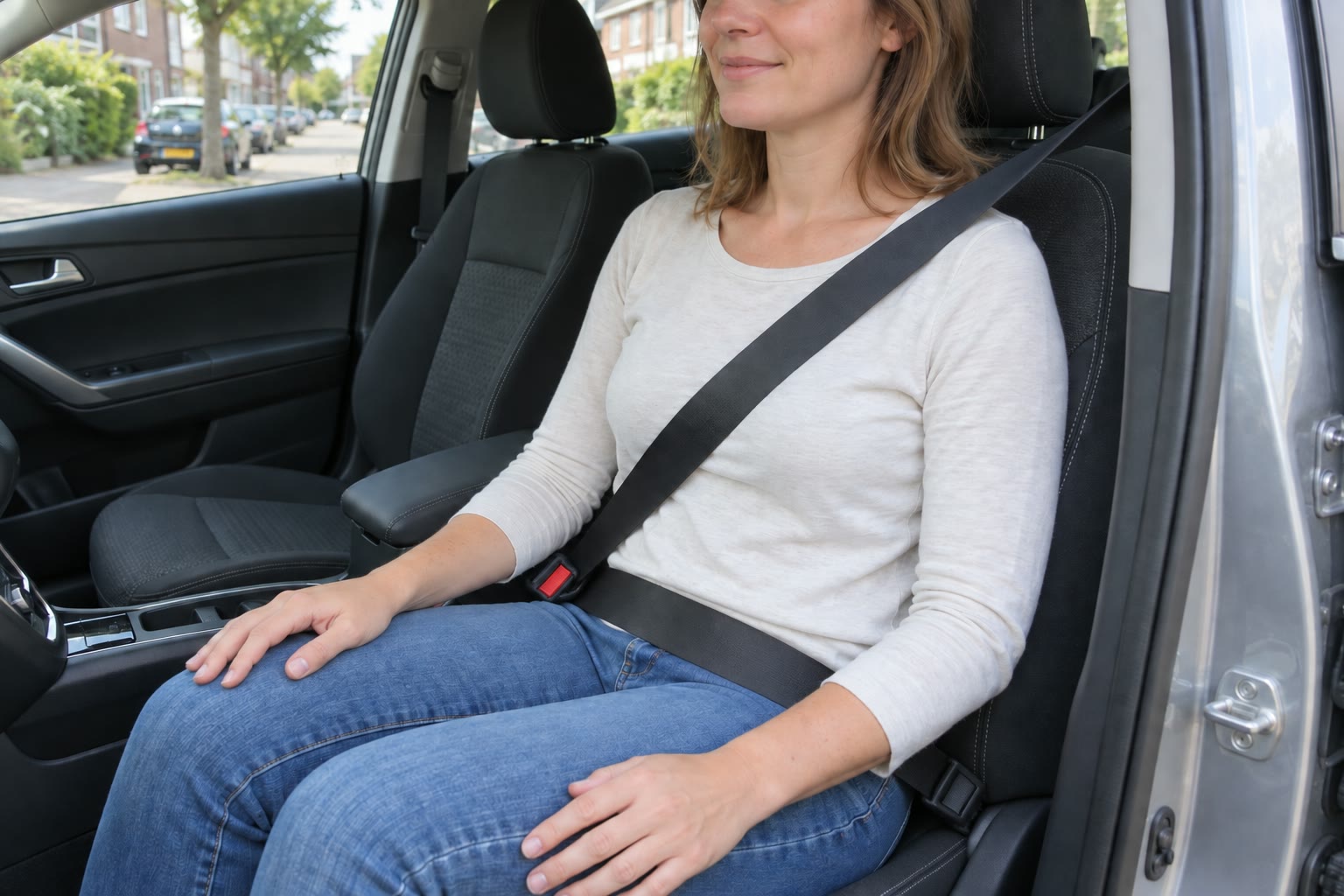
All occupants of a motor vehicle must wear a seatbelt while the vehicle is moving. The driver is responsible for ensuring that passengers under 18 are properly restrained. The seatbelt must be worn correctly — across the shoulder and chest, not tucked under the arm.
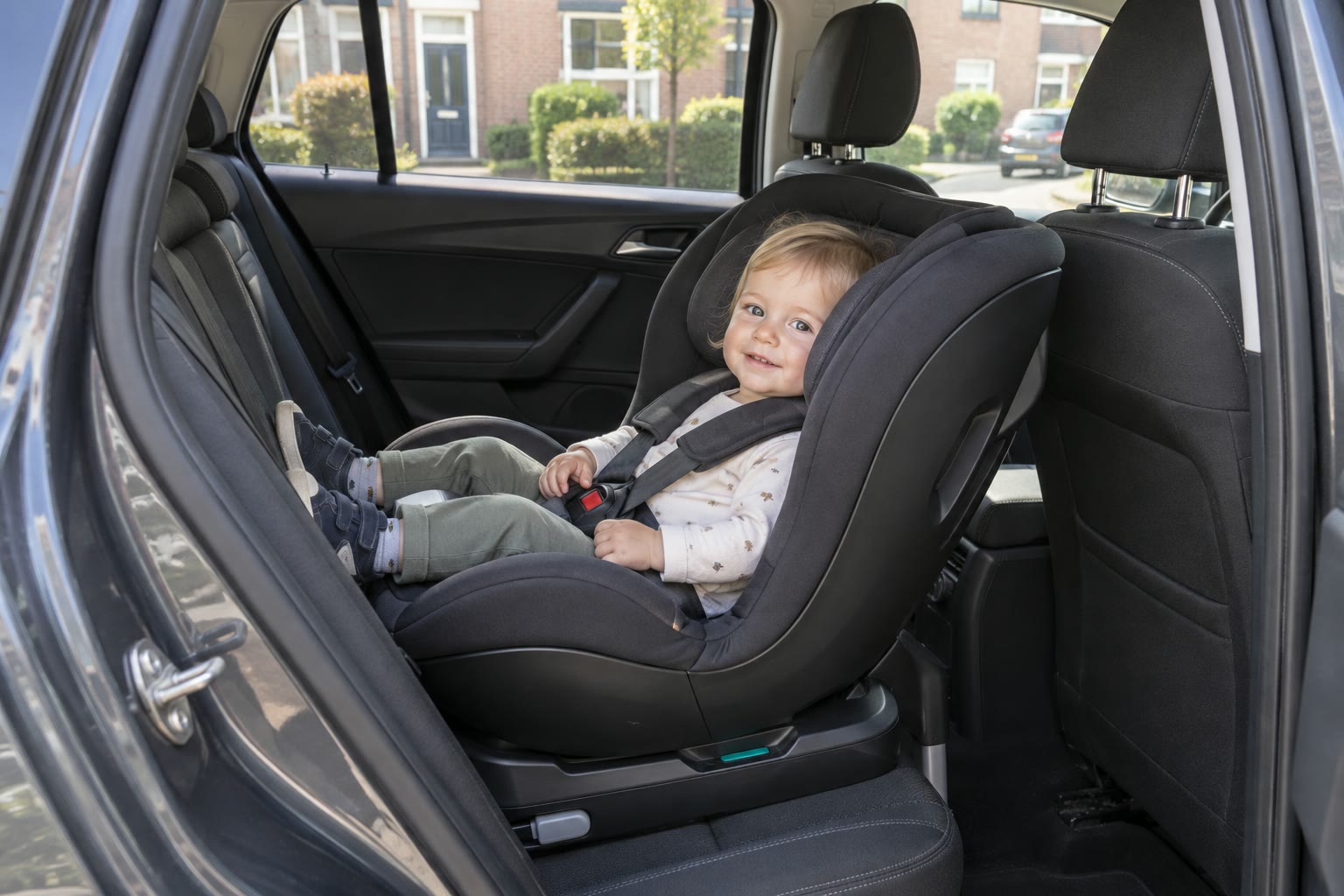
Children under 1.35 metres tall must generally use an approved child restraint system suitable for the child and fitted correctly. Children may be carried in an approved child seat in the front or rear. A rear-facing child seat may only be used on a seat with a front airbag if that airbag has been deactivated.
Certain occupants are exempt from the seatbelt requirement — for example, people with a medical certificate confirming they cannot wear a seatbelt, drivers reversing, and some professional categories. Exemptions are listed on a special card which must be carried in the vehicle.
§ 28 — Helmets
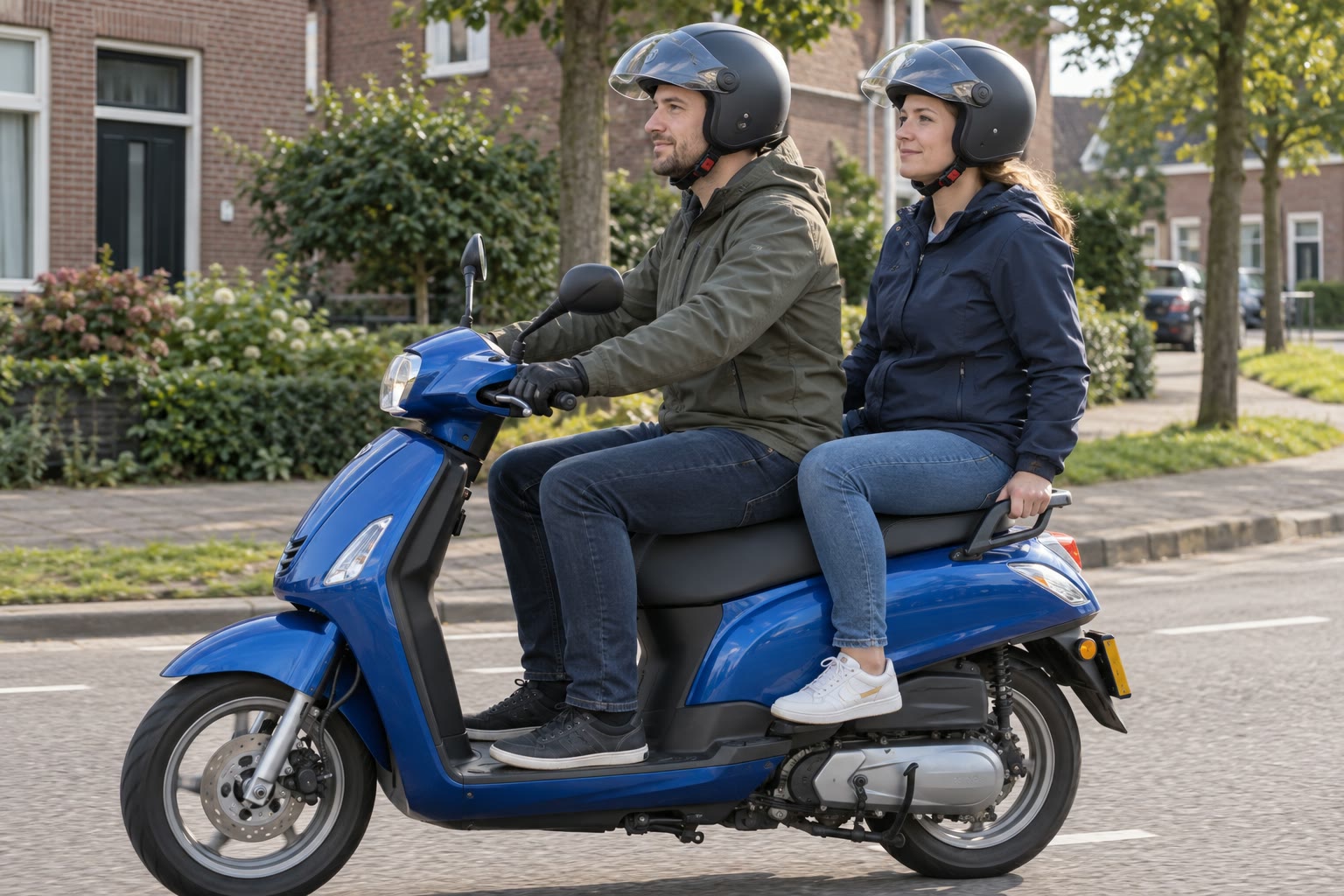
The driver and any passenger of a motorcycle or moped (bromfiets) must wear an approved helmet that is properly fastened while the vehicle is moving. The helmet must meet the required safety standard.
Snorfiets riders and their passengers must also wear an approved helmet. A snorfiets rider may use an approved moped helmet or an approved speed-pedelec helmet. Speed-pedelec riders and passengers are likewise subject to an approved-helmet requirement.
Vehicle-specific exemptions can exist where the law expressly provides for them, for example for certain vehicles equipped with an approved safety cell. Do not treat a safety cell as a general personal exemption from the helmet rules.
§ 29 — Children on Bicycles & Mopeds
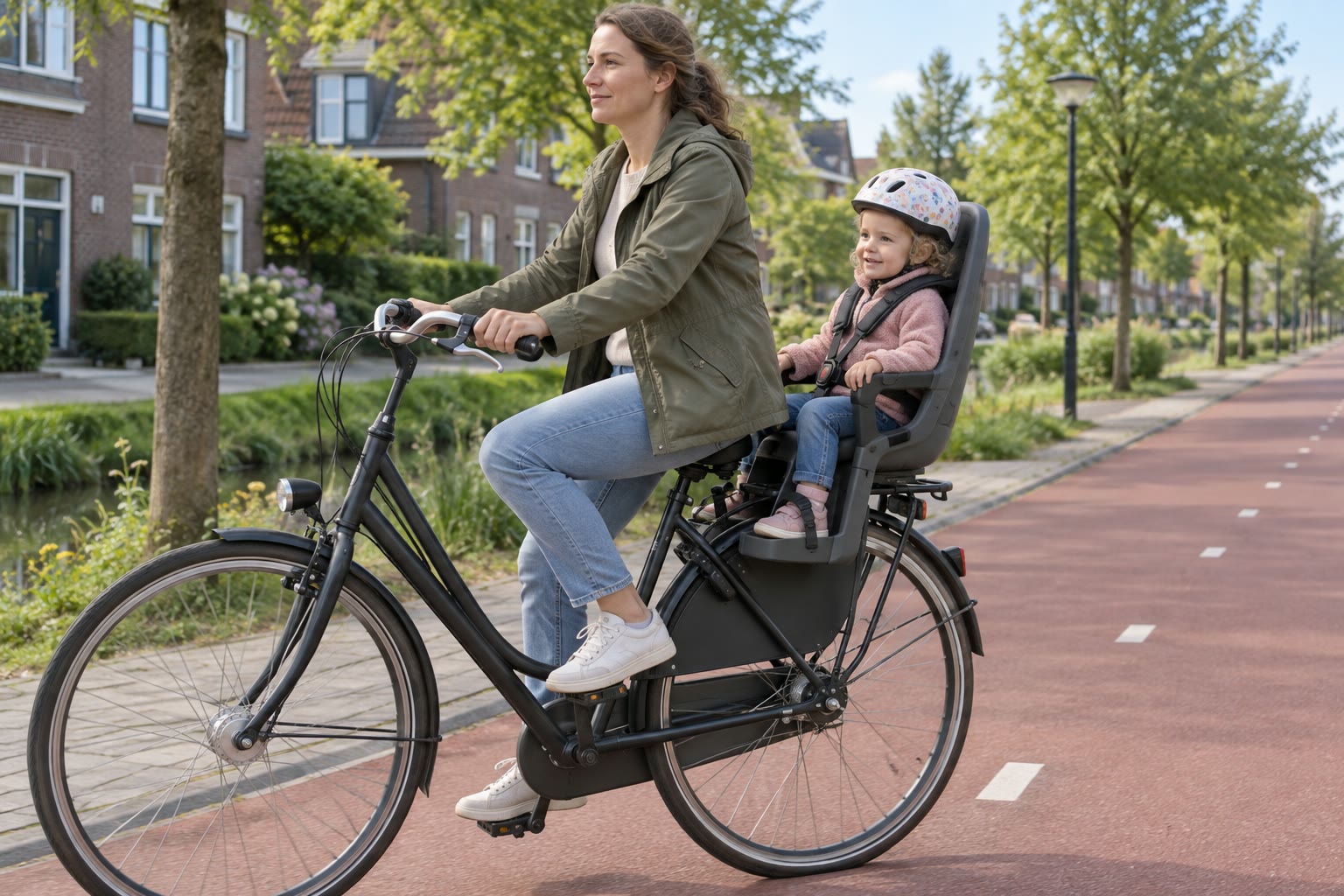
Children under 8 years old carried on a bicycle, snorfiets or bromfiets must have a safe seating position that provides sufficient support for the back, hands and feet — for example, a suitable child seat. Children carried on a bromfiets or snorfiets must also comply with the applicable helmet requirement.
The rules focus on a safe, properly supported seating position; there is no general Dutch traffic rule that only one child may ever be carried on a bicycle. The number of passengers must be compatible with the vehicle's design and safe use.
§ 30 — Mobile Phones While Driving
It is prohibited to hold and use a mobile phone — or any other handheld electronic communication device — while driving. This applies to all drivers: car drivers, cyclists, moped riders, and all others.
The prohibition concerns holding a mobile electronic device while driving. Hands-free use is permitted in principle for drivers, including cyclists and moped riders, provided the device is not held and its use does not create danger or hinder traffic. A securely mounted device may therefore be used without holding it, but safe attention to traffic remains essential.
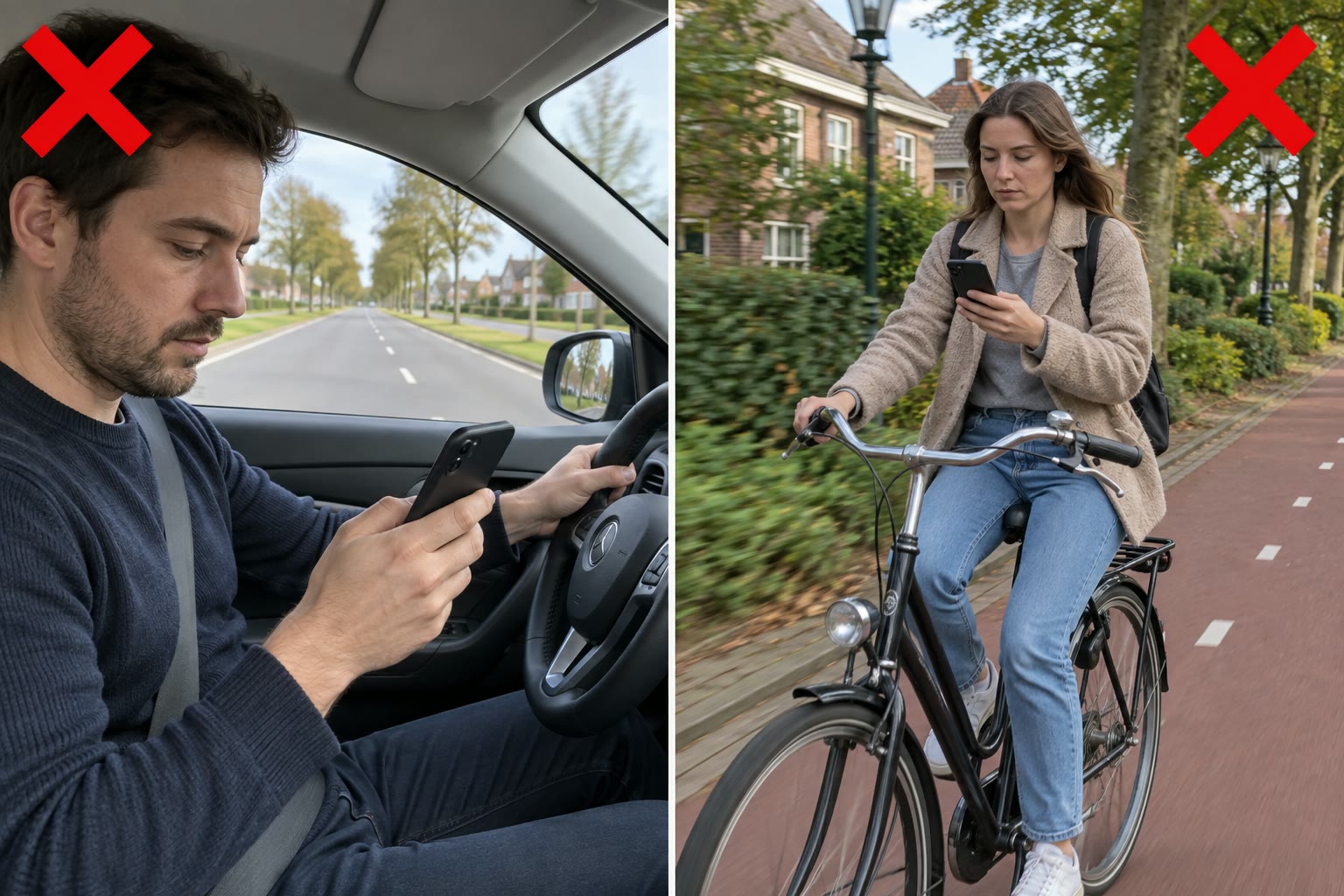
The mobile phone prohibition is frequently assumed to apply only to car drivers. It applies to all drivers, including cyclists. Riding a bicycle while holding a phone is prohibited and carries a fine.
§ 31 — Carrying Passengers in Trailers & Load Spaces
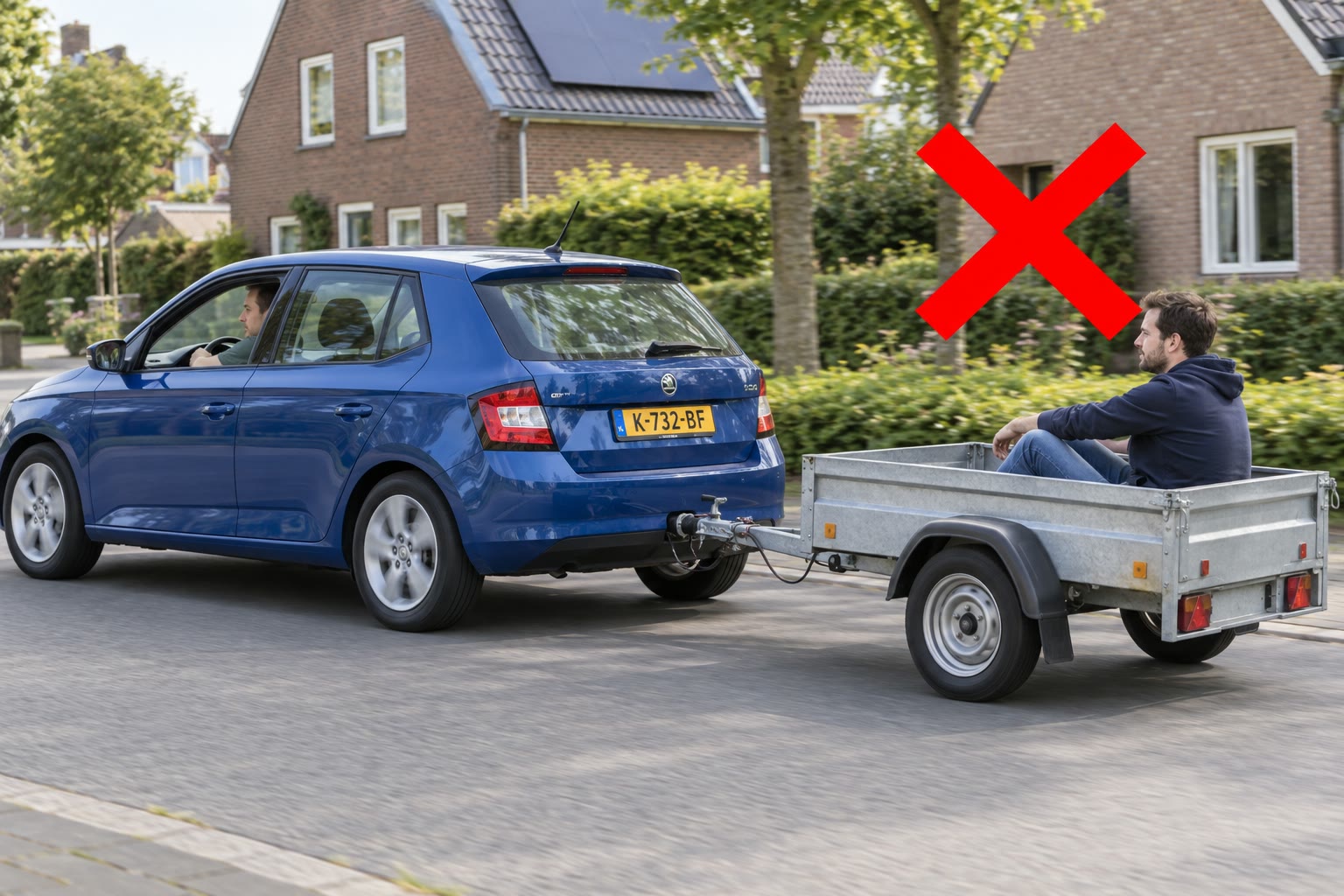
It is generally prohibited to carry passengers in trailers, in the load space of a vehicle, or in the open load area of a truck. Passengers must always travel in the enclosed passenger compartment of a vehicle — not in or on a trailer being towed.
Specific exceptions exist for certain agricultural vehicles, vehicles used for organised trips with special authorisation, and historic vehicles under supervision. These exceptions require specific permits or conditions to be met.
Chapter 1 covers core active rules of the road: where to drive, how to signal, when to yield, how speed limits work, when stopping or parking is prohibited, and which safety requirements apply. Key principles include keeping right, giving way to drivers from the right at equivalent unregulated intersections, respecting tram priority where the ordinary rules require it, not blocking intersections, signalling important lateral movements, seatbelt and helmet requirements, and the ban on holding a mobile electronic device while driving.
For speed questions, distinguish the statutory default from the limit actually shown on the road. In particular, motorway limits depend on the road section, signs and time of day. For stopping and parking, remember the difference between a solid yellow line (no stopping) and a broken yellow line (no parking).